
Eugene, Oregon
Want to see how Eugene compares to other top cities in Oregon? Explore all city regulations in Oregon. →
Eugene, OR
Generally Investor Friendly
STR Regulations for Eugene, Oregon
Explicit Overview: Are Short-Term Rentals Allowed in Eugene, OR?
Yes. Short‑term rentals are allowed in the City of Eugene. Properties located inside the city limits that rent for 30 days or fewer must register annually with the City, and operators must collect and remit the 4.5% Transient Room Tax (TRT). Properties with a Eugene address that sit outside the city (in unincorporated Lane County) are not subject to Eugene’s STR registration requirement. If your STR is outside the City of Eugene, you should verify county or state-level requirements before operating.
What do Airbnb hosts actually earn in Eugene?
Eugene hosts earn a median $26,752/year with $176 ADR and 53% occupancy.
Top performers pull in $38,908+ per year.
See the full Eugene market breakdownHow to Start a Short-Term Rental Business in Eugene (Step-by-Step)
- Confirm jurisdiction and eligibility
- Confirm the property is within Eugene’s city limits using the city’s online boundary checker.
- Confirm the intended use is permitted under local zoning and building rules, including any accessory space you plan to rent (attached or detached).
- Prepare to register (annual, free)
- Gather required information:
- Owner/operator name
- STR street address
- Owner-occupied status
- Local contact name and phone for a person responsible for the STR
- Register online. No fee is required for registration.
- Set up taxation and compliance
- Register for Eugene’s Transient Room Tax (TRT), a 4.5% tax on overnight stays for stays ≤30 days. Upon completion, the City issues a Certificate of Authority; display it at the rental property.
- Understand your nightly and occupancy limits:
- Maximum stay: 30 consecutive nights.
- Occupancy: up to five unrelated guests or a single family, regardless of unit size.
- Operational planning
- Decide between renting an entire home, a room in a home (with access to common areas such as kitchen and laundry), or a permitted separate dwelling unit (e.g., ADU or middle housing unit).
- If renting a room(s) in your home:
- Provide access to common areas in the home.
- Ensure any accessory living space is permitted as habitable space.
- If renting a separate dwelling unit:
- Confirm the unit is separately permitted (includes ADUs and certain middle housing units).
- Overnight camping/shelter is allowed on residential property under specific rules, but trailers, campers, RVs, or tiny houses on wheels cannot be used as short-term rentals if payment is required.
- Understand neighbor considerations and complaint channels; Code Compliance investigates issues specific to STRs.
- Align long-term rental rules if necessary
- If you intend to rent for >30 days, Eugene’s Rental Housing Code applies (safety standards, documentation, tenant protections).
Required Documents, Permits, Licenses, and Guidelines
-
City Registration (annual)
- Content: owner/operator name, STR address, owner-occupied status, local contact info
- Fee: None
- Link: See References, “Short‑Term Rentals in Eugene” (Registration portal)
-
Transient Room Tax (TRT) registration
- Requirement: Collect 4.5% TRT on all stays ≤30 days
- Outcome: Certificate of Authority issued and must be displayed at the property
- Link: See References, “Transient Room Tax (TRT)”
-
Zoning and land use
- STRs must be in compliance with zoning. If renting a room in the home, accessory living space must be permitted as habitable space and guests must have access to common areas. For separate dwelling units (e.g., ADUs/middle housing), confirm the unit is separately permitted.
-
Building and safety standards (particularly relevant to long‑term rentals; and generally good practice)
- Eugene’s Rental Housing Code contains standards for structural integrity, plumbing, heating, weatherproofing, security, smoke detectors, carbon monoxide alarms, electrical systems, appliances, rodent control, and more. See References, “Eugene Code 8.425 – Rental Housing – Standards and Protections.”
-
Property restrictions for non‑STR camping
- Overnight camping in a vehicle, camper, or trailer is allowed on the driveway of a single‑unit dwelling, with no payment allowed. A trailer/camper on residential property cannot be used as an STR.
Specific Regulations for Short-Term Rentals (Eugene, Lane County, Oregon)
City of Eugene (inside city limits)
- Allowed: Short‑term rentals (≤30 days) are permitted and must register annually with the City.
- Tax: Collect and remit the 4.5% Transient Room Tax; Certificate of Authority must be displayed.
- Stay limit: Stays may not exceed 30 consecutive nights.
- Occupancy: Up to five unrelated individuals or a single family unit per STR, irrespective of dwelling size.
- Registration scope: Only properties within the Eugene city limits must register.
- Hosting formats allowed:
- Entire home (≤30 days; annual registration and TRT compliance).
- Room in a home (guests must have access to common areas; accessory space must be permitted as habitable; 30‑day limit; registration; TRT).
- Separate dwelling unit (includes ADUs and certain middle housing units; 30‑day limit; registration; TRT).
- Camping: Overnight camping/shelter is allowed in a driveway for single-unit dwellings, but cannot be used as an STR if a fee is charged.
- Long‑term rentals (>30 days): Rental Housing Code applies.
Lane County / State
- Properties with Eugene addresses that are located in unincorporated Lane County are not required to register under Eugene’s STR ordinance. State-level law does not impose a uniform, statewide short‑term rental permitting regime; regulation is primarily local.
- Statewide, Oregon has a 1.5% Transient Lodging Tax on bookings under 30 nights (separate from Eugene’s local TRT). Hosts should confirm whether Airbnb or their platform remits taxes on their behalf; if not, they must remit both state and local taxes as applicable.
Contact Information for Local STR Authorities
-
Permit and Information Center (general permitting)
- Address: 99 W. 10th Avenue, Eugene, OR 97401
- Phone: (541) 682‑5086
- Website: See References, “City of Eugene – Permit and Info Center / PDD”
-
Short-Term Rental Registration (Process/Status)
- Contact: Jimi Parker, Planning and Development
- Email: JParker@eugene-or.gov
- Phone: (541) 682‑5379
-
Code Compliance (complaints/concerns specific to STRs)
- Phone: (541) 682‑5819
- Email: codecompliance@ci.eugene.or.us
-
Land Use (zoning/land use questions)
- Phone: (541) 682‑8336
- Email: landuseinfo@ci.eugene.or.us
-
Transient Room Tax (TRT registration/authority)
- Phone: (541) 682‑5022 (also listed as 541‑682‑5035 in city documents)
- Email: trt@ci.eugene.or.us
- Website: See References, “Transient Room Tax (TRT)”
-
City Boundary Checker (jurisdiction verification)
- Website: See References, “Check if your property is within the City limits”
-
City Hall (general city contact)
- Address: 500 East 4th Avenue, Eugene, OR 97401
- Website: See References, “City of Eugene – Contact Us”
Source Pages (IMPORTANT)
- City of Eugene – Short-term Rental Registration and Information (PDF): www.eugene-or.gov/DocumentCenter/View/48331/Short-term-Rentals
- Short-Term Rentals in Eugene (City web page): www.eugene-or.gov/3359/Short-Term-Rentals-in-Eugene
- Transient Room Tax (TRT) registration and guidance: www.eugene-or.gov/1155/Transient-Room-Tax-TRT
- City of Eugene – Permit and Info Center / Planning and Development: www.eugene-or.gov/pdd
- City boundary checker (is the property inside Eugene city limits?): www.eugene-or.gov/2125
- Eugene Code 8.425 – Rental Housing – Standards and Protections (long-term rental standards): eugene.municipal.codes/EC/8.425
- Short-Term Rental Ordinance (Ord. 20638): www.eugene-or.gov/DocumentCenter/View/59906/Ord-20638-Short-Term-Rentals
Practical Notes for Investors
- Operate within Eugene city limits to benefit from clear, investor‑friendly rules (annual free registration, 4.5% TRT).
- If your Eugene address is in unincorporated Lane County, do not rely on Eugene’s STR registration; seek county guidance and verify state tax obligations.
- Consider guest capacity and length‑of‑stay caps when pricing and marketing; 30‑night maximum is a hard line in Eugene.
- If hosting a room in your home, ensure compliant access to common areas and that any accessory space is permitted as habitable.
- For separate dwelling units (ADUs/middle housing), confirm current permitting status with Land Use before listing.
- Maintain transparent guest policies and local contact availability to minimize neighbor complaints and Code Compliance issues.
Next step
Found a property in Eugene?
Paste any address and get estimated revenue, cash-on-cash return, and comparable STR performance in under 5 minutes. 3 free analyses per day.
Free brief
Get the free Eugene STR Investment Brief
Revenue data, top neighborhoods, seasonal trends, and the key regulations for Eugene, Oregon in one email.
Eugene
Market Saturation Score
Photos of Eugene

Overview of Eugene
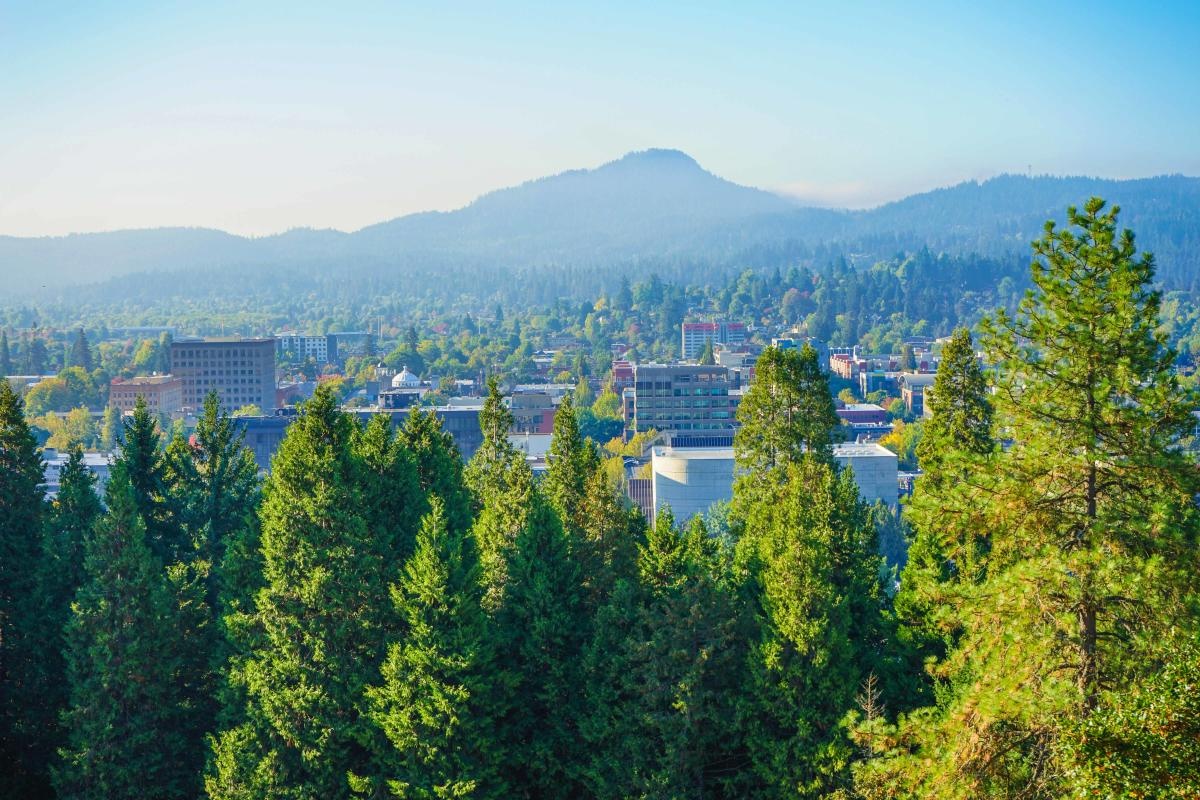
Eugene is the second-largest city in Oregon and the seat of Lane County, home to an estimated population of around 175,000 residents. Set in the southern Willamette Valley at the confluence of the McKenzie and Willamette rivers, it carries a laid-back, outdoors-oriented character shaped by the presence of the University of Oregon and a long tradition of track and field. The city is widely known as "Track Town USA" for its deep connection to the sport, and it serves as a natural gateway to the Oregon Coast, the Cascade Range, and the broader Willamette wine country. It sits roughly 110 miles south of Portland, about a two-hour drive up Interstate 5.
A short drive east of the city center, Mount Pisgah rises as a local favorite for hiking and wildflower viewing. The summit trail covers just a couple of miles and rewards visitors with sweeping views over the Willamette Valley, while the surrounding Howard Buford Recreation Area offers picnic spots, seasonal wildflower meadows, and an arboretum. It is a particularly popular sunset destination, only about ten minutes from downtown Eugene.
Another defining landmark is the University of Oregon campus, whose renovated Hayward Field anchors the city's identity as a track and field capital. The rebuilt stadium has hosted major international competitions, and the surrounding area includes museums such as the Jordan Schnitzer Museum of Art and the Museum of Natural and Cultural History. The campus itself, with its mix of historic brick buildings, green quads, and the Erb Memorial Union, gives Eugene a college-town atmosphere that draws visitors year-round.
About an hour west of Eugene, the Oregon Coast begins near Florence, where visitors find the Oregon Dunes National Recreation Area, the historic Heceta Head Lighthouse, and a string of scenic beaches. To the east, the Willamette National Forest and the McKenzie River corridor offer whitewater rafting, hot springs, and waterfall hikes within about an hour's drive. Further afield, Crater Lake National Park lies roughly 150 miles to the southeast, making Eugene a workable base for a longer day trip to the country's deepest lake.
Eugene's combination of walkable downtown amenities, a strong university and arts scene, and quick access to both the Pacific coastline and the high Cascades makes it a versatile base for short-term rentals. Visitors can spend a morning exploring local markets and museums, an afternoon on a forested trail, and the next day watching the surf break on the coast, all without straying far from a single set of keys.
Want to know if a property in Eugene is a good investment?
Enter an address to get instant revenue potential and comps.