
Hickory, North Carolina
Want to see how Hickory compares to other top cities in North Carolina? Explore all city regulations in North Carolina. →
Hickory, NC
Generally Investor Friendly
STR Regulations for Hickory, North Carolina
Short-Term Rentals (STRs) in Hickory, NC: A Complete Investor's Guide
Is it Allowed? An Overview The short-term rental of residential property is generally allowed in Hickory, North Carolina. North Carolina state law, specifically the Vacation Rental Act (G.S. 42A), provides a legal framework for renting residential property for less than 90 days. The provided sources do not contain any city or county-specific ordinances for Hickory or Catawba County that prohibit or heavily restrict this activity. Therefore, while there is no explicit city-wide ban, investors must operate under the state's overarching regulations and should verify with the City of Hickory Planning Department to confirm there are no zoning or local restrictions on their specific property.
1. How to Start a Short-Term Rental Business in Hickory
Follow these steps to launch a compliant STR operation:
- Research Zoning Compliance: Before purchasing or listing a property, confirm with the City of Hickory Planning Department that STRs are a permitted use for your property's zoning classification. While state law allows the activity, local zoning can restrict it to certain districts.
- Secure All Necessary Permits and Licenses: Obtain all required documentation (see detailed list below). Failure to comply with permitting can invalidate your operation.
- Register for and Collect Taxes: Register with the North Carolina Department of Revenue (NCDOR) for sales tax and with the Catawba County Tax Administration for any local occupancy taxes.
- Ensure Property Standards: Verify the property meets all applicable building, housing, and safety codes. This includes having functioning smoke detectors and, in some cases, carbon monoxide detectors.
- Purchase Adequate Insurance: Secure a comprehensive liability insurance policy. Standard homeowner or landlord policies are often insufficient for the commercial risks of an STR.
- Develop Operational Protocols: Create clear house rules, check-in/out procedures, and a system for handling guest issues and complaints.
- List and Market Your Property: Once compliant, list your property on platforms like Airbnb or Vrbo. Ensure all required permit numbers are displayed in advertisements as per local requirements (if applicable).
2. Required Documents, Permits, Licenses, and Guidelines
While a specific city permit isn't confirmed in the sources, the following are generally required for an STR in North Carolina:
- Zoning Permit/Approval: Although the Schroeder v. Wilmington case (2022) struck down Wilmington's registration system, it upheld the authority of cities to require zoning permits for STRs to ensure compliance with land use regulations (e.g., ensuring they are not operating in prohibited zones like certain residential areas). Action Required: Check with the City of Hickory to confirm if a zoning permit is required for your property.
- Business License: This is often required at the city or county level for any business activity. Action Required: Verify with the City of Hickory Finance Department and Catawba County.
- Sales Tax Registration: You must register with the NCDOR to collect and remit state sales tax (6.75% - 7.5%) on your gross receipts.
- Local Occupancy Tax Registration: You must register with Catawba County to collect and remit any local occupancy taxes imposed by the county.
- Vacation Rental Act Compliance: You must comply with the requirements of the state Vacation Rental Act (G.S. 42A). This includes, but is not limited to:
- Providing a written rental agreement.
- Disclosures to guests.
- Handling security deposits according to specific rules.
- Insurance Documentation: Proof of liability insurance.
- Guest Registration Log: While not explicitly stated in the sources for Hickory, many jurisdictions require the operator to maintain a log of all guests for a specific period (e.g., 3 years).
3. Specific Regulations for Short-Term Rentals (State, County, and City)
State Level (North Carolina):
- Vacation Rental Act (G.S. 42A): This is the primary law governing STRs in NC. It classifies an STR as the rental of residential property for fewer than 90 days to a guest who has a permanent residence elsewhere. It mandates specific contract terms, security deposit handling, and guest rights.
- Sales Tax: STRs are subject to North Carolina state sales tax (4.75%) plus any applicable local sales tax (2-2.75%).
- Schroeder v. Wilmington Precedent: This 2022 court case significantly impacts STR regulation. The court ruled that local governments cannot require registration as a condition for receiving a certificate of occupancy. However, they can still enforce zoning permits, operational requirements (like parking and occupancy limits), and safety standards.
County Level (Catawba County):
- Occupancy Tax: Catawba County, like most North Carolina counties, likely imposes a Room Occupancy Tax on accommodations rented for less than 90 days. You are responsible for collecting this tax from guests and remitting it to the county tax collector. The exact rate should be verified with the Catawba County Tax Administration.
City Level (Hickory):
- The provided sources do not contain any specific city ordinances for Hickory regulating short-term rentals. The legal framework is based on state law. It is critical to contact the City of Hickory directly to confirm there are no local ordinances, permit requirements, or zoning restrictions that apply to your STR. The city may regulate aspects like parking, noise, and the number of guests, even if the state does not.
Important Note on Taxes: The source from Hostaway states that Airbnb and Vrbo often collect and remit these taxes automatically on behalf of hosts in North Carolina. However, the host is ultimately responsible for ensuring the taxes are paid. You should verify with the platforms and the relevant tax authorities.
4. Contact Information for Local Authorities
Since the sources did not provide Hickory-specific contacts, here are the relevant state and county agencies to begin with. You must then contact the City of Hickory for local verification.
-
North Carolina Department of Revenue (NCDOR):
- Website: NCDOR Sales and Use Tax for Rentals/Accommodations
- Phone: 1-877-252-3052
- Purpose: For sales tax registration and information.
-
Catawba County Tax Administration:
- Website: Catawba County Official Website
- Phone: (828) 465-8400
- Purpose: For information on local occupancy taxes and business licenses.
-
City of Hickory (Contact for zoning and permits):
- Planning Department: You must contact the City of Hickory directly to speak with the Planning Department to confirm zoning compliance and any required permits for a short-term rental. The main city phone number is (828) 323-7400. Their official website is www.hickorync.gov. Look for the "Planning & Development" or "Building Inspections" section.
5. Source Links
- Land Use Regulation of Short-Term Rental of Residential Property (UNC School of Government): https://www.sog.unc.edu/resources/microsites/planning-and-development-regulation/land-use-regulation-short-term-rental-residential-property
- Airbnb Rules in North Carolina (Hostaway): https://www.hostaway.com/blog/airbnb-rules-north-carolina/
- North Carolina Landlord Tenant Rental Laws & Rights for 2025 (DoorLoop): https://www.doorloop.com/laws/north-carolina-landlord-tenant-rights
Disclaimer: This guide is based solely on the provided content and general North Carolina law. Regulations for short-term rentals can change frequently and vary by locality. It is the investor's sole responsibility to verify all current regulations, permit requirements, and tax obligations with the City of Hickory and Catawba County before operating a short-term rental. Consider consulting with a local attorney specializing in land use or real estate law for personalized advice.
What do Airbnb hosts actually earn in Hickory?
Hickory hosts earn a median $29,594/year with $140 ADR and 71% occupancy.
Top performers pull in $38,850+ per year.
See the full Hickory market breakdownNext step
Found a property in Hickory?
Paste any address and get estimated revenue, cash-on-cash return, and comparable STR performance in under 5 minutes. 3 free analyses per day.
Free brief
Get the free Hickory STR Investment Brief
Revenue data, top neighborhoods, seasonal trends, and the key regulations for Hickory, North Carolina in one email.
Hickory
Market Saturation Score
Photos of Hickory


Overview of Hickory
Hickory sits in the rolling foothills of western North Carolina, in Catawba County, and has a population of roughly 43,000. Long recognized as a center of the American furniture industry — the surrounding region still produces a significant share of U.S.-made residential furniture — the city has a working-class heritage balanced with a quietly revitalized downtown, a growing craft beverage scene, and easy access to both the Blue Ridge Mountains and the Charlotte metro area. It lies about 60 miles northwest of Charlotte, the nearest major city, and serves as a natural gateway to the High Country of North Carolina for travelers who want a more affordable, less-crowded base than Asheville or Boone.
Just southeast of Hickory, Lake Norman — North Carolina's largest man-made lake, with more than 500 miles of shoreline — offers boating, paddleboarding, fishing, and lakeside restaurants within about a 35- to 45-minute drive of downtown. It is a year-round draw, especially for visitors from the greater Charlotte area who want a water-based outing without committing to a full mountain drive.
West of Hickory, the Blue Ridge Parkway begins winding through the High Country within roughly an hour's drive, offering some of the most scenic motor touring on the East Coast. From the Linn Cove Viaduct near Grandfather Mountain to the Moses H. Cone Memorial Park near Blowing Rock, the parkway provides an ever-changing sequence of overlooks, hiking trailheads, and small mountain communities that draw leaf-peepers in autumn and outdoor enthusiasts in summer.
About an hour and fifteen minutes northwest of Hickory, the small resort town of Blowing Rock sits perched above the John's River Gorge and is known for its storybook main street, antique shops, and the namesake Blowing Rock cliff, where updrafts create the optical illusion of light objects being thrown back from the precipice. It is a popular day trip or overnight excursion for Hickory-based visitors exploring the High Country.
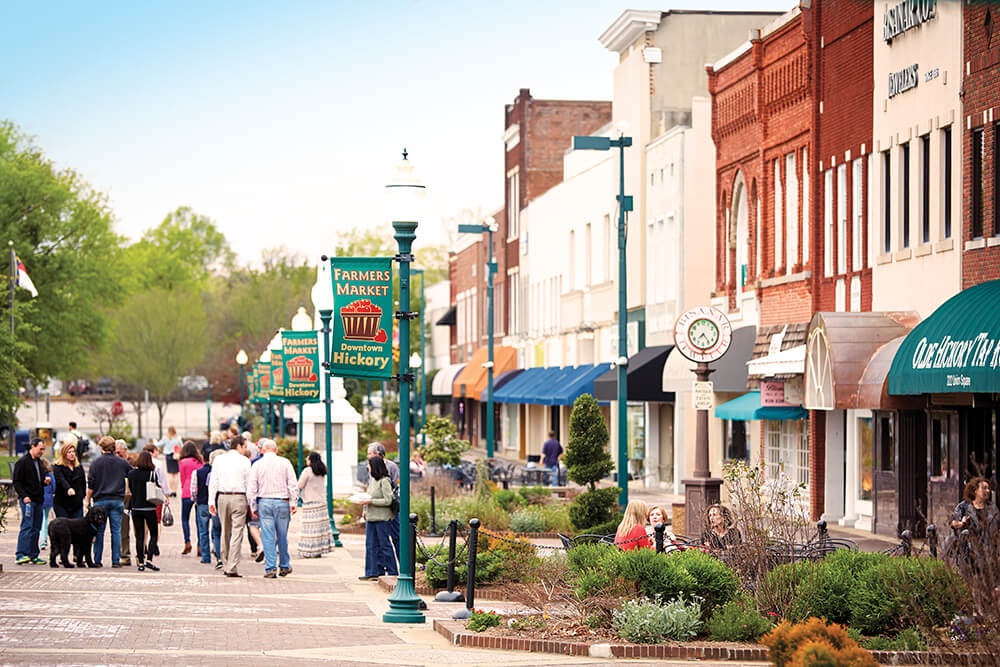
Closer to home, Hickory's walkable downtown has invested in streetscape improvements, public murals, and a cluster of cultural venues that includes the SALT Block, a community complex that combines art, science, and library programming within a few blocks of independent restaurants and taprooms. Together with the city's strong local identity, this combination of outdoor access, regional heritage, and proximity to Charlotte makes Hickory a quietly versatile base for short-term rental operators looking to capture both weekend mountain travelers and longer-stay visitors passing through the foothills.
Want to know if a property in Hickory is a good investment?
Enter an address to get instant revenue potential and comps.