
San Francisco, California
Want to see how San Francisco compares to other top cities in California? Explore all city regulations in California. →
San Francisco, CA
Challenging To Investors
STR Regulations for San Francisco, California
Executive Overview: STR Status in San Francisco
Short-term rentals are allowed in San Francisco, CA, but under strict regulatory framework. The city permits short-term residential rentals (stays under 30 nights) only for permanent residents who live in their units as their primary residence. This represents a significant shift from pre-2015 when all short-term rentals were illegal in the city. San Francisco operates under a charter city authority that allows local regulation of short-term rentals while maintaining compliance with state law.
Key Framework: The city operates under the "hosted vs. un-hosted" model where permanent residents can host unlimited stays when present with guests, but are limited to 90 un-hosted nights per calendar year. This regulatory structure balances housing preservation with legitimate home-sharing opportunities.
What do Airbnb hosts actually earn in San Francisco?
San Francisco hosts earn a median $51,640/year with $226 ADR and 83% occupancy.
Top performers pull in $77,267+ per year.
See the full San Francisco market breakdownHow to Start a Short-Term Rental Business in San Francisco
Step 1: Eligibility Assessment
Before proceeding with any applications, you must verify that both you and your property meet all eligibility requirements:
Host Requirements:
- You must be a permanent resident of San Francisco
- Must be an owner or tenant of the unit you plan to rent
- Must have lived in the dwelling for at least 60 days before applying
- Plan to live in the unit for at least 275 nights per year
- Must maintain only one primary residence
Property Requirements:
- Must be compliant with all City codes
- Cannot be located in The Presidio, Fort Mason, or Treasure Island
- Cannot be a Single-Room-Occupancy (SRO) or dormitory
- Cannot be a Below-Market-Rate (BMR) or Public Housing unit
- Must be permitted and designed for residential use
- Cannot be subject to an Ellis Act eviction after November 2014
- Cannot have sleeping quarters in outdoor areas, including treehouses and vehicles
Step 2: Business Registration
You must register your hosting business with the Treasurer & Tax Collector BEFORE applying for short-term rental certification.
- Apply for a Business Registration Certificate (Business Account Number/BAN)
- If you already have another business registered, update your account to add hosting
- Select industry type "Accommodations"
- Fee structure is variable based on gross receipts or payroll expenses
Step 3: Short-Term Rental Application
After obtaining your Business Registration Certificate, apply to the Office of Short-Term Rentals:
- Complete the online application through the SF Public Planning Portal
- Submit all required documentation (detailed in next section)
- Pay the non-refundable $925 application fee
- Application is valid for two years upon approval
Step 4: Platform Compliance
Once approved, you must ensure your listing complies with hosting platform requirements:
- Display your registration number prominently in all listings
- Separate listings are required for hosted vs. un-hosted stays
- Maintain accurate property descriptions
- Comply with platform-specific insurance and safety requirements
Required Documents, Permits, and Licenses
Primary Registration Documents
1. Business Registration Certificate
- Issued by San Francisco Office of the Treasurer & Tax Collector
- Receipt of pending application is sufficient to begin certification process
2. Short-Term Rental Application
- Available through SF Public Planning Portal: sfplanning.org/str/become-certified-host
- Non-refundable fee: $925 (valid for two years upon approval)
3. Proof of Property-Liability Insurance
- Minimum $500,000 coverage required
- Proof not required if hosting exclusively through platforms providing this coverage (Airbnb, VRBO)
- Encourage discussion with personal insurer about coverage adequacy
4. Proof of Permanent Residency Two of the following documents (no more than one utility bill):
- California Driver's License
- SF City ID Card
- Vehicle Registration Card from California DMV
- Proof of Homeowner's Tax Exemption (single-family dwelling or condominium only)
- Original utility bill from SFPUC, Recology, or PG&E (with payment stub)
- Voter Registration Card or Certificate
Ongoing Compliance Documents
5. Quarterly Reports
- Required for approved hosts only
- Due January 31, April 30, July 31, and October 31
- Submitted through OSTR Public Portal
6. Transient Occupancy Tax (TOT) Registration
- 14% tax on gross rental income for stays under 30 days
- Administered by Treasurer & Tax Collector
- Airbnb currently the only Qualified Website Company in San Francisco
7. Business Personal Property Tax
- Form 571-STR required annually
- Filed with San Francisco Assessor-Recorder's Office
Specific Regulations for Short-Term Rentals
Host Limitations and Requirements
Residency Requirements:
- Must spend at least 275 nights per calendar year in the rental unit
- Can only register one residential unit (if you own a multi-unit building, only the unit where you reside)
- Must be present at least 75% of days occupied if haven't lived there full year
Rental Activity Limits:
- Hosted stays: Unlimited when host is present overnight in same unit as guests
- Un-hosted stays: Maximum 90 nights per calendar year
- Must create separate listings for hosted vs. un-hosted stays
Revenue Restrictions (Tenants Only):
- Monthly STR revenue cannot exceed monthly rent payment
- Applies only to units subject to rent control provisions
Ineligible Property Types
Permanently Ineligible Properties:
- Income-restricted affordable housing and BMR units
- Student housing, dormitories, and SRO buildings (except seasonal exceptions)
- Buildings subject to Ellis Act eviction after November 2014
- Legally established ADUs or JADUs (only 30+ day rentals permitted)
- Sleeping quarters in shipping containers, outdoor areas, vehicles
- Non-residential areas in commercial/industrial buildings
- Properties in Treasure Island, Fort Mason, or Presidio
- Boats or watercraft
- Group Housing properties
Special Regulations for Specific Property Types:
- Residential Hotels: Limited tourist room allowances based on DBI list
- Tourist Hotels and Timeshares: Exempt from OSTR registration, use BAN number
- Live/Work Units: STR allowed only in "live" area, not "work" portion
Intermediate Length Occupancies (ILOs)
Definition: Rentals for 30+ consecutive days but less than 364 days
- Maximum 1,000 ILO units permitted citywide
- Requires specific permit separate from STR certification
- Not subject to short-term rental regulations or TOT
Tax and Fee Obligations
Transient Occupancy Tax (TOT):
- 14% tax on gross rental income for stays under 30 days
- Currently collected and remitted by Airbnb
- If hosting through other platforms, individual collection and remittance required
Tourism Improvement District (TID) Assessment:
- Additional assessment administered with TOT
- Applies to same stay duration as TOT
Business Personal Property Tax:
- Annual reporting of business property inventory
- Potential tax liability based on reported property value
Platform and Listing Requirements
Registration Display:
- Unique record number for pending applications (e.g., 2023-123456STR)
- Certificate number for approved applications (e.g., STR-0001234)
- Incorrect numbers can result in listing removal and reservation cancellation
Listing Accuracy:
- Must clearly indicate hosted vs. un-hosted stays
- Cannot describe hosted stay as entire unit or exclusive access
- Must reflect actual spaces and occupancy arrangements
Compliance and Enforcement
Quarterly Reporting Requirements:
- Only approved hosts must file quarterly reports
- Report all short-term stays during three-month periods
- Failure to file can result in certificate suspension
Insurance and Safety Requirements:
- Maintain minimum $500,000 liability insurance
- Post safety information sign inside front door with emergency information
- Ensure unit complies with all building and housing codes
Appeals Process:
- 30-day window to appeal application denials or certificate revocations
- Must cease STR activity during appeal process
- Violations result in $484 per day penalties
Contact Information for Local Authorities
Primary Authority: Office of Short-Term Rentals (OSTR)
Physical Address: San Francisco Planning Department Office of Short-Term Rentals 1650 Mission Street, Suite 400 San Francisco, CA 94103
Phone: 628-652-7599
Email: shorttermrentals@sfgov.org
Website: sfplanning.org/office-short-term-rentals
Quarterly Reporting Portal: aca-prod.accela.com/CCSF/Default.aspx
Supporting Agencies
San Francisco Treasurer & Tax Collector Business Registration and TOT Administration
Phone: 311 (for general inquiries)
Website: sftreasurer.org/business/register-business
Business Registration: sftreasurer.org/registration
TOT Information: sftreasurer.org/business/taxes-fees/transient-occupancy-tax-tot
Help Center: sftreasurer.org/help-center
San Francisco Assessor-Recorder Business Personal Property Tax
Website: www.sfassessor.org/property-information/business-owners/571-l-business-property-statement-e-file
San Francisco Rent Board Long-term Rental and Tenant Protection Information
Website: sf.gov/departments/rent-board
Source Documentation Links
Primary Regulatory Sources
- SF Planning STR FAQs: sfplanning.org/str/faqs-short-term-rentals
- OSTR Main Page: sfplanning.org/office-short-term-rentals
- SF STR Starter Guide: www.sf.gov/guide-opening-short-term-residential-rental
- San Francisco Administrative Code Chapter 41A: codelibrary.amlegal.com/codes/san_francisco/latest/sf_admin/0-0-0-27965
Application and Compliance
- Become Certified Host Application: sfplanning.org/str/become-certified-host
- Quarterly Reporting Portal: aca-prod.accela.com/CCSF/Default.aspx
- OSTR Appeal Procedures: sfplanning.org/sites/default/files/documents/ostr/OSTR_Appeal_Procedures.pdf
- Platform Summary Letter and Guidelines: sfplanning.org/sites/default/files/documents/ostr/OSTR_Platforms_Summary_Letter_Admin_Guidelines.pdf
Business Registration and Tax Resources
- Business Registration: sftreasurer.org/business/register-business
- Transient Occupancy Tax: sftreasurer.org/business/taxes-fees/transient-occupancy-tax-tot
- Business Personal Property Tax: www.sfassessor.org/property-information/business-owners/571-l-business-property-statement-e-file
Specialized Regulations
- Intermediate Length Occupancies: sfplanning.org/project/intermediate-length-occupancy-ilo-dwelling-units
- ILO Dwelling Units Controls: sfplanning.org/project/intermediate-length-occupancy-ilo-dwelling-units#controls
- SF Planning Code: codelibrary.amlegal.com/codes/san_francisco/latest/sf_planning/0-0-0-17747
Platform Resources
- Airbnb SF Host Guide: www.airbnb.ca/help/article/871
- Platform Compliance Guidelines: sfplanning.org/sites/default/files/documents/ostr/OSTR_Platforms_Admin_Guidelines.pdf
Critical Compliance Notes for Investors
-
Zoning Verification: Always verify property zoning and eligibility before purchase, as many property types are permanently ineligible for STR conversion.
-
Insurance Gaps: Platform-provided insurance may not cover all scenarios; consult with licensed insurance professionals about comprehensive coverage.
-
Tax Complexity: Multiple tax obligations apply (TOT, TID, business personal property tax); maintain detailed records and consider professional tax preparation.
-
Regulatory Changes: San Francisco actively enforces and periodically updates STR regulations; stay current through regular OSTR communication.
-
Neighborhood Relations: While not regulatory requirements, maintaining positive relationships with neighbors and adherence to noise/parking rules can prevent complaints that trigger enforcement actions.
This guide represents the regulatory landscape as of the provided documentation date. Short-term rental regulations in San Francisco are actively enforced and periodically updated; investors should verify current requirements with the Office of Short-Term Rentals before making business decisions.
Next step
Found a property in San Francisco?
Paste any address and get estimated revenue, cash-on-cash return, and comparable STR performance in under 5 minutes. 3 free analyses per day.
Free brief
Get the free San Francisco STR Investment Brief
Revenue data, top neighborhoods, seasonal trends, and the key regulations for San Francisco, California in one email.
San Francisco
Market Saturation Score
Photos of San Francisco


Overview of San Francisco
San Francisco sits at the tip of a peninsula in northern California, occupying a compact city and county of roughly 47 square miles that is home to approximately 808,000 residents. The city is celebrated for its steep rolling hills, sweeping bay and ocean views, Victorian and Edwardian architecture, and a cool, often foggy maritime climate. It serves as the cultural and economic heart of the Bay Area and a gateway to the redwood forests, wine regions, and coastline of Northern California. The nearest major city across the bay is Oakland, just a short drive over the San Francisco–Oakland Bay Bridge, while San Jose lies roughly 50 miles to the south.
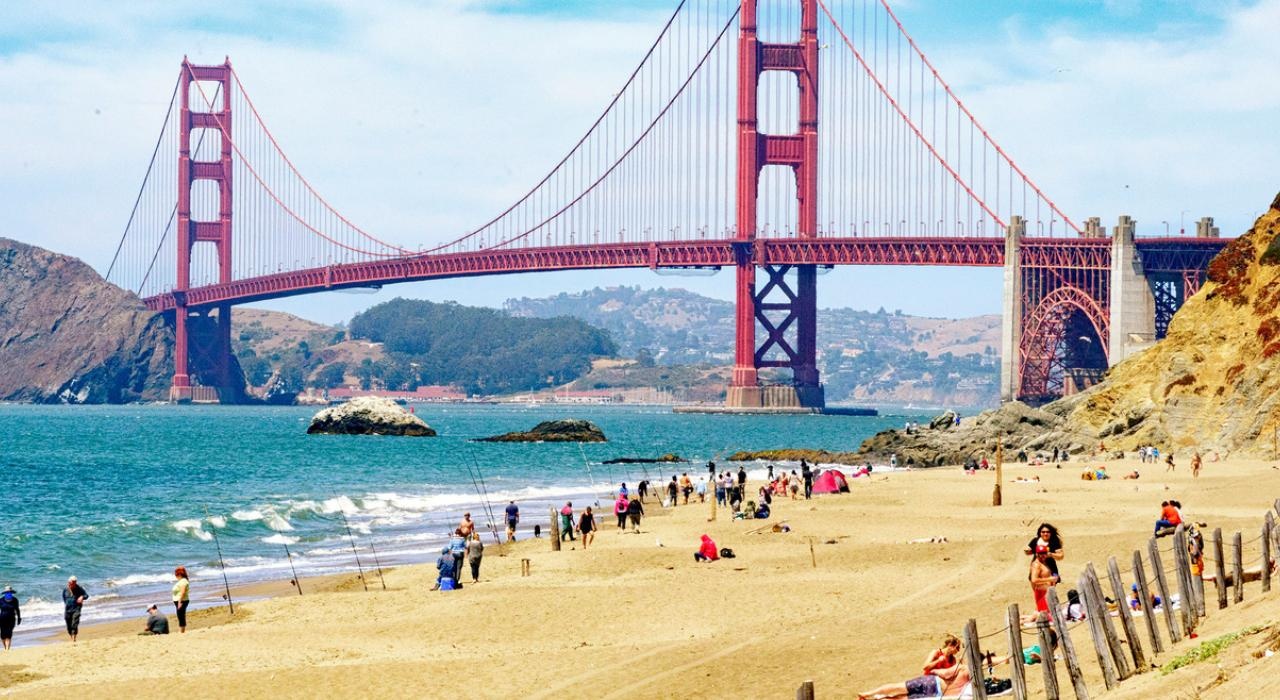
The Golden Gate Bridge anchors the city's identity like few structures in the world. Spanning the strait that connects the bay to the Pacific Ocean, the international-orange suspension bridge has been an enduring symbol of the city since it opened in 1937. Visitors can walk or bike across its roughly 1.7-mile span, or take in views from the surrounding bluffs and beaches of the Golden Gate National Recreation Area. Golden Gate Bridge
Just offshore, Alcatraz Island draws visitors year-round with its well-preserved federal penitentiary and the stories of its famous inmates. Reachable only by ferry from Pier 33, the rocky outcrop known as "the Rock" offers audio tours that bring the site's dramatic history to life, along with excellent views back toward the city skyline and the bay. Alcatraz Island
A short drive north of the city, across the Golden Gate Bridge, Muir Woods National Monument protects some of the last old-growth coast redwoods in the region. The monument's quiet groves of towering trees, less than an hour from downtown, offer an easy escape into a much older California landscape of fern-lined canyons and shaded trails. Muir Woods National Monument
For a change of pace from forests and city streets, the rolling vineyards of Napa and Sonoma valleys lie about an hour and a half to the north. The region is one of the most recognized wine-producing areas in the world, with hundreds of tasting rooms, farm-to-table restaurants, and a warm, sunny climate that contrasts nicely with San Francisco's coastal fog.
San Francisco's appeal as a short-term-rental market is hard to overstate. The city packs world-class dining, iconic landmarks, and a dense calendar of cultural events into a walkable footprint, while day-trip access to redwoods, wine country, the Pacific coast, and even Yosemite National Park a few hours to the east makes it a natural base for travelers who want urban energy and outdoor adventure in the same trip. For owners, this means tapping into one of the most visited urban destinations in the United States, supported by a steady mix of leisure tourists, business travelers, and international visitors throughout the year.
Want to know if a property in San Francisco is a good investment?
Enter an address to get instant revenue potential and comps.