
Morgantown, West Virginia
Want to see how Morgantown compares to other top cities in West Virginia? Explore all city regulations in West Virginia. →
Morgantown, WV
Generally Investor Friendly
STR Regulations for Morgantown, West Virginia
Overview: Are short-term rentals allowed in Morgantown, WV?
Explicit answer: Yes—short-term rentals are allowed in Morgantown, West Virginia, provided you comply with all applicable city, county, and state requirements. Morgantown regulates STRs through its general rental housing framework and permitting system. Practically, this means you must register and periodically inspect rental properties under city code, confirm your zoning allows STR use, obtain any required permits/approvals, and fulfill tax obligations at the state and local levels. The city’s Code Enforcement division administers the rental registration, inspections, and compliance program. Given West Virginia’s localized approach, STR rules can evolve; confirm the latest with the City of Morgantown and your own zoning classification before listing.
Sources: City of Morgantown Rental Information; RedAwning WV STR overview; Checkmate Rentals WV overview; Proper Insurance WV regulations.
What do Airbnb hosts actually earn in Morgantown?
Morgantown hosts earn a median $24,136/year with $156 ADR and 58% occupancy.
Top performers pull in $34,612+ per year.
See the full Morgantown market breakdownHow to Start an STR Business in Morgantown
- Confirm zoning and use eligibility
- Verify that STR use is permitted at your specific property address and zone. If the property is in a single‑family or sensitive residential district, expect additional restrictions (e.g., owner‑occupancy limits or conditional use approvals). Engage Morgantown’s Planning & Zoning to interpret your district’s allowed uses before purchase or conversion.
- Register the rental property with the City
- All rental housing within city limits must be registered and is inspected once every three years under the International Property Maintenance Code (IPMC). Prospective occupants can verify registration status, compliance letter, occupancy type, and maximum occupancy via Code Enforcement.
- Obtain required permits/licenses
- Short-term rental operations must obtain the city’s standard business license/permit as applicable and complete any associated inspections. Some zoning districts or property types may require additional approvals (e.g., conditional use).
- Set up taxes
- Register to collect and remit West Virginia’s 6% consumer sales tax on STR transactions, and Morgantown’s local hotel occupancy tax (commonly 6%, subject to confirmation). If you operate under an LLC or other entity, complete state business registration.
- Establish local management and 24/7 responsiveness
- Maintain an available local contact who can respond to safety issues, neighbor concerns, or code violations within a reasonable timeframe. For out‑of‑state owners, hiring a local property manager is typical.
- Operational readiness
- Equip the property with compliant safety systems (smoke/CO alarms, fire extinguisher, emergency info) and manage parking, noise, and waste in line with city ordinances. Keep thorough records for inspections and tax filings.
Source: City of Morgantown Rental Information; RedAwning; Checkmate Rentals; Jaken Finance (2026 outlook).
Required Documents, Permits, Licenses, and Guidelines
City-level
- Property registration: Register all rental property with the City; city keeps record of registration status and issues letters of compliance post-inspection.
- Permit/licensing: Obtain the city’s short-term rental permit/business license as required; zoning may trigger conditional use.
- Inspections: Properties are inspected once every three years under the IPMC; violations must be corrected within 20 days or the property faces citations, condemnations, or both.
- Occupancy verification: Occupancy type and maximum permitted occupancy are confirmed by Code Enforcement and can be verified by calling the city.
- Local contact: Maintain current local contact information for rapid response to issues.
State-level
- Business entity registration (if applicable): File with the West Virginia Secretary of State when operating as an LLC, corporation, etc.
- Sales tax registration: Register with the West Virginia State Tax Department to collect/remit the 6% consumer sales tax.
- Recordkeeping: Maintain detailed income/expense records for accurate filings.
Source: City of Morgantown Rental Information; RedAwning; Checkmate Rentals; Jaken Finance.
Specific Regulations by Jurisdiction (Morgantown, Monongalia County, West Virginia)
City of Morgantown (municipal)
- Registration and inspections: All rental properties must be registered and are inspected once every three years under the IPMC; code corrections typically required within 20 days.
- Safety and building code: The City adopts the West Virginia Building Code; properties must meet state‑adopted safety and maintenance standards.
- Occupancy and compliance: The City records occupancy type and maximum occupancy for registered rentals; prospective tenants/guests and owners can verify status through Code Enforcement.
- Zoning and approvals: Short-term rentals must align with zoning. Depending on district, STRs may be permitted as‑of‑right or require conditional use; check district‑specific rules before listing.
- Taxes: West Virginia state sales tax of 6% applies to STRs; the City also levies a local hotel occupancy tax commonly at 6% (confirm the current rate and collection requirements).
- Noise, parking, waste: Standard city ordinances on nuisance, parking, and waste management apply; ensure guest policies and property management mitigate neighborhood impacts.
- Ongoing oversight: The City can verify registration and compliance and responds to complaints; maintain documentation and correct issues promptly.
Monongalia County (county)
- West Virginia’s approach is largely local; your primary obligations arise under Morgantown city code when the property is within city limits. County-level STR‑specific regulations were not identified in the provided sources. Confirm with the County Commission/Planning if your property is outside city limits or in unincorporated areas.
State of West Virginia
- Sales tax: 6% consumer sales tax applies to short-term rentals unless exempt; register to collect and remit.
- Local lodging taxes: Municipal hotel occupancy taxes apply at the city level (e.g., Morgantown’s local tax); rates and procedures vary.
- Business registration: If operating as an LLC or other entity, register with the Secretary of State.
- Building/safety codes: The State Building Code establishes minimum safety requirements adopted locally.
- No statewide STR license: Licensing/permitting is handled locally.
Sources: City of Morgantown Rental Information; RedAwning; Checkmate Rentals; Proper Insurance; Jaken Finance (2026 outlook).
Taxes and Filing
- State sales tax: Register with the West Virginia State Tax Department and collect/remit 6% consumer sales tax on STR transactions. Maintain monthly or quarterly filings as assigned.
- Local hotel occupancy tax: Morgantown commonly charges 6% (subject to confirmation). Determine whether you remit directly to the City or through a third‑party processor and establish filing schedules.
- Income taxes: Report STR income to the IRS and West Virginia; consider deductions (depreciation, utilities, maintenance, platform fees) and consult a tax professional familiar with STRs.
- Recordkeeping: Track nightly rates, cleaning fees, taxes collected/remitted, guest nights, and expenses; strong records support accurate filings and reduce audit risk.
Source: RedAwning; Checkmate Rentals; Jaken Finance; Proper Insurance.
Safety and Operational Standards
- Minimum safety: Functional smoke detectors, carbon monoxide alarms (where applicable), a fire extinguisher, and posted emergency/exit information.
- Building systems: Electrical and plumbing systems must be compliant and safe; properties must meet adopted building and maintenance codes.
- Inspections and re-inspections: The city’s triennial inspection schedule applies; violations must be corrected within specified timelines (e.g., 20 days).
- Insurance: Obtain liability coverage appropriate for commercial STR operations; while not always mandated by city code, adequate insurance is a standard risk‑management practice.
- Local management: Provide a local contact capable of rapid response for emergencies, complaints, and compliance issues; this is increasingly standard in WV municipalities.
Sources: City of Morgantown Rental Information; RedAwning; Checkmate Rentals; Proper Insurance.
Enforcement, Complaints, and Contact Information
- City contact (Code Enforcement—Rental Registration and Compliance):
- Phone: 304‑284‑7401 (for occupancy/compliance verification)
- Rental registration verification: 304‑284‑7528
- Email: rentals@morgantownwv.gov
- Physical address: 389 Spruce Street, Morgantown, WV 26505
- Hours: Monday–Thursday, 7:00 a.m.–5:30 p.m.
- Online: City of Morgantown—Rental Information; see rental registration and inspection references
- General city contact:
- Phone: 304‑284‑7405
- Physical address: 389 Spruce Street, Morgantown, WV 26505
- Planning & Zoning (zoning compliance and permit questions):
- Contact via City of Morgantown Planning & Zoning (municipal directory)
- Taxes:
- West Virginia State Tax Department—Consumer Sales Tax registration and filing information (state-level sales tax)
- Complaint channels:
- Code Enforcement (rental compliance)
- General city service requests through the City’s SeeClickFix portal or city “Submit a Service Request” page
Sources: City of Morgantown Rental Information (contact details and compliance); Planning & Zoning reference; Jaken Finance (local contact and 24/7 response expectations).
Forward‑Looking Notes (2026 and beyond)
- Investors should monitor emerging proposals such as tiered licensing (owner‑ vs. non‑owner‑occupied), mandatory registration with reporting, stricter occupancy limits, enhanced safety requirements, and formalized “good neighbor” policies with defined response times for complaints. While not all proposals are enacted, they reflect direction in peer college markets and may be adopted in Morgantown over time. Confirm any new requirements with City Planning/Code Enforcement before investing.
Source: Jaken Finance (2026 outlook for Morgantown STR rules).
Key Takeaways for STR Investors
- Short-term rentals are allowed in Morgantown subject to city registration, inspections, and zoning compliance; this is layered with state sales tax and city hotel occupancy tax obligations.
- Confirm zoning and obtain the necessary permits before listing; be prepared for triennial inspections and prompt correction of violations.
- Maintain robust recordkeeping and tax filings; appoint a local contact to manage operations and neighbor relations.
- Verify current requirements with Code Enforcement (rental registration) and Planning & Zoning (zoning/permitting).
Source Links
- City of Morgantown Rental Information (municipal registration, inspections, occupancy, contacts): www.morgantownwv.gov/176/Rental-Information
- RedAwning—West Virginia STR Regulations: www.redawning.com/pm/post/west-virginia-short-term-rental-laws
- Checkmate Rentals—West Virginia STR Rules: www.checkmaterentals.com/blog/west-virginia-short-term-rental-rules
- Proper Insurance—West Virginia Airbnb Laws and STR Regulations: www.proper.insure/regulations/west-virginia-airbnb-laws-and-short-term-rental-regulations/
- Jaken Finance—Morgantown Short-Term Rental Laws 2026: A Complete Guide: www.jakenfinancegroup.com/morgantown-short-term-rental-laws-2026-a-complete-guide
Note: Municipal rules can change. Always verify current requirements with the City of Morgantown (Code Enforcement, Planning & Zoning) and the West Virginia State Tax Department before commencing operations.
Next step
Found a property in Morgantown?
Paste any address and get estimated revenue, cash-on-cash return, and comparable STR performance in under 5 minutes. 3 free analyses per day.
Free brief
Get the free Morgantown STR Investment Brief
Revenue data, top neighborhoods, seasonal trends, and the key regulations for Morgantown, West Virginia in one email.
Morgantown
Market Saturation Score
Photos of Morgantown


Overview of Morgantown
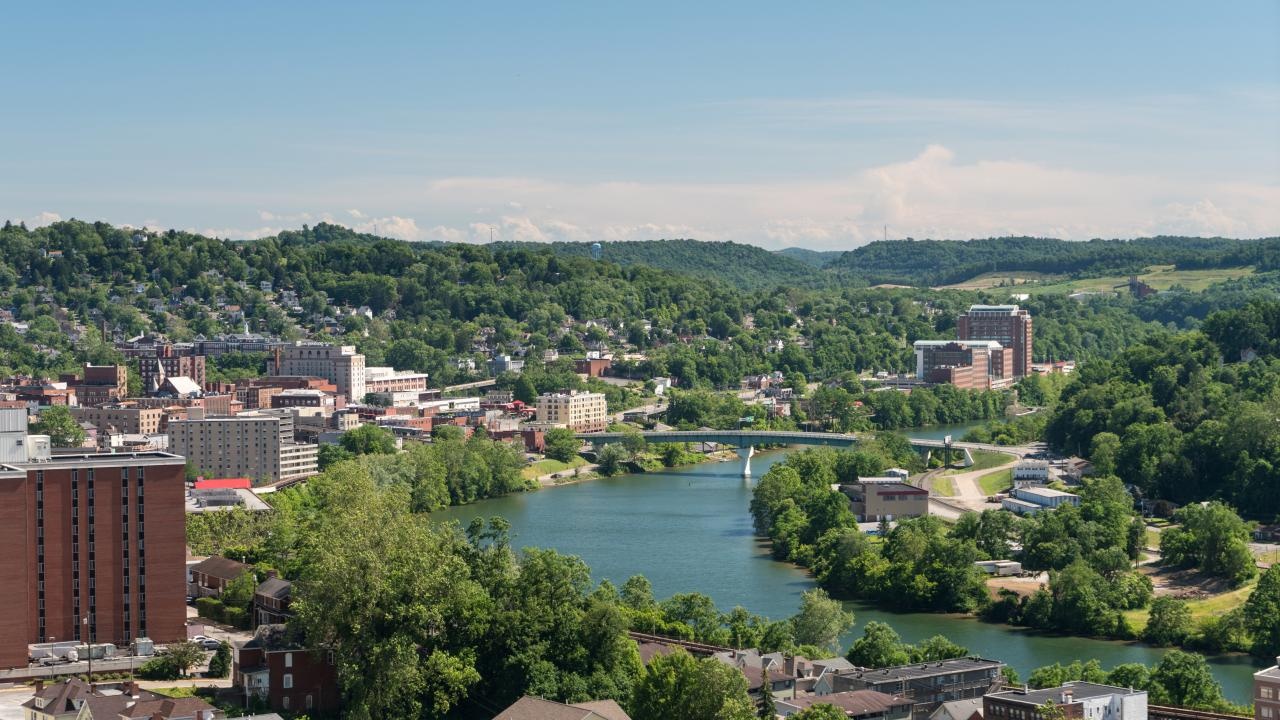
Morgantown is a lively college town set in the rolling hills of north-central West Virginia, serving as the seat of Monongalia County and the home of West Virginia University. The city has a population of roughly 30,000 residents, a number that swells considerably when students are on campus, and the broader metropolitan area adds tens of thousands more. Best known as a hub of Mountaineer athletics, healthcare, and Appalachian outdoor recreation, Morgantown carries the energetic, walkable feel of a university town while sitting within easy reach of some of the most scenic stretches of the Allegheny highlands. It lies about 70 miles south of Pittsburgh, Pennsylvania, and roughly 200 miles east of Columbus, Ohio, making it a convenient crossroads between the Midwest and the Mid-Atlantic.
Just outside the city, Coopers Rock State Forest is one of West Virginia's most popular outdoor destinations, drawing hikers, climbers, and sightseers year-round. About a 15- to 20-minute drive east of downtown, the forest spreads across more than 12,000 acres of hardwood ridges and sandstone cliffs, with the main overlook delivering sweeping views of the Cheat River gorge. In winter, parts of the forest are used for cross-country skiing, and the fall foliage draws visitors from across the region.
Within the city itself, the West Virginia University campus is the cultural and social anchor, mixing historic brick buildings with modern facilities and the open green of the downtown Evansdale and Downtown campuses. Mountaineer football games at Milan Puskar Stadium regularly fill the town with tens of thousands of visitors, and the WVU museums, performing arts venues, and the downtown High Street corridor give guests plenty to explore on quieter weekends. The Morgantown Personal Rapid Transit, a small automated people-mover linking the campuses, is a quirky point of interest in its own right.
Outdoor recreation also extends right into town along the Monongahela River, where a network of rail-trails, riverside paths, and nearby Cheat Lake offers miles of running, biking, and paddling within a short drive of the city center. About 10 to 15 minutes east of downtown, Cheat Lake provides boating, fishing, and quiet coves, while the surrounding ridges connect to a wider web of state forest trails.
Morgantown's combination of a year-round university population, a strong regional healthcare and research economy, and quick access to Appalachian outdoor escapes makes it a natural fit for short-term rental owners. Visitors come for football weekends, campus events, medical appointments, and family trips into the surrounding forests, and the city's compact, walkable core means rentals here appeal equally to leisure travelers and to those visiting students and patients throughout the year.
Want to know if a property in Morgantown is a good investment?
Enter an address to get instant revenue potential and comps.