
Superior, Wisconsin
Want to see how Superior compares to other top cities in Wisconsin? Explore all city regulations in Wisconsin. →
Superior, WI
Generally Investor Friendly
STR Regulations for Superior, Wisconsin
Overview: Are short‑term rentals allowed in Superior, WI?
Yes. Short‑term rentals are allowed in Superior, Wisconsin. Short‑term rentals are defined by state law as lodging accommodations offered for pay to tourists or transients for fewer than 30 consecutive days. To operate legally, property owners must obtain both state licensing for tourist rooming houses (TRH) and a Superior city short‑term rental license, and pass a health inspection performed by the Douglas County Environmental Health Department. The city requires licensing of properties rented for fewer than 30 consecutive days (state definition). In addition, hosts must comply with state short‑term rental statutes (Wis. Stat. § 66.1014), including rental‑day limits for certain stay lengths, licensing triggers (for more than 10 nights per year), and local ordinances. Superior’s licensing requirement took effect January 1, 2023.
What do Airbnb hosts actually earn in Superior?
Superior hosts earn a median $28,632/year with $182 ADR and 54% occupancy.
Top performers pull in $39,244+ per year.
See the full Superior market breakdownHow to start a short‑term rental business in this market
A practical, step‑by‑step path to legal compliance and operation:
- Verify zoning and property readiness
- Confirm the property is in a zone that permits the intended residential use and short‑term rental activity. Zoning details vary by location and are not fully covered in the provided sources; check the City of Superior zoning code.
- Ensure the unit can meet health and safety standards in ATCP 72 (Wisconsin’s Tourist Rooming House rules) and the county inspection checklist.
- Obtain state‑level approvals
- Apply for and obtain a Wisconsin Tourist Rooming House (TRH) license if you plan to rent for more than 10 nights per year. TRH licenses are administered by the Wisconsin Department of Agriculture, Trade and Consumer Protection (DATCP). Under a TRH license, an operator may rent up to 4 units (rooms, cabins, or cottages); a Hotel License is required for 5 or more units.
- If you will collect taxable rents, register for Wisconsin sales and use tax (state sales tax is 5.5% per state guidance). See the “Taxes” note below.
- Obtain county health approval
- Douglas County Environmental Health conducts inspections for TRH properties. Schedule and pass the required health inspection. The city’s STR license requires a Douglas County health inspection ($15 inspection fee).
- Use the TRH Inspection Checklist and Good Neighbor Guidelines to prepare the property.
- Obtain a city short‑term rental license
- Apply to the City Clerk’s Office. Two license options exist:
- Annual license: $50, valid January 1 to December 31.
- Seasonal license: $10 per month, covering only the months when you intend to rent.
- A $15 inspection fee per license term covers the Douglas County inspection required as part of the city license.
- Submit initial applications and renewals by November 1 each year; late fees may apply. Licenses are non‑transferable (not valid upon sale or relocation).
- Platform listing and market readiness
- Major platforms (Airbnb, VRBO) require proof of licensing and compliance. Listing without a valid license violates city policy and platform rules.
- Set up operations to collect room taxes and applicable sales taxes; prepare guest communications that reference local quiet hours, parking, trash, and occupancy limits.
- Maintain compliance
- Keep licenses current and renew by November 1 each year (city).
- Maintain proof of insurance and retain records of room/sales tax remittance.
- Monitor state statutes (Wis. Stat. § 66.1014), county ordinances, and city rules for changes.
Required documents, permits, licenses, and guidelines
State and local approvals required to operate:
- Wisconsin Tourist Rooming House (TRH) license (DATCP). Required if renting more than 10 nights per year; permits up to 4 units under TRH; 5+ units require a Hotel License.
- Wisconsin sales and use tax registration (if collecting taxable rent).
- Douglas County TRH Health Permit and successful inspection. Prepare using the county’s TRH Inspection Checklist and Good Neighbor Guidelines.
- City of Superior Short‑Term Rental License (annual or seasonal), plus $15 inspection fee.
- Evidence of liability insurance (homeowner’s or business liability) in line with county ordinance expectations.
- Compliance with Wisconsin Administrative Code ATCP 72 (tourist rooming house standards).
- Douglas County Food Safety and Recreational Licensing Ordinance (local health and safety requirements).
- Any local room tax registration requirements (see “Taxes” below).
- Utility and safety disclosures as applicable (e.g., sanitizing utensils disclosure, jetted tub sanitizing guide).
Specific regulations for short‑term rentals (city, county, state)
City of Superior (licensing and operation)
- Licensing: Required for properties rented for fewer than 30 consecutive days (state definition). Two license types:
- Annual license: $50, valid January 1–December 31.
- Seasonal license: $10 per month, for the months of intended rental.
- Inspection: $15 per license term; Douglas County Environmental Health performs the inspection required for city licensing.
- Timing: Initial application and annual renewals due by November 1; late fees may apply.
- Non‑transferability: Licenses cannot be transferred to new owners or new locations; a new application is required upon sale or relocation.
- Enforcement: Properties cannot operate without a license; platforms require proof of compliance before listing. The city has not capped the number of licenses.
Douglas County (health and safety standards)
- Health licensing: TRH license/permit required; inspections ensure compliance with ATCP 72 and county ordinance standards.
- Allowed units: Up to 4 units under TRH; Hotel License for 5+ units.
- Safety and sanitation: Must follow ATCP 72 requirements and county‑provided guidance, including:
- TRH Inspection Checklist.
- Good Neighbor Guidelines.
- Sanitizing Utensils Disclosure.
- Jetted Tub Sanitizing Guide.
- Liability insurance: County ordinance expectations include maintaining appropriate liability coverage (homeowner’s or business).
Wisconsin State (statutory framework)
- Wis. Stat. § 66.1014 governs short‑term rentals statewide:
- Prohibition provision: Municipalities cannot prohibit STRs of 7 consecutive days or longer.
- Durational limits: For rentals between 7–29 consecutive days, municipalities may limit total rental days to no fewer than 180 days in any consecutive 365‑day period and may require those days to run consecutively; municipalities cannot specify the calendar period of the 180‑day block.
- Local authority preserved: Municipalities may regulate other aspects of STRs so long as not inconsistent with the statute.
- Licensing trigger: Municipalities may require a local license for any person who “maintains, manages, or operates” a short‑term rental for more than 10 nights per year.
- Wisconsin Administrative Code ATCP 72: State health and safety standards for tourist rooming houses.
- Hotel vs TRH: TRH allows up to 4 units; 5 or more units require a Hotel License.
Taxes
- State sales tax: 5.5% (hosts must register with the Wisconsin Department of Revenue and collect/remit).
- Local room taxes: May apply at the municipal level (specific Superior room tax details were not provided in the sources). Confirm room tax registration and rates with the City Clerk/Treasurer.
Safety and occupancy specifics (from county/state sources)
- Off‑street parking: No specific city parking ratio is stated in the provided sources. ATCP 72 and local checklists address occupancy, safety equipment, and sanitation standards; confirm parking and occupancy with the county inspection checklist and city license conditions.
- Good neighbor rules: Follow Douglas County Good Neighbor Guidelines to mitigate noise, trash, and neighborhood impacts.
Zoning (notes)
- Towns and villages may have additional STR ordinances; Superior’s zoning rules and residential use classifications are not detailed in the provided sources. Confirm zoning compliance with the City of Superior Planning/Zoning Department.
Taxes
- State sales tax (5.5%) applies to taxable room rentals; register with the Wisconsin Department of Revenue if you will collect and remit sales tax.
- Local room taxes may be imposed by municipalities (Superior specific room tax details are not provided in the sources). Hosts should confirm room tax registration, rates, and remittance schedules with the City Clerk/Treasurer or Finance Department.
Contact information (local authorities in charge of STRs)
- Douglas County Environmental Health (licensing and inspections)
- Phone: 715‑395‑1304
- Ask to speak with an Environmental Health Specialist regarding TRH licensing and inspection.
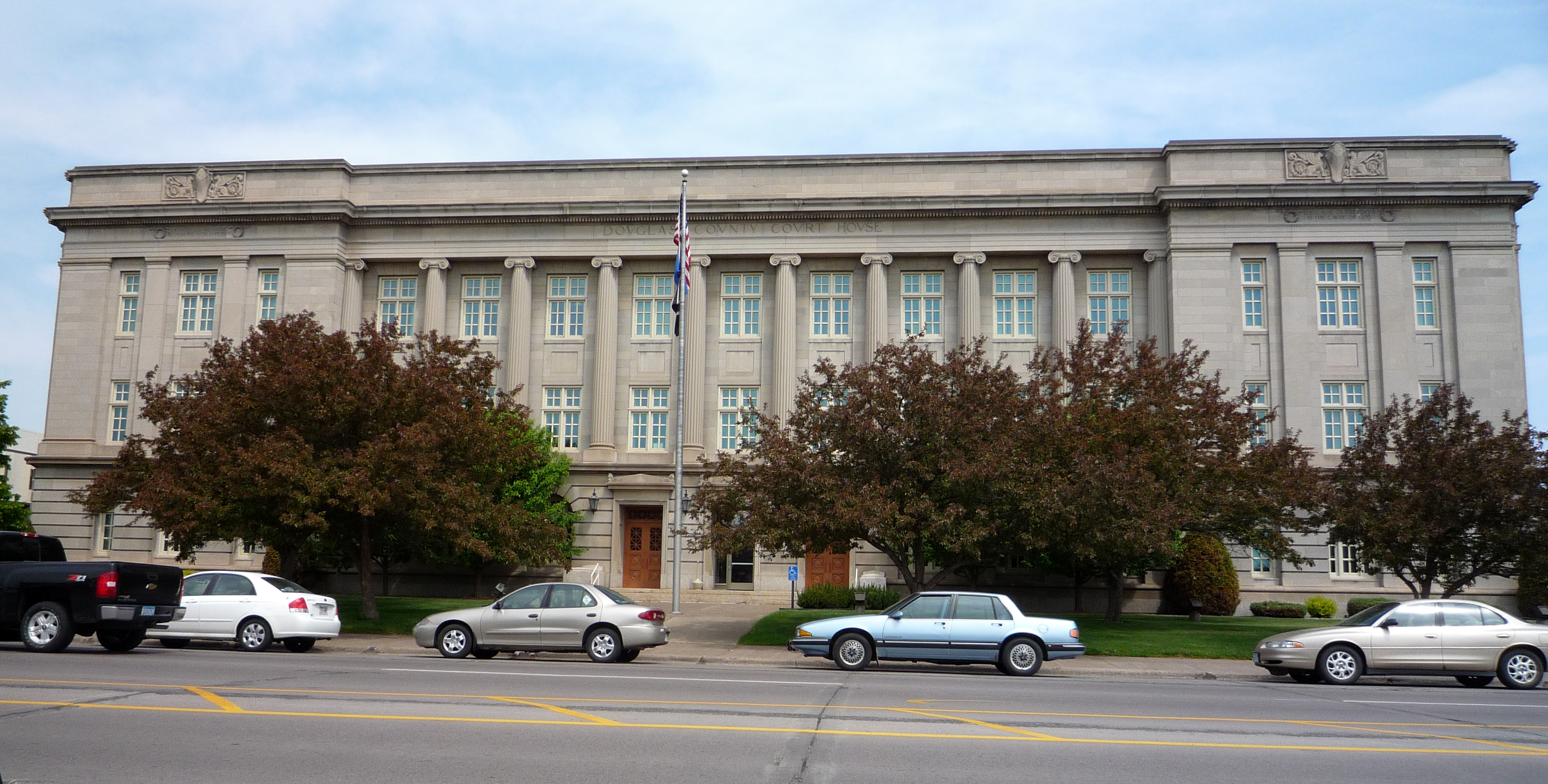
- Douglas County Courthouse (general contact)
- 1313 Belknap Street, Superior, WI 54880
- Phone: 715‑395‑1341
- Email: countyclerk@douglascountywi.org
- Website: douglascountywi.gov
- City of Superior (short‑term rental licenses)
- City Clerk’s Office
- Phone: 715‑395‑7200
- Email: cityclerk@ci.superior.wi.us
- State licensing (TRH)
- Wisconsin Department of Agriculture, Trade and Consumer Protection (DATCP)
- Website: datcp.wi.gov (Tourist Rooming Houses program page)
Important disclaimers
- This guide relies exclusively on the provided sources. Where details (e.g., zoning classifications, local room tax rates, or city‑specific occupancy limits) are not covered in the sources, contact the city or county directly.
- Regulations evolve. Investors should re‑confirm state statutes (Wis. Stat. § 66.1014), ATCP 72, county ordinance requirements, and city licensing rules prior to purchase or operation.
Source links
- Douglas County – Short‑Term Rental (Tourist Rooming House) overview: douglascountywi.gov/1064/Short-Term-Rental-Tourist-Rooming-House
- Wisconsin Administrative Code Chapter ATCP 72 (Tourist Rooming Houses): docs.legis.wisconsin.gov/code/admin_code/atcp/055/72
- Douglas County TRH License/Permit Ordinance: douglascountywi.org/DocumentCenter/View/2048/313-Douglas-County-Food-Safety-and-Recreational-Licensing-Ordinance
- TRH Permit Application (Hotel/Motel/TRH/Campground/Pool License Application): douglascountywi.org/DocumentCenter/View/8156/Hotel-Motel-TRH-Campground-Pool-License-Application
- Wisconsin DATCP – Short Term Rental Guidance (Tourist Rooming Houses): datcp.wi.gov/Pages/Programs_Services/TouristRoomingHouses.aspx
- A Guide to Renting Out Your Property For Overnight Stays (Wisconsin Lodging Association): wisconsinlodging.org/uploads/1/3/4/7/134752307/short_term_rentals_for_web.pdf
- Douglas County Good Neighbor Guidelines: douglascountywi.org/DocumentCenter/View/13523/Good-Neighbor-Guidelines
- Douglas County TRH Inspection Checklist: douglascountywi.org/DocumentCenter/View/13525/TRH-Inspection-Checklist
- Sanitizing Utensils Disclosure: douglascountywi.org/DocumentCenter/View/14067
- Jetted Tub Sanitizing Guide: douglascountywi.org/DocumentCenter/View/14074
- Superior Telegram – “Superior to require licenses for short‑term rentals”: superior-telegram.com/news/local/superior-to-require-licenses-for-short-term-rentals
Quick operational checklist for investors
- Confirm zoning with City of Superior.
- Secure state TRH license (if renting >10 nights/year).
- Register for Wisconsin sales tax.
- Schedule and pass Douglas County health inspection; prepare to ATCP 72 and county checklist.
- Obtain city STR license (annual or seasonal) by Nov 1; pay $15 inspection fee.
- Set up room/sales tax collection and remittance.
- Document insurance coverage; maintain good neighbor practices.
- List only after licenses are approved; maintain compliance year‑round.
Next step
Found a property in Superior?
Paste any address and get estimated revenue, cash-on-cash return, and comparable STR performance in under 5 minutes. 3 free analyses per day.
Free brief
Get the free Superior STR Investment Brief
Revenue data, top neighborhoods, seasonal trends, and the key regulations for Superior, Wisconsin in one email.
Superior
Market Saturation Score
Photos of Superior


Overview of Superior
Superior, Wisconsin sits in Douglas County at the southwestern tip of Lake Superior, immediately across the harbor from Duluth, Minnesota. The two cities together form the Twin Ports, a major Great Lakes shipping hub with a long working-port character. Superior has a population of roughly 26,000 and serves as a gateway to the Northwoods of Wisconsin and to outdoor recreation along the largest of the Great Lakes. The city lies about 150 miles northeast of Minneapolis–Saint Paul and is essentially adjacent to Duluth, which sits just to the east across the harbor.
About 13 miles south of Superior, Pattison State Park features Big Manitou Falls, a 165-foot cascade that is the tallest waterfall in Wisconsin and one of the tallest east of the Rocky Mountains. The park includes hiking trails, a sandy swimming beach on Interfalls Lake, and campsites along the Black River, making it a popular day trip for visitors who want a quick dose of Northwoods scenery without driving very far from town.
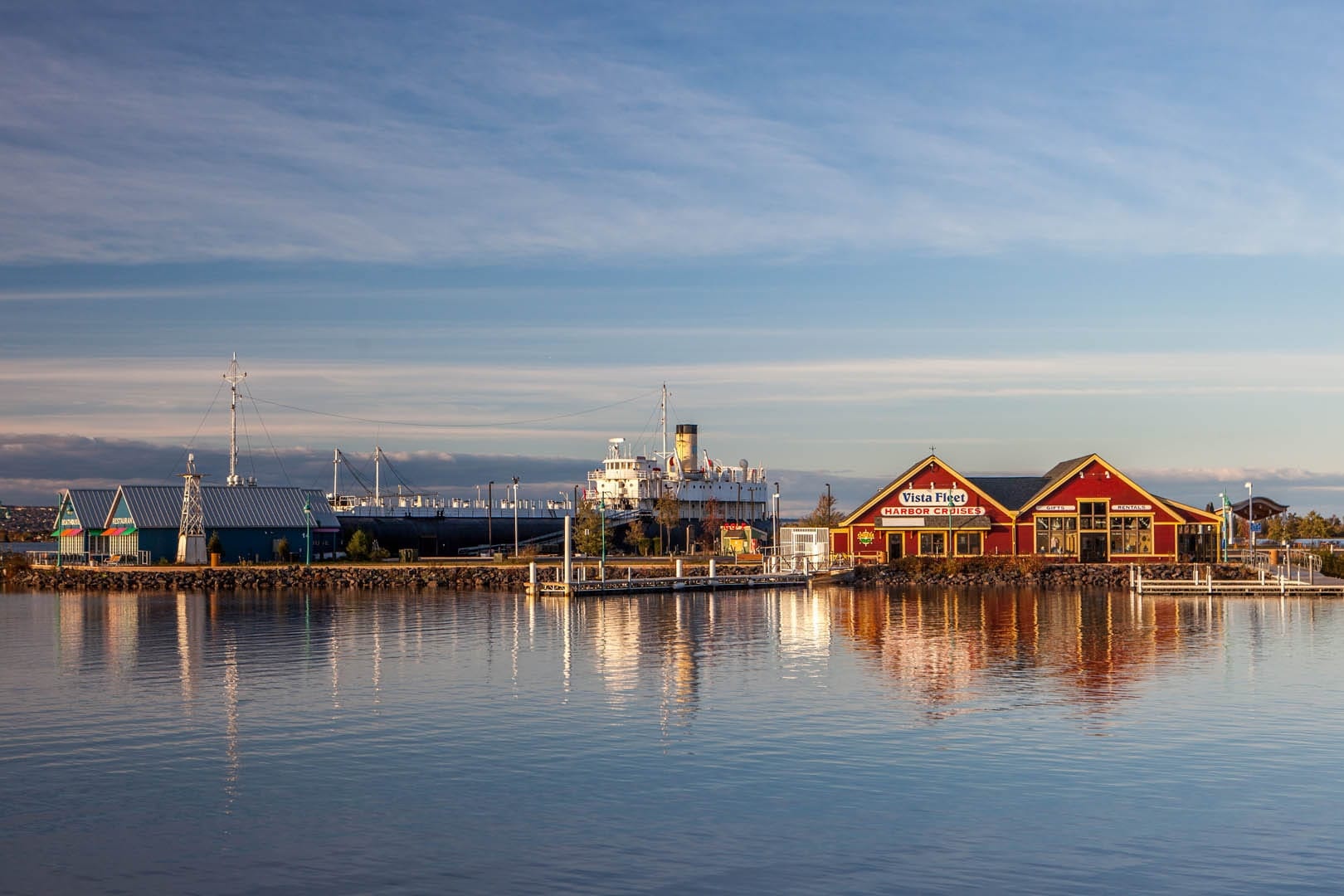
In Superior's harbor at Barker's Island, the SS Meteor is the last surviving whaleback freighter in the world, an unusual vessel type developed in Duluth-Superior in the late 19th century. The ship is preserved as a museum and is open seasonally for tours, giving visitors a tangible sense of the maritime heritage that shaped the Twin Ports.
Northwest of the city, Wisconsin Point extends about two and a half miles into Lake Superior, with a sandy beach, a network of hiking and nature trails, and the historic Wisconsin Point Lighthouse at its tip. The peninsula is a popular spot for watching freighters, sunrises over open water, and seasonal bird migrations along the lakefront, and it is one of the closest places to Superior where visitors can experience the open lake up close.
Fairlawn Mansion, a Victorian-era house built in the 1890s by a regional lumber baron, stands in Superior and operates today as a house museum filled with period furnishings. Listed on the National Register of Historic Places, it offers a glimpse into the wealth generated by the lumber industry that fueled the city's growth in the late 19th century.
With its blend of maritime heritage, immediate access to Duluth's restaurants and waterfront, and a string of state parks and natural areas within a short drive, Superior offers a layered base for short-term rentals. Visitors can pair a stay on the Lake Superior shore with day trips to waterfalls, lighthouses, and the broader Northwoods, all within roughly an hour of the city.
Want to know if a property in Superior is a good investment?
Enter an address to get instant revenue potential and comps.