
Fremont, Wisconsin
Want to see how Fremont compares to other top cities in Wisconsin? Explore all city regulations in Wisconsin. →
Fremont, WI
Generally Investor Friendly
STR Regulations for Fremont, Wisconsin
Overview: Are Short-Term Rentals Allowed?
Short-term rentals (STRs) are allowed in the Town of Fremont, Wisconsin—explicitly, “Yes.” They are regulated primarily at the state level as “tourist rooming houses” and may be conditioned at the local level by zoning. The Town’s zoning ordinance does not define or prohibit STRs directly; rather, lodging uses are addressed through defined land use categories (e.g., “Commercial Indoor Lodging Facility” and “Bed and Breakfast Establishment”). As a practical matter, most investor-owned STRs in the Town will be reviewed as either:
- A “Tourist Rooming House” (state-regulated lodging) and/or
- A “Commercial Indoor Lodging Facility” (or “Resort Establishment,” depending on the property’s scale and configuration) under the Town zoning code.
A Tourist Rooming House is a lodging business renting rooms to tourists for less than one month, required by Wisconsin state law to be licensed and inspected by the county health department and to meet state health and safety standards. A Bed and Breakfast Establishment, by contrast, must be operator-occupied, limit guests to five rooms, and operate no more than 10 nights in any 12‑month period.
- Investor-owned, not operator-occupied STRs typically do not qualify as a “Bed and Breakfast Establishment.”
- The Town’s zoning has no separate “short-term rental” use category. Operators should expect zoning review under the lodging definitions above, with conditions tied to district standards, setbacks, site plan and parking, and state health rules.
Bottom line: STRs are allowed in Fremont, but you must follow state licensing and health rules (county-administered) and any local zoning requirements that apply to lodging uses.
State-Level Licensing and Health Requirements (Wisconsin)
- License requirement: Any Tourist Rooming House (TRH) renting rooms for fewer than 30 days to travelers and tourists must be licensed by the Wisconsin Department of Agriculture, Trade and Consumer Protection (DATCP) and inspected for compliance. This applies across Wisconsin, including Waupaca County.
- Administration: In Waupaca County, the Health & Human Services Department issues and enforces TRH licenses under Wisconsin Administrative Code Chapter ATCP 73 and related DHS statutes and rules.
- Core compliance themes:
- Sanitation (e.g., properly plumbed and vented bathrooms; safe food handling if meals are offered)
- Life safety (e.g., smoke detectors, carbon monoxide detectors, posted evacuation plans, fire extinguishers; window egress may be regulated depending on occupancy configuration)
- Water quality (where private wells are used; testing and mitigation if required)
- Occupancy limits (per approved sleeping rooms and plan)
- Proper refuse storage, recycling, and pest control
- Good neighbor practices and posted emergency contacts
Important: The county/district health office administers the state TRH program locally. Investors must verify the local inspection protocol and any recent updates with the Waupaca County Health & Human Services office before opening.
References:
- Wisconsin Statutes Chapter 254 (public health)
- Wisconsin Administrative Code: ATCP 73 (Tourist Rooming Houses) and DHS (facility safety standards)
Zoning and Local Use Authorization in the Town of Fremont
The Town of Fremont Zoning Ordinance contains lodging-related land uses that are relevant to STRs:
- Commercial Indoor Lodging Facility: Overnight housing in individual rooms or suites (often with private bathrooms), may have in-room/suite kitchens. Parking is calculated at one space per room or suite, plus one space for every employee on the largest working shift.
- Resort Establishment: Overnight lodging in rooms, suites, cabins, or cottages, often with indoor and outdoor recreational facilities for guests. Density is capped at 10 occupancy units per acre. Parking is one space per unit plus one space per employee on the largest shift.
- Bed and Breakfast Establishment: Operator‑occupied residences with no more than five guest rooms, serving meals only to renters, and in operation for more than 10 nights in any 12‑month period. Parking is one space per bedroom. This category is generally unsuitable for investor-owned STRs unless the owner lives on-site and meets the operational thresholds.
- Short-Term Rental: Not defined in the ordinance; STRs will likely be reviewed as one of the lodging categories above or as a Conditional Use where applicable.
- Mobile Home: A separate category with specific rules and exceptions; generally not applicable to standard STRs.
Zoning context:
- The zoning map and district standards (e.g., RR, SR‑10, SR‑20, SR‑M, PD, RC‑N, RC‑G, RI‑G, RI‑I) establish where lodging uses are permitted, conditionally permitted, or require site plan review. Section 15.6.6 lists lodging categories and parking requirements. Section 15.4 contains district regulations (density, lot size, setbacks, height).
- Typical investor-owned STRs that are not operator-occupied generally do not fit the Bed and Breakfast definition and therefore need to be evaluated against Commercial Indoor Lodging Facility or Resort Establishment standards in the applicable zoning district.
- STRs in shoreland areas (near lakes/flowages) are subject to Waupaca County Shoreland Zoning, which sets additional setbacks and development standards along waterways.
- A zoning permit is required before operating any lodging business; some lodging uses may require a Conditional Use Permit (CUP) or Site Plan Review.
- The Town requires a Land Use Permit and may require a Conditional Use Permit; see Section 15.2.3 and 15.2.3.4.
- See Section 15.2.10 (Principal Residential Structures) for limits on multiple principal structures on a parcel.
Noise and nuisance:
- Chapter 08 – Nuisance Noise applies in the Town; STR operators must control guest noise and adhere to Town rules regarding disturbances and quiet hours.
Permits, Documents, and Approvals: Step-by-Step
- Pre-screening and zoning check
- Confirm zoning district and applicable lodging category (likely Commercial Indoor Lodging Facility or Resort Establishment).
- Confirm whether the use is Permitted, Permitted with Site Plan Review, or Conditional in the subject zoning district.
- Check shoreland status if near a lake or navigable stream; additional setbacks and approvals may apply.
- Confirm that only one principal residential structure is on the parcel unless otherwise allowed (Section 15.2.10).
- Building and life safety readiness
- Existing structure: Confirm code-compliant egress, smoke/CO detectors, posted evacuation plan, fire extinguisher(s), safe electrical systems, and adequate ventilation and sanitation.
- If any structural changes are planned, obtain necessary building permits and approvals from the Town’s building inspector before occupancy.
- Zoning approvals
- Land Use Permit: Required before operation; application procedures in Section 14.03. A site plan is typically required for lodging uses; see Section 9.0 (Site Plan Review).
- Conditional Use Permit (if applicable): For lodging uses that are conditional in the zoning district; requires Plan Commission review, a detailed site plan, and compliance with district standards. Permits expire if work does not progress to exterior shell completion within one year (unless extended).
- State health licensing for Tourist Rooming House
- Apply for a Tourist Rooming House license with Waupaca County Health & Human Services (under ATCP 73). Provide:
- Facility floor plan with room dimensions and use designations
- Sleeping room count and maximum occupancy
- Life safety documentation (detectors, extinguishers, egress plan)
- Water and sewage information (public sewer/private onsite wastewater treatment system)
- Property details (address, owner/operator info, contact numbers)
- Complete any required inspections and address deficiencies before issuance.
- Retain license on premises and renew per state timelines.
- Ongoing compliance and filings
- Tax remittance: Wisconsin Shared Revenue requires registration and quarterly/monthly reporting of sales and use taxes related to the STR. Consult a tax professional and the Department of Revenue guidance.
- Occupancy taxes: If lodging taxes apply (e.g., county room tax), register and remit as required.
- Insurance: Obtain liability and property coverage appropriate for transient lodging; consider including off-premises guest accidents if applicable.
State Statutes and Administrative Codes (Summaries)
- Wisconsin Statutes Chapter 254: Establishes public health authority and framework for lodging safety (including tourist rooming houses).
- Wisconsin Administrative Code ATCP 73: Licensing and operational standards for Tourist Rooming Houses.
- Wisconsin Administrative Code DHS (various): Facility safety and sanitation standards referenced by the TRH program (administered locally).
- Local ordinances:
- Town of Fremont Zoning Ordinance (Chapter 15), including lodging use definitions and district standards.
- Town of Fremont Chapter 08 – Nuisance Noise.
- Waupaca County Shoreland Zoning Ordinance (Chapter 32): Additional controls for lakes/flowages.
- Waupaca County Building Code and related codes for structural/life-safety compliance.
- Waupaca County Non-Metallic Mining Reclamation (if site disturbance): Less relevant to STRs but part of land use framework.
County-Level Requirements (Waupaca County)
- The county administers the state Tourist Rooming House license and inspections for STRs in the Town of Fremont.
- Shoreland zoning (county-wide) applies to properties adjacent to navigable waters, imposing water setbacks and additional development rules that can affect structures, driveways, and land disturbance.
Town-Specific Regulations (Town of Fremont)
- Zoning approval required: Lodging uses fall under defined land use categories; STRs will be evaluated accordingly, typically as Commercial Indoor Lodging Facility or Resort Establishment.
- Conditional Use Permit and Site Plan Review may apply, depending on district and intensity of use.
- Bed and Breakfast is a distinct, operator-occupied category not suited to most investor-owned STRs (and limited by 10+ nights operation threshold).
- Principal residential structures: Not more than one principal residential structure per parcel unless the use falls within allowed exceptions (Section 15.2.10).
- Shoreland development: If your property is near a water body, it may be subject to Waupaca County Shoreland Zoning Ordinance setbacks and permitting.
- Noise: Chapter 08 – Nuisance Noise applies; implement quiet hours and guest policies to prevent violations.
Contacts
Town of Fremont (Local Zoning and Building)
- Address: E7403 Hwy 110, Fremont, WI 54940 (Mailing: PO Box 450, Fremont, WI 54940)
- Phone: (920) 446‑2777
- Fax: (920) 446‑2778
- Email: townoffice@townfremontwi.gov
- Website: townfremontwi.gov/
- Relevant pages:
- Ordinances: townfremontwi.gov/ordinances/
- Forms & Permits: townfremontwi.gov/forms-permits/
- Building Permits: townfremontwi.gov/building-permits/
- Zoning Ordinance (PDF): Chapter 15 (see document link in Source Pages)
Waupaca County Health & Human Services (Tourist Rooming House Licensing)
- Phone: Confirm current number with Town or County (contact the Town office if needed).
- Website: www.co.waupaca.wi.us/health-and-human-services
- Note: This department administers the state TRH licensing program at the county level.
Wisconsin Department of Agriculture, Trade and Consumer Protection (DATCP)
- Phone: General DATCP number (verify)
- ATCP 73 Licensing Program (Tourist Rooming Houses)
- Website: datcp.wi.gov
Source Pages (Key Documents)
- Town of Fremont – Zoning Ordinance (Chapter 15) (PDF): energyzoning.org/sites/default/files/PDF/5513527850_Waupaca_Fremont%20Town_20220913.pdf
- Town of Fremont – Ordinances Index: townfremontwi.gov/ordinances/
- Town of Fremont – Forms & Permits: townfremontwi.gov/forms-permits/
- Town of Fremont – Building Permits: townfremontwi.gov/building-permits/
- Town of Fremont – Contact: townfremontwi.gov/contact-us/
- Town of Fremont – Nuisance Noise (Chapter 08): PDF link on Ordinances page (see ordinances list)
- Waupaca County Health & Human Services: www.co.waupaca.wi.us/health-and-human-services
Notes:
- The Town’s website states “Ordinances are currently under review and are subject to changes…,” which underscores the importance of checking the latest ordinance text or contacting the Town office for updates before making investment or permitting decisions.
- If a specific zoning district or shoreland condition applies to your parcel, obtain the official zoning map, district standards, and any CUP/Site Plan Review requirements from the Town prior to acquisition or operation.
What do Airbnb hosts actually earn in Fremont?
Fremont hosts earn a median $25,018/year with $283 ADR and 46% occupancy.
Top performers pull in $40,216+ per year.
See the full Fremont market breakdownNext step
Found a property in Fremont?
Paste any address and get estimated revenue, cash-on-cash return, and comparable STR performance in under 5 minutes. 3 free analyses per day.
Free brief
Get the free Fremont STR Investment Brief
Revenue data, top neighborhoods, seasonal trends, and the key regulations for Fremont, Wisconsin in one email.
Fremont
Market Saturation Score
Photos of Fremont


Overview of Fremont
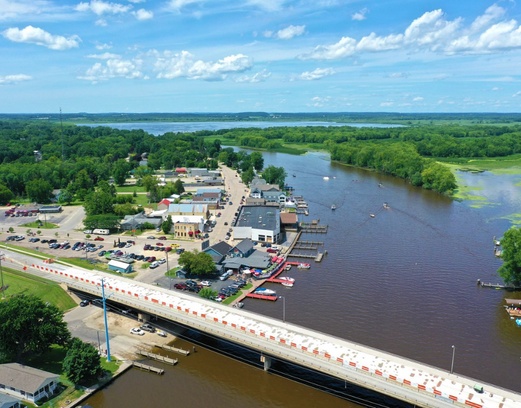
Fremont is a small village in Waupaca County, in the heart of central Wisconsin. With a population of roughly 600 residents, it has the quiet, rural character typical of the region's farming communities, and it sits among the rolling woodlands, lakes, and trout streams that make this part of the state a popular destination for outdoor recreation. The village is best known as a launch point for trips along the Wolf River, one of Wisconsin's most celebrated paddling and fishing corridors, and it draws visitors year-round who come for the surrounding natural scenery as much as for the friendly small-town atmosphere. It lies about 50 miles southwest of Appleton, the nearest sizeable city, and roughly 100 miles northwest of Madison, placing it within easy reach of the Fox Valley while still feeling firmly off the beaten path.
Just outside the village, the [Wolf River](en.wikipedia.org/wiki/Wolf_River_(Wisconsin) offers some of the most distinctive paddling experiences in the upper Midwest. In spring, the river is famous for the annual lake sturgeon run, when these enormous prehistoric fish travel upstream and draw thousands of visitors to viewing stations and riverbanks; in summer, the same stretch is a popular route for canoeists and kayakers moving between small communities. A short drive northwest of Fremont puts visitors near Hartman Creek State Park, a wooded retreat of more than 1,400 acres that surrounds the chain of glacial lakes around which the city of Waupaca is built. The park offers hiking, biking, and horseback riding trails, a swimming beach, and a network of campgrounds, making it a natural day-trip companion for anyone staying in the area.
A little farther afield, the Chain O' Lakes in and around the city of Waupaca draws boaters, anglers, and families looking for calm water and sand-bottomed swimming spots. Twenty-two interconnecting lakes form a recreational hub that has defined the Waupaca area's identity for more than a century, with summer cottages, public beaches, and lakeside restaurants giving the region a classic Wisconsin lake-country feel. Closer to Fremont itself, the surrounding Waupaca County countryside is laced with smaller lakes, public fishing spots, and thousands of acres of state wildlife areas that are popular with hunters, birders, and snowmobilers once winter sets in.
For short-term rental owners, Fremont offers a compelling combination of small-town affordability and a strong year-round outdoor draw. Its position along the Wolf River and within easy driving distance of Hartman Creek State Park, the Chain O' Lakes, and several other central Wisconsin recreation hubs gives the village a built-in audience of paddlers, anglers, families, and snowmobilers, while its distance from major cities helps it feel like a genuine getaway rather than a quick suburban stopover.
Want to know if a property in Fremont is a good investment?
Enter an address to get instant revenue potential and comps.