
Lake Stevens, Washington
Want to see how Lake Stevens compares to other top cities in Washington? Explore all city regulations in Washington. →
Lake Stevens, WA
Challenging To Investors
STR Regulations for Lake Stevens, Washington
Overview: Are short‑term rentals allowed?
Yes. Short‑term rentals (STRs) are allowed in Lake Stevens, Washington, under Ordinance 1139, which updated the Lake Stevens Municipal Code at LSMC 14.44.064. STRs are a permitted, Type I land use in residential zoning districts (as shown in LSMC Table 14.40‑I), subject to a city business license and a supplemental city STR permit. The City caps the total number of active STR licenses at 50 and imposes local siting, spacing, occupancy, parking, and operational standards designed to minimize impacts on neighborhoods. Operating an STR without a valid city permit and business license is unlawful.
Important: While Lake Stevens has its own regulations, operators must also comply with Washington State requirements for lodging taxes and certain consumer safety provisions. County-level approvals (e.g., Snohomish County Health Department) may apply for food‑related operations or other health‑related activities associated with the property.
References: STR FAQ; Ordinance 1139; LSMC 14.44.064; HeraldNet article summarizing the ordinance and implementation context.
What do Airbnb hosts actually earn in Lake Stevens?
Lake Stevens hosts earn a median $29,880/year with $174 ADR and 63% occupancy.
Top performers pull in $40,584+ per year.
See the full Lake Stevens market breakdownHow to start a short‑term rental business in Lake Stevens
Investors should approach STR startup systematically to ensure both legal compliance and operational viability.
- Confirm eligibility and zoning
- Use the city’s zoning map to verify your property is in a zone where STRs are permitted (see LSMC Table 14.40‑I).
- STRs must be operated within permanent, legal structures. RVs, boathouses, and open land are not allowed.
- You can use an Accessory Dwelling Unit (ADU) as an STR if it is a legal, permitted structure and complies with all STR standards.
- Decide hosting model and local contact
- Hosted or unhosted STRs are allowed. Either way, you must maintain a 24/7 local contact who can respond to complaints and take remedial action if necessary. The local contact’s name and phone number must be submitted to the city and appear on the STR register whenever the property is rented.
- Determine occupancy and bedroom limits
- Occupancy: Maximum of eight individuals total at any time.
- Bedroom limits: No more than two guests per bedroom per stay (children five and under are not counted toward this limit).
- Party definition: No more than two “parties” per rental. A party is defined as four or fewer unrelated people (families are not limited by the four‑person rule).
- Plan parking and safety
- Provide off‑street parking at least nine feet wide and 19 feet long:
- 1–2 bedrooms rented: minimum one off‑street stall.
- 3–4 bedrooms rented: minimum two off‑street stalls.
- 5+ bedrooms rented: minimum three off‑street stalls.
- Provide documentation of working fire extinguishers, smoke detectors, carbon monoxide detectors, and clearly marked exits.
- Submit application and fees
- Submit a Type I land use application for an STR permit and a city business license. The application is made through the city’s online permit portal; you will need to create an account if you do not have one.
- Pay the city application fee ($500) and annual renewal fee ($100). Permit issuance runs for one year from the date of issuance.
- Tax and licensing compliance
- Obtain a Washington State business license and the city endorsement.
- Remit lodging taxes to the State per RCW 64.37.020.
- Post “good neighbor guidelines”
- Post a city‑approved set of “good neighbor guidelines” in a conspicuous place inside the STR, including:
- Nonemergency police contact info.
- Designated parking location(s).
- Emergency shut‑offs location.
- Noise control prohibitions (including quiet time between 10 p.m. and 7 a.m.).
References: STR FAQ; Ordinance 1139 (LSMC 14.44.064).
Required documents, permits, licenses, and guidelines
A clear documentation checklist helps prevent processing delays and reduces enforcement risk.
- Permit and license
- Type I STR permit application (via online portal).
- City business license (Chapter 4.04 LSMC).
- Contact information
- Owner and operator details.
- Name and phone number for a responsible party (24/7 local contact) for inclusion on the city’s STR register whenever rented.
- Property information
- Address and a written description of the area to be rented (number of bedrooms).
- Safety and exits documentation
- Fire extinguishers, smoke and carbon monoxide detectors, clearly marked exits.
- Good neighbor guidelines
- City‑approved form posted in the STR with required content (noise, parking, emergency info).
- State licensing and taxes
- Washington State business license (apply online) and city endorsement.
- Remit Washington lodging taxes (RCW 64.37.020).
References: STR FAQ; Ordinance 1139 (LSMC 14.44.064).
Specific regulations for short‑term rentals
Lake Stevens’ STR regulations are codified under LSMC 14.44.064 (Ordinance 1139). The following highlights are central to investor compliance:
-
Zoning and classification
- STRs are a Type I permit and permitted use in multiple residential zoning districts (see LSMC Table 14.40‑I).
- STRs cannot be used as event venues (weddings, banquets, fundraisers, or other large events for compensation).
-
Licensing and issuance
- Permits and licenses are issued for one year and must be renewed annually.
- The Planning and Community Development Director or designee evaluates compliance with LSMC 14.44.064 and nuisance/noise regulations.
- It is unlawful to offer or rent an STR without a valid city permit.
-
Operator limits and transferability
- No more than two STRs may be operated by any operator within the city (individual, family unit, domestic partnership, or acting as a principal in a business entity).
- Permits are not transferable to another operator or location.
-
Separation requirements
- STRs must be separated by at least 150 feet, measured parcel‑edge‑to‑parcel‑edge radius.
-
Occupancy and bedrooms
- Maximum eight total individuals at any time.
- No more than two guests per bedroom per stay (children five and under are not counted).
- No more than two parties per rental; a party is up to four unrelated people; families are not limited by the four‑person rule.
-
Parking
- Required off‑street parking stalls sized at minimum 9 feet by 19 feet:
- 1–2 rented bedrooms: one stall.
- 3–4 rented bedrooms: two stalls.
- 5+ rented bedrooms: three stalls.
- Boat trailers/RVs may be parked only if adequate off‑street parking is provided and does not conflict with required parking.
- Required off‑street parking stalls sized at minimum 9 feet by 19 feet:
-
STR register and updates
- Provide valid contact information for a responsible party every day the property is rented.
- Any changes to the responsible party’s name or phone number must be submitted to the city within 14 days.
-
Good neighbor guidelines
- Must be posted on a city‑approved form with specified content.
-
Complaints and enforcement
- Complaints and enforcement are subject to Chapter 17.20 LSMC (including fines and penalties).
- Progressive enforcement for multiple violations (LSMC 17.20.030).
- A revoked permit and business license holder cannot receive a new STR permit for two years from revocation.
- Consumer safety violations are subject to RCW 64.37.030.
-
Taxes
- Timely payment of applicable sales/use and other state lodging taxes is required.
-
Building permits
- Building permits may be required for structural or other modifications (entrances, walls, plumbing, electrical) or for new ADUs.
References: STR FAQ; Ordinance 1139; LSMC 14.44.064; HeraldNet article.
County and state regulations relevant to Lake Stevens
While Lake Stevens’ STR code is city‑specific, investors must also comply with county and state requirements:
-
Washington State (RCW 64.37)
- Lodging taxes must be remitted to the State per RCW 64.37.020.
- Consumer safety standards apply per RCW 64.37.030; the city references these standards in its good neighbor guidelines posting requirement.
-
Snohomish County Health Department
- If any food‑related business is operated at the STR (e.g., catering, events, or food service), a food handler’s card and compliance with applicable health regulations may be required. The STR FAQ and LSMC home occupation section note health‑department requirements for certain activities.
-
Municipal code context
- Noise regulations (LSMC Chapter 9.56) and nuisance activity regulations (LSMC Chapter 9.60) apply and are referenced in the STR standards and good neighbor guidelines.
- Parking requirements are detailed in LSMC Chapter 14.72; the STR FAQ reiterates dimensions and stall requirements.
References: STR FAQ; Ordinance 1139.
Contact information for the local authority in charge of STRs
City of Lake Stevens – Planning and Community Development (STR permitting and code administration)
- Phone: (425) 622‑9400
- Online permit portal: Create an account and submit through the city’s portal (link provided in STR FAQ)
Washington State licensing and lodging taxes
- Business Licensing Service (Washington State)
- Apply for state business license and endorsements online (see “Apply for your state license and city endorsement” link referenced in the STR FAQ)
References: STR FAQ.
Links to source pages
- Short‑Term Rental (STR) FAQ: www.lakestevenswa.gov/DocumentCenter/View/11788/STR-FAQ
- Ordinance 1139 – Short‑Term Rentals Code Amendment: www.lakestevenswa.gov/DocumentCenter/View/10978/Ordinance-1139---October-25?bidId=-
- LSMC Chapter 14.44 – Short‑Term Rentals (and supplementary regulations): www.codepublishing.com/WA/LakeStevens/html/LakeStevens14/LakeStevens1444.html
- HeraldNet coverage of new STR rules: www.heraldnet.com/news/after-months-of-debate-new-rules-for-airbnbs-in-lake-stevens/
- City Zoning Map (for verifying permitted zones): www.lakestevenswa.gov/DocumentCenter/View/11788/STR-FAQ (STR FAQ references this map and includes the link within)
This guide synthesizes the city’s adopted regulations and official guidance. Investors should consult the city’s portal and municipal code for any subsequent amendments, fee updates, or procedural changes.
Next step
Found a property in Lake Stevens?
Paste any address and get estimated revenue, cash-on-cash return, and comparable STR performance in under 5 minutes. 3 free analyses per day.
Free brief
Get the free Lake Stevens STR Investment Brief
Revenue data, top neighborhoods, seasonal trends, and the key regulations for Lake Stevens, Washington in one email.
Lake Stevens
Market Saturation Score
Photos of Lake Stevens


Overview of Lake Stevens
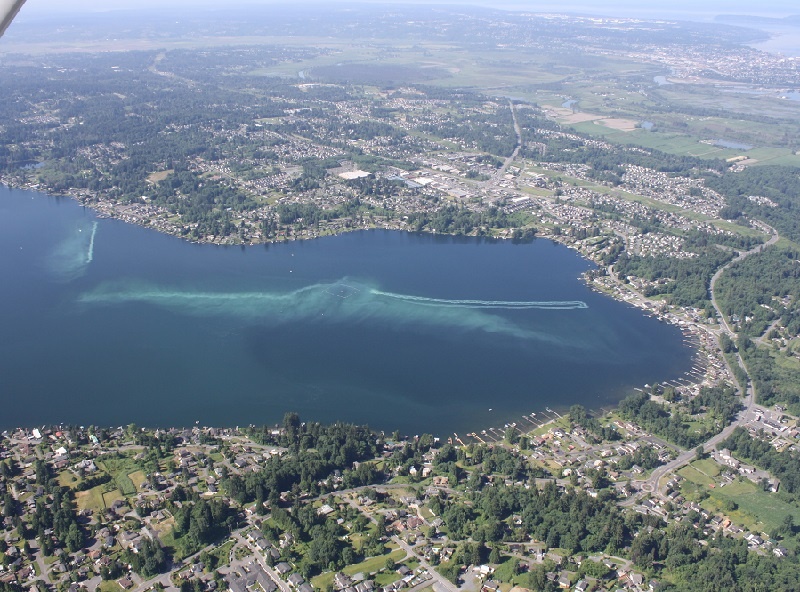
Lake Stevens is a suburban city in Snohomish County, Washington, wrapped around the northern and eastern shores of the freshwater lake that gives it its name. With a population of roughly 33,000, it has the feel of a quiet residential community that swells with visitors on warm weekends, when the lake fills with boaters, paddleboarders, and swimmers. It sits about 35 miles north of Seattle, just off Interstate 5 and US 2, making it an easy base for travelers exploring the greater Puget Sound region or heading east into the Cascades.
The lake itself is the city's centerpiece and primary draw. Public launch ramps, a city beach, and a waterfront park give visitors access to swimming, fishing for trout and kokanee, kayaking, and small-craft boating in a setting framed by forested hills and modest lakefront homes. The waterside Lake Stevens Community Park and the surrounding shoreline are popular for picnics and sunset walks during the warmer months.
A short drive east brings visitors into the foothills of the Cascades. Mount Pilchchuck State Park sits within roughly an hour's drive and offers a strenuous but rewarding hike to a historic fire lookout with sweeping views of the surrounding mountains, the Puget Sound, and on clear days, the distant peak of Mount Rainier. The trailhead is accessed through the small town of Granite Falls, a useful stop for coffee or a meal before or after a hike.
West of the city, the historic town of Snohomish lies just a few miles away and is known for its preserved downtown of antique shops, tasting rooms, and small restaurants housed in 19th-century buildings. Further west, Everett's waterfront and the Future of Flight Aviation Center are within about 15 miles, offering Boeing factory tours and a glimpse of the region's deep ties to commercial aviation. For those willing to drive a bit farther, the Stevens Pass ski area in the Cascades is roughly 70 miles to the southeast, providing winter skiing and summer hiking within a couple of hours.
Lake Stevens makes a compelling base for short-term rentals because it offers a peaceful, lake-oriented experience while remaining within easy reach of Seattle, the Snohomish Valley, the Cascades, and the broader Puget Sound. Its combination of small-town character, outdoor recreation, and proximity to both urban amenities and mountain wilderness appeals to families, road-trippers, and remote workers looking to balance nature with convenience.
Want to know if a property in Lake Stevens is a good investment?
Enter an address to get instant revenue potential and comps.