
Kent, Washington
Want to see how Kent compares to other top cities in Washington? Explore all city regulations in Washington. →
Kent, WA
Challenging To Investors
STR Regulations for Kent, Washington
Short-Term Rental (STR) Investor Guide: Kent, WA (and King County Context)
Important note: The District of Kent, British Columbia also has an STR program, but this guide covers Kent, Washington (King County), per your jurisdictional focus.
Overview: Are Short-Term Rentals Allowed in Kent, WA?
Yes. Short-term rentals are permitted in Kent under Washington State law (RCW 64.37), with local restrictions adopted by the City of Kent. Kent allows STRs for stays of fewer than 30 consecutive nights. City rules add occupancy, licensing, and residency conditions that apply on top of state requirements.
What do Airbnb hosts actually earn in Kent?
Kent hosts earn a median $26,725/year with $158 ADR and 64% occupancy.
Top performers pull in $38,438+ per year.
See the full Kent market breakdownHow to Start a Short-Term Rental Business in Kent, WA
1) Verify Property Eligibility and Compliance
- Confirm the property is within Kent city limits.
- STRs are permissible in residential zones under standard home-use rules; verify no deed restrictions or HOA limits conflict with short-term rentals.
- Meet state and local safety requirements:
- Carbon monoxide alarms installed per state building code (RCW 19.27.530).
- Post required guest information in each STR unit (see Consumer Safety section).
- Maintain $1,000,000 primary liability insurance or use a platform that provides equivalent coverage.
2) Apply for a City Business License
- Obtain a Kent business license; this is required to operate an STR in the city.
- As of the city’s adopted 2019 ordinance:
- License fee: $51 (this figure was established in 2019; confirm current fee directly with the city).
- License must be renewed annually.
3) Tax Registration and Compliance
- Register for state/local tax accounts as applicable:
- Washington State combined sales tax reporting (lodging is generally subject to the sales tax regime).
- King County lodging tax (if required by county regulations).
- Local “hotel/motel” or other lodging taxes the City of Kent administers or collects through the state.
- Collect and remit all applicable taxes. If a platform (Airbnb, Vrbo, etc.) collects/remits on your behalf, ensure they do so correctly and maintain records.
4) Operate According to City Restrictions (Per 2019 Ordinance)
- Limit stays to fewer than 30 consecutive nights.
- If renting only part of your home (not the entire dwelling), limit to 3 rooms.
- Owner or non-transient tenant must live at the property at least 6 months per year (permanently).
- Comply with safety posting requirements (see Required Postings below).
- Provide parking consistent with neighborhood constraints; avoid street overflow.
- Respect noise, nuisance, and zoning rules.
5) Maintain Ongoing Compliance
- Keep insurance active and review coverage annually.
- Post the STR business license in the unit and the contact information for the responsible person/operator.
- Retain documentation for tax filings and city inspections.
- Monitor local code updates; maintain contact details on file with the city.
Required Documents, Permits, Licenses, and Guidelines
State Requirements (Washington RCW 64.37)
- $1,000,000 primary liability insurance, or platform-provided equivalent coverage.
- Consumer safety postings in each STR unit:
- Short-term rental street address.
- Emergency contact info for police/fire/medical.
- Floor plan indicating fire exits and escape routes.
- Maximum occupancy limits.
- Operator or designated contact info (available 24/7 during guest stays).
- Provide guest contact availability during the stay.
- Ensure carbon monoxide alarms are installed per state building code rules.
- Platforms must register with the Department of Revenue; platforms must inform operators about tax obligations and safety requirements and warn that personal homeowners’ policies may exclude STR use.
Local Requirements (City of Kent 2019 Ordinance)
- City business license required; as adopted:
- License fee: $51
- License must be displayed in the unit
- Limit to 3 rooms when renting part of a home.
- Entire home may be rented; however, owner/tenant residency requirement applies.
- Owner or non-transient tenant must reside at the home at least 6 months per year.
- Stays limited to fewer than 30 consecutive nights.
- Additional local rules may apply (e.g., noise, parking); comply with city municipal code.
Specific Regulations: City of Kent, King County, and State of Washington
City of Kent (Local)
- Allowed uses: Residential STRs are permissible subject to municipal code.
- 30-night maximum stay rule.
- Owner/tenant permanent residency requirement (≥ 6 months per year).
- Room rental limit: Maximum of 3 rooms if renting part of a home.
- Licensing: City business license required; fee $51 (as of 2019); confirm current fee with city.
- Display license and responsible-person contact in the unit.
King County (County Level)
- King County does not impose countywide STR-specific restrictions on top of state law; county-level short-term rental rules may apply in unincorporated King County and vary by location. Kent is an incorporated city, so city rules apply within city limits; confirm with the county for properties outside the city.
State of Washington (RCW 64.37)
- STR definition: A lodging use, not a hotel/motel or bed and breakfast, where a dwelling unit or portion is offered for fewer than 30 consecutive nights.
- Taxes: Operators must remit all applicable local, state, and federal taxes (sales, lodging, occupancy, etc.), unless a platform remits on their behalf.
- Insurance: Maintain primary liability insurance with aggregate coverage of at least $1,000,000 for the STR unit; or use a platform that provides equal or greater coverage.
- Consumer safety: Provide contact information, emergency postings, CO alarms compliance, and ensure contact availability during guest stays.
- Platforms: Must register with the Department of Revenue, inform operators of tax and safety obligations, and provide written notice about potential insurance exclusions in personal policies.
Consumer Safety: Required Postings
Place these in a conspicuous location in each STR unit:
- Short-term rental street address.
- Emergency contact info for police, fire, EMS.
- Floor plan with exits and escape routes.
- Maximum occupancy limits.
- Operator or designated contact info available 24/7 during guest stays.
- Carbon monoxide alarm compliance statement (and actual installation per state code).
Compliance and Enforcement
- The city relies on resident complaints and audits for enforcement; expect inspections on request.
- Violations of local rules can result in citations and fines; expect typical municipal infraction processes.
- First violation of state consumer safety requirements triggers a warning letter; subsequent violations are a class 2 civil infraction under RCW 7.80.
Contact Information: Local Authority in Charge of STRs
- City of Kent, Economic & Community Development (Business Licensing):
- Phone: 253-856-5455
- Website (Business Licenses): www.kentwa.gov/pay-and-apply/apply-for-a-business-license
- City General Contact:
- Phone: 253-856-5000
- Website: www.kentwa.gov/departments/econ-community-dev/city-planning
- Washington State Department of Revenue (platform registration):
- Website: dor.wa.gov
Important Notes for Investors
- Kent’s 2019 ordinance allows STRs with the conditions summarized above; verify current city fees and any recent amendments directly with the city.
- The six-month permanent residency requirement is significant and disqualifies “absentee landlord” STR strategies within Kent.
- Insurance exclusions are common in homeowners’ policies for STRs; obtain a commercial STR policy or confirm platform-provided coverage limits.
Links to Source Pages
- City of Kent: Business Licenses (apply/renew). www.kentwa.gov/pay-and-apply/apply-for-a-business-license
- City of Kent: Economic & Community Development. www.kentwa.gov/departments/econ-community-dev/city-planning
- Kent Reporter coverage of Kent’s 2019 STR restrictions. www.kentreporter.com/news/kent-city-council-adopts-short-term-housing-rental-restrictions/
- Washington RCW 64.37 (Short-Term Rentals). app.leg.wa.gov/RCW/default.aspx?cite=64.37&full=true
- Washington RCW 19.27.530 (Carbon monoxide alarms). app.leg.wa.gov/RCW/default.aspx?cite=19.27.530
Disambiguation: District of Kent, BC (Optional Reference Only)
The District of Kent, British Columbia (in the Fraser Valley Regional District) has a separate STR program that allows STRs with two categories (Guest Unit and Principal Residence), zoning allowances in Agricultural, Rural Residential, Lake Area Residential, and other zones, license fees ($125 Guest Unit, $500 Principal Residence), occupancy caps (Guest Unit up to 6; Principal Residence up to 10), and Agricultural Land Reserve (ALR) compliance. If you are evaluating Kent, BC rather than Kent, WA, see the District of Kent, BC Short-Term Rentals page. www.kentbc.ca/en/business-and-development/short-term-rentals.aspx
Next step
Found a property in Kent?
Paste any address and get estimated revenue, cash-on-cash return, and comparable STR performance in under 5 minutes. 3 free analyses per day.
Free brief
Get the free Kent STR Investment Brief
Revenue data, top neighborhoods, seasonal trends, and the key regulations for Kent, Washington in one email.
Kent
Market Saturation Score
Photos of Kent


Overview of Kent
Kent is a sizable suburban city in King County, Washington, home to roughly 130,000 residents. Situated in the Green River Valley about 20 miles south of downtown Seattle, it carries the practical feel of a working Puget Sound community, with a mix of light-industrial districts, retail centers, and quiet residential neighborhoods. Kent is best known as a commuter hub, a regional shopping destination in southern King County, and a convenient base for travelers passing through the Seattle-Tacoma metropolitan area, with the Seattle-Tacoma International Airport sitting just to the northwest.
The Green River defines much of the city's identity, flowing through the heart of Kent and continuing southeast toward the Cascade foothills. Locals gravitate to the river for casual walks, salmon viewing during the seasonal runs, and a tangible sense of the region's glacial and volcanic past. The Green River Trail and connected parklands stitch together several neighborhoods, offering miles of paved pathway that eventually reach larger natural areas upstream. From central Kent, the upper reaches of the gorge are roughly a 30-minute drive to the east.
ShoWare Center anchors the Kent Station district, a walkable mixed-use area of restaurants, shops, and entertainment venues. The arena hosts WHL hockey, indoor football, concerts, and family shows, and it gives the city a year-round event calendar that draws visitors from across south King County. It sits adjacent to the Sounder commuter rail station, making it easy to reach from downtown Seattle or Tacoma without a car, and the surrounding district has become a natural gathering spot for both residents and out-of-town guests.
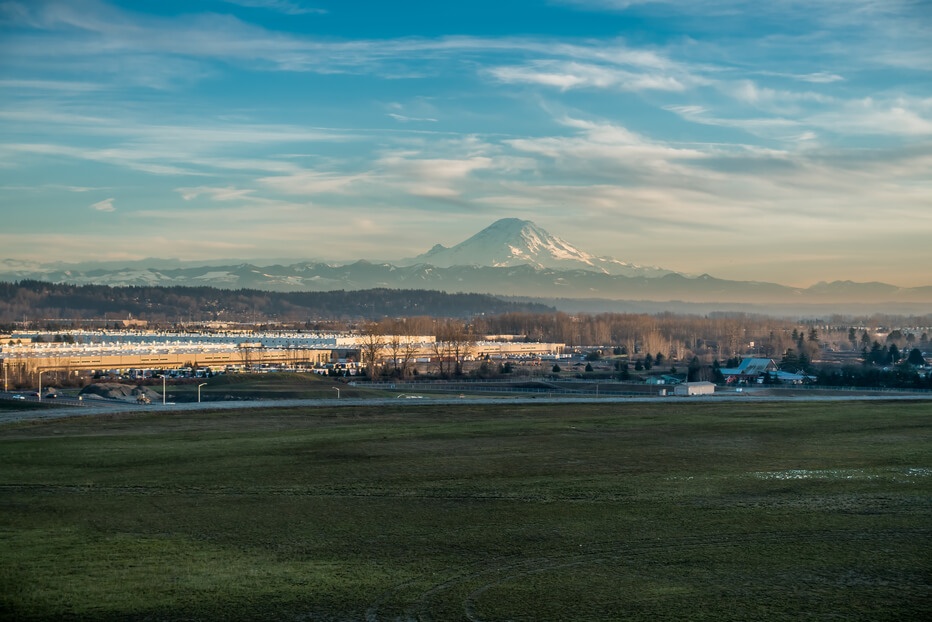
Within roughly a 90-minute drive southeast, Mount Rainier National Park offers one of the Pacific Northwest's most iconic outdoor experiences. The Paradise and Longmire areas showcase wildflower meadows, glaciers, and an extensive trail system, while Sunrise opens seasonally for high-country hiking. Closer to home, the Puget Sound waterfront in nearby Tacoma and Des Moines, the wineries of the Woodinville area to the north, and Seattle's downtown attractions are all within an easy day's reach, giving visitors plenty of reasons to use Kent as a launching point.
Kent makes a practical and appealing base for short-term rentals because of its central position in the Seattle-Tacoma corridor. Guests enjoy quick access to the airport, downtown Seattle, Tacoma's cultural institutions, and the Cascades, while staying in a quieter, more affordable community than the urban core. The combination of local amenities, transit connectivity, and proximity to both city attractions and major natural destinations gives the city a broad and steady year-round appeal.
Want to know if a property in Kent is a good investment?
Enter an address to get instant revenue potential and comps.