
Peacham, Vermont
Want to see how Peacham compares to other top cities in Vermont? Explore all city regulations in Vermont. →
Peacham, VT
Challenging To Investors
STR Regulations for Peacham, Vermont
Short-Term Rental Investor's Guide: Peacham, Vermont
1. Overview: Are Short-Term Rentals Allowed in Peacham, VT?
Explicit Answer: Yes, short-term rentals are allowed in Peacham, Vermont, primarily as "Bed & Breakfast" or "Inn" operations. However, their permissibility depends entirely on the zoning district in which the property is located.
The Zoning Regulations classify short-term lodging uses like Bed & Breakfast and Inn as either "Permitted Uses" (requiring site plan review) or "Conditional Uses" (requiring a permit from the Development Review Board - DRB) based on the specific district. It is crucial to determine the zoning district of your property as this dictates the initial approval pathway. Properties in districts where Bed & Breakfast and Inn are not listed as allowed uses (e.g., Shoreland Districts for new structures) are not permitted to operate an STR.
Key Districts and STR Status:
- Rural District (RD): Bed & Breakfast and Inn are listed as Permitted Uses (requiring site plan review).
- Village District (VD): Bed & Breakfast and Inn are listed as Permitted Uses (requiring site plan review).
- Agricultural Overlay (AO): Bed & Breakfast or Inn is listed as a Conditional Use (DRB approval required).
- Shoreland One (SL1) & Two (SL2): Lodging uses are not explicitly listed as allowed for new structures. Existing non-conforming lodging uses may be governed by non-conforming use provisions. New STRs are likely not permitted.
- Well Head Protection District Overlay (WH): Lodging uses are not listed as allowed.
2. How to Start a Short-Term Rental Business in Peacham
The process involves several steps, starting with confirming zoning compliance and ending with obtaining a Certificate of Occupancy.
Step 1: Determine Zoning District and Permissible Use
- Consult the official Zoning Map (available at the Peacham Town Clerk's office or online) to identify your property's district.
- Cross-reference the district's permitted or conditional uses (detailed in Section 3) to confirm that Bed & Breakfast or Inn is an allowed use. If it's a conditional use, be prepared for a public hearing before the DRB.
Step 2: Site Plan Review (Required for Permitted Uses in RD & VD)
- Submit a site plan application to the Development Review Board (DRB). The DRB review focuses on the compatibility of the use with the site, its design, traffic, parking, landscaping, etc. See Section 801 of the regulations.
Step 3: Conditional Use Review (Required for Conditional Uses in AO)
- Submit a conditional use application to the DRB. This process includes a public hearing. The DRB will evaluate the application against general standards (Section 802.1) and supplemental considerations (Section 802.2) to ensure the use will not have an undue adverse effect on the capacity of existing/planned development, the character of the affected area, or traffic on roads/highways.
Step 4: Zoning Permit Application
- After obtaining DRB approval (for site plan or conditional use), apply for a Zoning Permit from the Zoning Administrator. No zoning permit shall be issued for any use or structure other than one or two-unit dwellings and other exempted uses until DRB approval is granted.
Step 5: Compliance with On-Site Sewage Disposal Rules
- All new dwellings, including those used for lodging, must be served by a wastewater disposal system meeting Vermont Environmental Protection Rules standards. Submit plans with the zoning permit application (Section 407).
Step 6: Certificate of Occupancy
- Upon completion of construction and approvals, apply for a Certificate of Occupancy from the Zoning Administrator. This certificate states that the structure conforms to the zoning regulations and is lawful for its intended use (Section 508). Use or occupancy without this certificate is unlawful.
3. Required Documents, Permits, Licenses, and Guidelines
The specific documents required will vary based on whether your use is permitted or conditional and the nature of the project. The general requirements include:
- Zoning District Determination: Proof of zoning (e.g., a letter from the Zoning Administrator, map copy).
- Site Plan Application (for Permitted Uses - RD, VD): Requires submission of two sets of site plans per Section 801.2, including:
- Names and addresses of owner and adjoining properties.
- Survey of the land showing existing features (contours, structures, utilities, rights-of-way).
- Site plan showing proposed structures, location, roads, driveways, traffic, parking, and landscaping.
- Conditional Use Application (for Conditional Uses - AO): Requires a location and site plan map and a narrative description per Section 802. It also requires providing a list of all adjoining property owners.
- Zoning Permit Application: Application form and fees submitted to the Zoning Administrator after DRB approval.
- Wastewater System Plans: Plans meeting state standards must be submitted with the zoning permit application (Section 407).
- Vermont Project Review Sheet: The application must include this sheet, identifying all required state and federal permits. These permits must be obtained before a municipal permit can be issued (Section 507.1.2).
- Access Permit: If creating a new driveway or access road, an Access Permit from the town/state is required (Section 403.2).
- Certificate of Occupancy: Required after construction and before use (Section 508).
4. Specific Regulations for Short-Term Rentals in Peacham
While the primary regulation is the zoning district classification, the following specific rules apply:
A. Zoning Districts (Minimum Lot Size & Setbacks)
- Rural District (RD): Min. Lot: 2 acres, Min. Front Setback: 65 ft.
- Village District (VD): Min. Lot: 0.5 acres, Min. Front Setback: 40 ft.
- Agricultural Overlay (AO): Min. Lot: 2 acres. Subdivisions of 3+ lots require Planned Unit Development (PUD) approval. Development must not negatively impact agricultural operations, water resources, etc. (See Section 306 for full criteria).
- Shoreland Districts (SL1, SL2): Min. Lot: 1 acre (SL1) & 2 acres (SL2). Front setbacks are 100 ft from the mean water mark. All development must comply with the Vermont Shoreland Protection Act and Vermont Wastewater System & Potable Water Supply Rules. New lodging structures are not listed as permitted uses.
B. Accessory Dwelling Units (ADUs)
- An ADU is a separate, smaller dwelling unit on the same lot as a primary dwelling. If the ADU is to be used for short-term rental, it must be a legal, permitted use in the zoning district (Section 418).
C. Flood Hazard Regulations
- Properties located within Special Flood Hazard Areas or Fluvial Erosion Hazard Zones are subject to very strict regulations. New STR structures are prohibited in these zones (Section 505.3). Existing non-conforming structures may be improved, but only under specific conditions and with required approvals. It is imperative to confirm if your property is in a hazard area.
5. Contact Information for Local Authority
- Zoning Administrator (Permits & Applications):
- Contact the Peacham Town Clerk's Office for the current Zoning Administrator's information.
- Address: Peacham Town Clerk, 1164 Vermont Route 232, Peacham, VT 05862
- Phone: (802) 592-3273
- Email: [Contact via Town Clerk]
- Website: https://peacham.org/
- Development Review Board (DRB) (Hearings & Appeals):
- Applications and hearings are administered through the Town Clerk's Office.
- Address: Peacham Town Clerk, 1164 Vermont Route 232, Peacham, VT 05862
- Phone: (802) 592-3273
- Email: [Contact via Town Clerk]
- Website: https://peacham.org/
- Planning Commission: Involved in amendments and long-range planning; may be contacted for questions about the Town Plan.
- Address: Peacham Town Clerk, 1164 Vermont Route 232, Peacham, VT 05862
- Phone: (802) 592-3273
- Email: [Contact via Town Clerk]
- Website: https://peacham.org/
6. Source Pages & Important Links
The following link provides direct access to the primary regulatory document used for this analysis.
- Town of Peacham Zoning and Flood Hazard Regulations: https://peacham.org/wp-content/uploads/2024/03/Peacham-Zoning-Regs-A47-clean-2024-11-Jan.pdf
This PDF contains all the detailed zoning maps, district definitions, development standards, and procedural requirements outlined in this guide. Investors must review it thoroughly to ensure full compliance.
What do Airbnb hosts actually earn in Peacham?
Peacham hosts earn a median $19,372/year with $203 ADR and 48% occupancy.
Top performers pull in $27,735+ per year.
See the full Peacham market breakdownNext step
Found a property in Peacham?
Paste any address and get estimated revenue, cash-on-cash return, and comparable STR performance in under 5 minutes. 3 free analyses per day.
Free brief
Get the free Peacham STR Investment Brief
Revenue data, top neighborhoods, seasonal trends, and the key regulations for Peacham, Vermont in one email.
Peacham
Market Saturation Score
Photos of Peacham



Overview of Peacham
Peacham is a small town in Caledonia County in Vermont's remote Northeast Kingdom, with a year-round population of roughly 700 residents. It is best known for its remarkably preserved 19th-century village, frequently cited as one of the most photographed in New England, and it serves as a quiet gateway to the outdoor landscapes of Groton State Forest and the surrounding Green Mountains. The nearest major city is Burlington, about 70 miles to the southwest, while the larger regional hub of St. Johnsbury sits roughly 10 miles to the north.
Just a few miles south of Peacham lies Groton State Forest, a sprawling tract of approximately 26,000 acres of forest, ponds, and modest mountain peaks that anchors outdoor recreation in the area. The forest encompasses several state parks, including Ricker Pond and Kettle Pond, and offers hiking trails, swimming spots, and fall foliage drives. A drive of about 10 to 15 minutes from the village center opens up a full day of low-key New England wilderness.
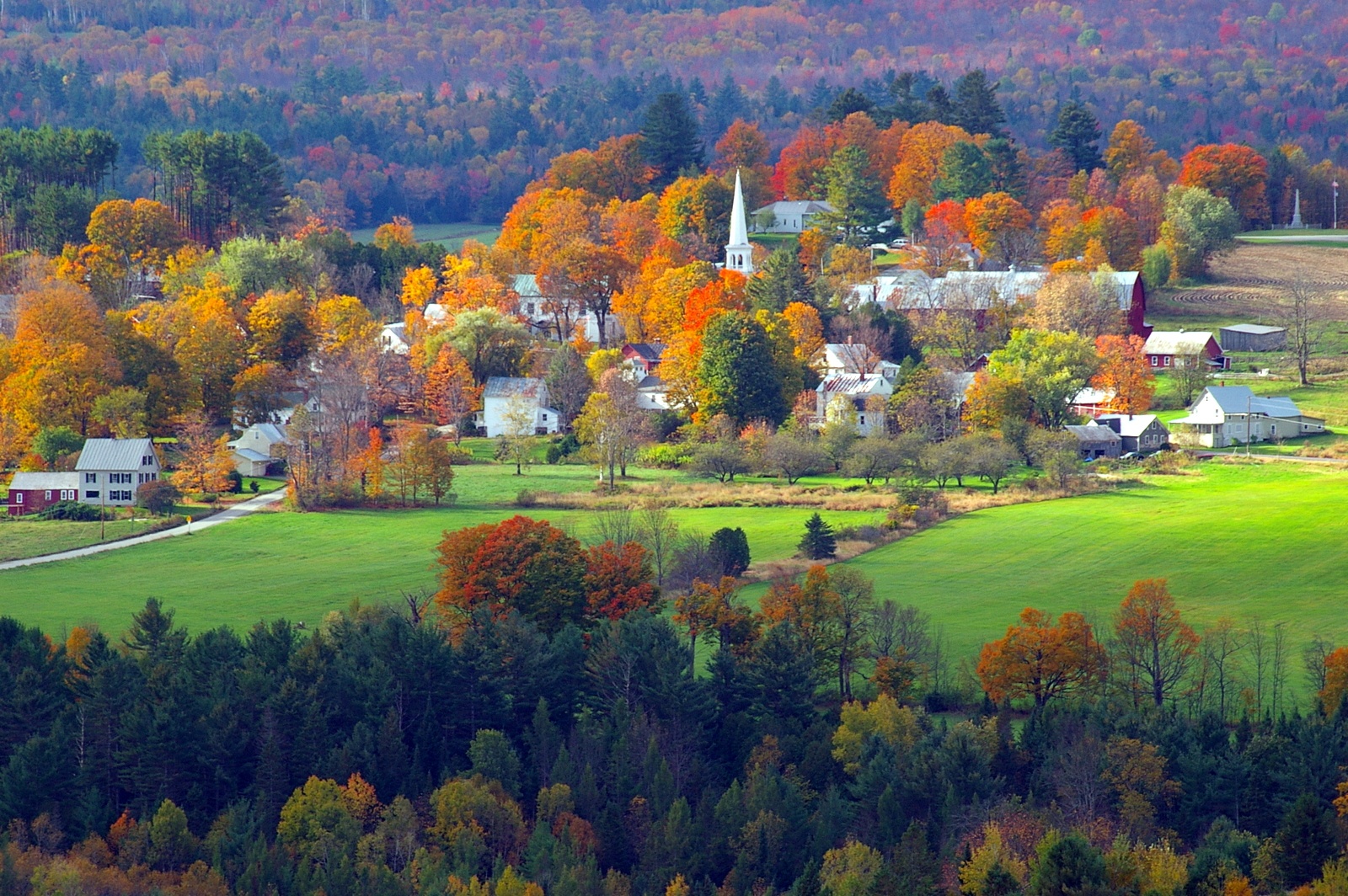
The village itself is a destination, with its white-steepled Congregational church, classic town common, and rows of historic homes giving it the feel of a living postcard. The Peacham Historic District is listed on the National Register of Historic Places, and visitors can spend an hour or two strolling the quiet streets and admiring the architecture amid the surrounding farmland and rolling hills. In winter, the snowy setting transforms the village into a classic New England scene.
About 15 minutes north of Peacham, the town of St. Johnsbury serves as the commercial and cultural hub of the Northeast Kingdom. It is home to the Fairbanks Museum, a natural-history institution housed in a striking Victorian-era building, and the adjacent St. Johnsbury Athenaeum, one of the country's few remaining private subscription libraries, with a gallery of American landscape paintings. The town's historic main street also offers restaurants, bookshops, and a small Vermont-focused food scene.
Roughly 20 minutes west of Peacham, the village of Cabot is home to the flagship store of the Cabot Creamery cooperative, where visitors can sample award-winning Vermont cheddars and watch cheese-making through viewing windows. The cooperative is owned by hundreds of regional farm families and remains a popular stop for travelers exploring the back roads of central Vermont.
Peacham appeals to short-term-rental
Want to know if a property in Peacham is a good investment?
Enter an address to get instant revenue potential and comps.