
Van Horn, Texas
Want to see how Van Horn compares to other top cities in Texas? Explore all city regulations in Texas. →
Van Horn, TX
Generally Investor Friendly
STR Regulations for Van Horn, Texas
Overview: Are Short‑Term Rentals Allowed in Van Horn, TX?
- Explicit answer: Yes, short‑term rentals are allowed in Van Horn, Texas. No city‑ or county‑specific STR ordinance was identified in the provided materials. As a result, operators must comply with state‑level requirements (primarily tax collection and remittance under the Texas Hotel Occupancy Tax regime) and any applicable federal, county, or municipal rules that may apply.
- Absence of localordinance language means Van Horn does not appear to regulate STRs through city licensing, registration caps, occupancy limits, or zoning‑based bans. Operators should nevertheless confirm with Van Horn city officials and Culberson County to ensure no local ordinances or HOA covenants affect STR use at a particular address.
- STRs must collect and remit the Texas Hotel Occupancy Tax (state 6%) plus any applicable local hotel occupancy tax (the typical local add‑on cited for similar small Texas jurisdictions is up to 7%, for a combined rate near 13%). This guide uses available evidence to present likely obligations and provides the verified sources.
How to Start a Short‑Term Rental Business in This Market
- Step 1: Site and Property Selection
- Verify the zoning or land use allows short‑term rentals of your intended type at the subject address. In the absence of a city STR ordinance, assume standard residential/commercial use rules apply, but confirm with the building/planning department before purchase.
- Review any homeowner association (HOA), condo association, or private covenants that could restrict rentals orSTR amenities; these are not in public code but can be binding and enforceable.
- Step 2: Tax Registration and Compliance
- Register with the Texas Comptroller’s office for Hotel Occupancy Tax (HOT). Short‑term rentals are subject to the state HOT (6%). Obtain a sales/use tax permit if needed and set up remittance.
- Determine the local HOT rate for Van Horn/Culberson County (evidence suggests a typical local add‑on up to 7%; operators should verify the current combined rate). Collect the combined rate from guests and remit per Comptroller guidance.
- Set up monthly or quarterly filing/payment cadence based on expected volume and the Comptroller’s thresholds; implement compliant invoicing and records retention.
- Step 3: Insurance and Risk Management
- Obtain a general liability policy appropriate for short‑term rentals (commonly $1M primary coverage) and property/umbrella coverage as applicable. Coordinate with any platform‑provided secondary liability if used.
- Confirm property conditions, utilities, and seasonal accessibility (especially in West Texas desert conditions).
- Step 4: Operations and Guest Management
- Provide a local or 24/7 contact for emergency response and guest issues; publish quiet hours, parking rules, maximum occupancy, and trash/recycling procedures.
- Equip the property with life‑safety items (e.g., working smoke detectors, fire extinguisher, carbon monoxide detectors as applicable).
- Maintain a detailed house manual and operating procedures for cleaning, turnover, and maintenance.
- Step 5: Platforms, Pricing, and Taxes
- Connect listings to major channels (Airbnb/VRBO, etc.). Build rates and availability with conservative assumptions to maintain availability and good review momentum.
- Ensure platform‑level tax settings match your Texas HOT obligations and your verified local rate. Reconcile monthly to avoid under/over‑remittance.
- Step 6: Ongoing Compliance and Renewals
- Monitor tax remittance deadlines and any rule changes at the city/county/state levels. Retain financial and booking records for at least four years.
Required Documents, Permits, Licenses, and Guidelines
- Documents and Registrations
- Texas Comptroller registration and tax account for Hotel Occupancy Tax (state 6%). Verify the local add‑on rate for Van Horn/Culberson County to arrive at a combined rate (evidence suggests typical up to 7%, implying ~13% combined). Source for state HOT: Texas Comptroller portal.
- Any local business/occupancy or tax registrations if city or county require them (not identified in provided sources).
- Property proof of ownership/lease authorization and insurance documentation (liability/property).
- Absentee host or authorized agent information if the operator resides out of state or out of county (as may be required by certain Texas local tax entities for audit and service of process).
- Permits and Inspections
- No Van Horn‑specific STR permits identified in the provided materials. In the absence of an STR ordinance, proceed under standard building, life safety, and residential use codes. Confirm with city/county building officials whether any inspections or certificates of occupancy are required for short‑term occupancy.
- Operational Guidelines
- Provide a local contact or 24/7 response capability; publish rules on occupancy limits, parking, and quiet hours to mitigate neighbor complaints.
- Comply with state fire and life safety codes for residential occupancies; equip with functional smoke and CO detectors, a fire extinguisher, and clear evacuation information.
- Collect and remit Texas state and local HOT; keep accurate guest‑night logs, rate records, and monthly reconciliations with platform reports. File and pay per Comptroller schedule.
- Best‑Practice Documentation
- House manual with Wi‑Fi, appliance instructions, trash schedules, and emergency contacts.
- Welcome information highlighting quiet hours, parking, and neighbor considerations.
Specific Regulations for Short‑Term Rentals in Van Horn (City), Culberson County (County), and Texas (State)
- City of Van Horn
- No city‑specific STR ordinance identified in the provided sources. Operators should treat STRs as permitted uses under standard residential or commercial land use rules, subject to taxes and general codes, unless city officials indicate otherwise.
- Verify zoning with the city building/planning department to avoid inadvertent conflicts with HOA covenants or deed restrictions.
- Culberson County
- No county‑specific STR ordinance identified in the provided sources. County development, health, and septic rules may affect use or occupancy; confirm any well/septic, floodplain, or driveway access constraints during due diligence.
- State of Texas
- Texas Hotel Occupancy Tax (6% state) applies to short‑term rentals; local add‑on taxes may apply. Collect, file, and remit per the Comptroller’s guidance.
- Municipalities in Texas commonly regulate STRs via local ordinances (e.g., registration, caps, inspection, zoning), but no Van Horn city ordinance was identified in the provided materials. If Van Horn later adopts rules, city code will control. Stay alert to state legislative developments related to STRs, as the Texas Legislature continues to consider policy reforms that could affect local authority.
Contact Information (Phone, Email, Website) for the Local Authority in Charge of STRs
- Texas State‑Level Tax Authority
- Texas Comptroller – Hotel Occupancy Tax
- Website: comptroller.texas.gov/taxes/hotel/
- Phone: Not provided in the content; contact via the Comptroller’s website for tax assistance.
- City of Van Horn (city hall/community development)
- Phone: Not provided in the content.
- Email: Not provided in the content.
- Website: Not provided in the content.
- Recommended action: Contact city hall to confirm zoning, any business/occupancy registrations, and whether any future STR ordinance is under consideration.
- Culberson County (county judge/commissioners court/assessment office)
- Phone: Not provided in the content.
- Email: Not provided in the content.
- Website: Not provided in the content.
- Recommended action: Contact the county to confirm the local Hotel Occupancy Tax rate applicable to STRs and any local permits or health requirements that may apply.
Important: Because the provided sources do not include city or county contact details, you must verify these with the local authorities before operating. Keep dated notes and copies of all correspondence and filings.
Links to Source Pages
- Texas Hotel & Lodging Association – STR Update 2018: texaslodging.com/short-term-rental-str-update-2018/
- Texas Comptroller – Hotel Occupancy Tax (state requirements): comptroller.texas.gov/taxes/hotel/
- RedAwning – Van, Texas STR Market Overview (contextual market overview only): www.redawning.com/pm/market-overview/van-texas
Notes and Practical Reminders
- Zoning confirmation is essential before acquisition. Even in the absence of a local STR ordinance, deed restrictions, HOA rules, or neighboring land uses can affect viability.
- Hotel Occupancy Tax compliance is mandatory and enforced. Maintain detailed records and reconcile platform remittance reports with your filings.
- Keep insurance current and appropriate for STR exposure; ensure life‑safety devices are installed and tested periodically.
- Maintain a professional guest communications plan, including clear house rules, to reduce complaints and preserve neighborhood goodwill.
- Because the provided content does not specify Van Horn’s exact local HOT rate or city/county contacts, you must verify the current rate and authorities prior to launching operations.
What do Airbnb hosts actually earn in Van Horn?
Van Horn hosts earn a median $4,896/year with $73 ADR and 40% occupancy.
Top performers pull in $9,188+ per year.
See the full Van Horn market breakdownNext step
Found a property in Van Horn?
Paste any address and get estimated revenue, cash-on-cash return, and comparable STR performance in under 5 minutes. 3 free analyses per day.
Free brief
Get the free Van Horn STR Investment Brief
Revenue data, top neighborhoods, seasonal trends, and the key regulations for Van Horn, Texas in one email.
Van Horn
Market Saturation Score
Photos of Van Horn


Overview of Van Horn
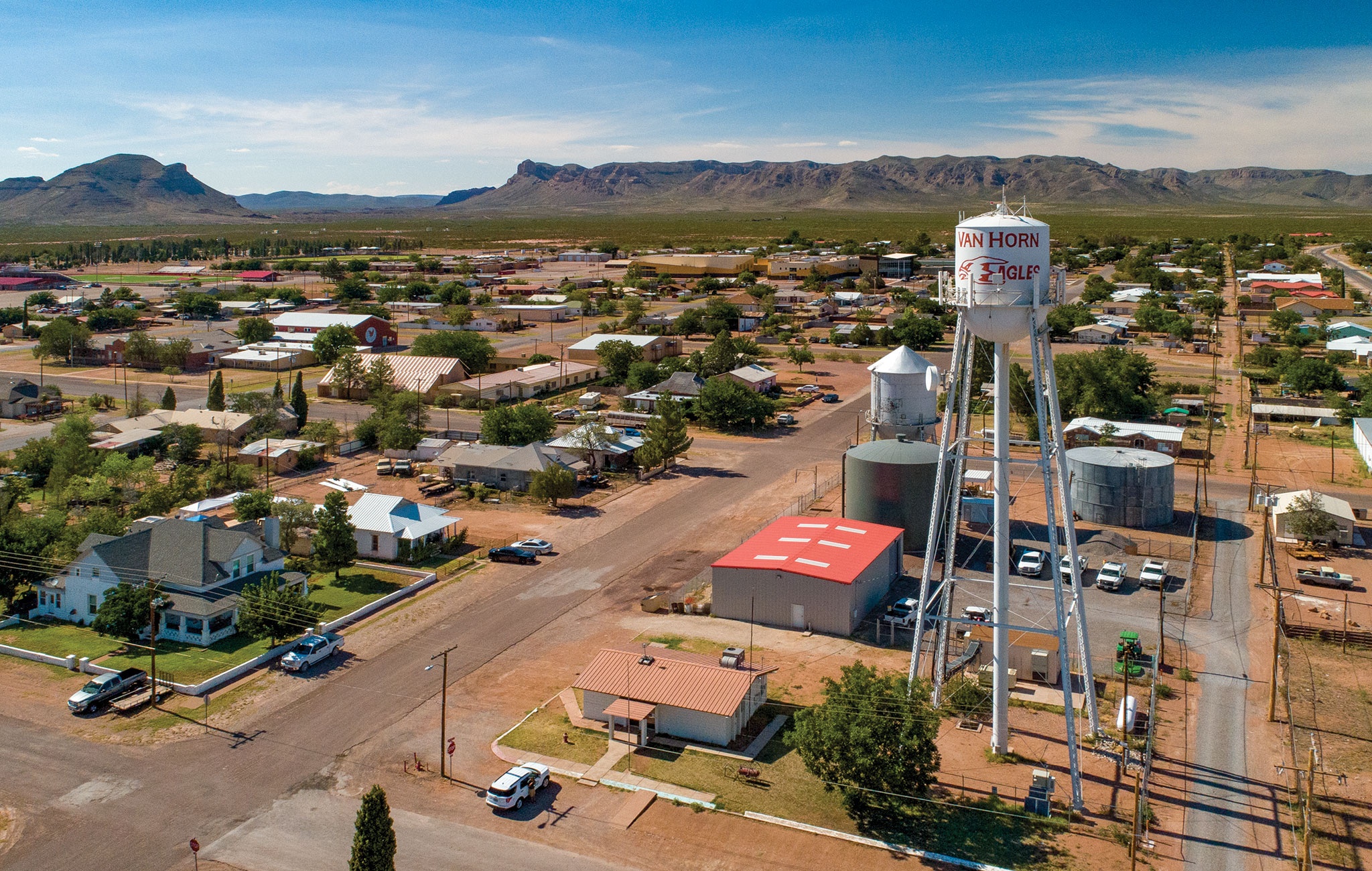
Van Horn is a small, high-desert town in far West Texas that serves as the seat of Culberson County. With a population of roughly 1,800, it has the feel of a quiet, sunbaked crossroads where Interstate 10 cuts through some of the most sparsely populated country in the state. The town is best known as the last major stop before travelers head northeast toward the mountains, and it has long served as a gateway to Guadalupe Mountains National Park and the wider Trans-Pecos region. El Paso, the nearest major city, lies about 120 miles to the northwest along I-10.
The marquee draw for any stay in Van Horn is Guadalupe Mountains National Park, a sprawling landscape of desert, canyon, and pine-clad peaks that includes Guadalupe Peak, the highest point in Texas at 8,749 feet. The park's Pine Springs Visitor Center sits roughly 60 miles northeast of town, an easy drive of just over an hour. Visitors come for the dramatic switchbacks of the Guadalupe Peak trail, the cool shade of McKittrick Canyon, and the relics of the old Butterfield Overland Mail stage route that once passed through the range.
Southeast of Van Horn, the rolling volcanic terrain of the Davis Mountains rises from the Chihuahuan Desert, offering a cooler, greener counterpoint to the lowlands. The range is anchored by Davis Mountains State Park and the nearby McDonald Observatory in Fort Davis, a world-renowned facility known for its public star parties and research telescopes. From Van Horn, the drive to Fort Davis is roughly 90 miles and takes around two hours along ranch-country highways.
To the north, across the New Mexico state line, Carlsbad Caverns National Park draws visitors into one of the most decorated cave systems in North America. The park's main entrance is approximately 140 miles from Van Horn, making it a longer day trip but a feasible one for guests who want to combine the Guadalupe Mountains with a stop at the caverns, or who are continuing on toward the Carlsbad area and beyond.
Van Horn's appeal for short-term rentals lies in its position at a literal crossroads of the American Southwest. Travelers heading to Guadalupe Peak, the Davis Mountains, or Carlsbad Caverns almost inevitably pass through town, and the limited lodging in the surrounding basin means there is consistent demand for well-located vacation homes. With its quiet streets, big desert skies, and easy access to three major national-park destinations, the town offers a rare combination of solitude and proximity to some of the most striking landscapes in the southern Rockies.
Want to know if a property in Van Horn is a good investment?
Enter an address to get instant revenue potential and comps.