
Charlestown, Rhode Island
Want to see how Charlestown compares to other top cities in Rhode Island? Explore all city regulations in Rhode Island. →
Charlestown, RI
Very Investor Friendly
STR Regulations for Charlestown, Rhode Island
Overview: Are Short-Term Rentals Allowed in Charlestown, RI?
Short-term rentals (STRs) are permitted in Charlestown, Rhode Island. State law governs STRs and explicitly prevents municipalities from prohibiting or banning the listing of residential units on third‑party hosting platforms. That means hosts can legally operate STRs in Charlestown, but they must comply with state registration, tax, and reporting requirements. Rhode Island’s STR regime is primarily state‑level; Charlestown does not appear to impose separate city‑specific licensing or bans under current state statutes. As an investor, this creates a single, statewide compliance pathway with predictable rules and centralized enforcement.
How to Start a Short‑Term Rental Business in Charlestown, RI
If you plan to list your property on a hosting platform (e.g., Airbnb, VRBO):
- Register your short‑term rental with the Rhode Island Department of Business Regulation (DBR). Hosting platforms that conduct business in Rhode Island are required by statute to list only registered properties; platform listings therefore hinge on DBR registration.
- Platforms typically handle registration reporting and tax collection/remittance under state statutes. You should verify that the platform has your DBR registration number on file and that your listing reflects accurate address and operational details.
- Consult DBR’s Real Estate Section for registration and operational guidance.
If you plan to rent independently (i.e., without using a hosting platform):
- Register your STR with DBR as above.
- Register with the Rhode Island Division of Taxation, obtain a sales tax permit (the standard annual fee is $10), and collect and remit the applicable sales and hotel taxes.
- Maintain records of rental activity, tax remittances, and guest receipts for audit and compliance purposes.
All STR operators should:
- Confirm local zoning does not prohibit transient lodging in your property’s zone (municipal land‑use controls may limit STRs, and state preemption is not universal on zoning). If in doubt, contact the Town of Charlestown Building/Zoning Department.
- Adhere to safety and health standards that apply to transient lodging (see statutory references below) and include an emergency information packet in the unit.
- Ensure accurate advertising that avoids deceptive claims and complies with platform policies and state consumer protection rules.
Required Documents, Permits, Licenses, and Guidelines
State-level documents and obligations:
- DBR Short‑Term Rental Registration
- Evidence: DBR registration number and confirmation on the state registry.
- How to apply: Via the state eLicensing portal.
- Purpose: Required for any STR listed on a hosting platform that conducts business in Rhode Island.
- Division of Taxation Business Registration and Sales Tax Permit
- Evidence: Sales tax permit and monthly/quarterly tax filings.
- How to obtain: Apply to the RI Division of Taxation; annual permit fee is $10.
- Purpose: Required for operators who advertise independently; platform‑mediated rentals often involve platform‑side tax collection, but you must confirm coverage and still register if advertising outside platforms.
- Tax Collection and Remittance
- Entire home/whole unit rentals: 8% total tax (7% state sales tax + 1% local hotel tax).
- Room rentals (30 days or fewer): 13% total tax (7% sales tax + 1% local hotel tax + 5% state hotel tax).
- Records: Retain guest logs, payment records, and tax remittance documents.
- Safety and Health Standards
- Posting: Clearly visible emergency information must be posted in the unit.
- Sanitation: Units must be thoroughly cleaned between stays; clean sheets, towels, and pillowcases must be provided for each rental.
- Detection: Functioning smoke detectors and carbon monoxide detectors are required; functioning fire extinguishers are recommended to meet safety expectations.
- Hosting Platform Compliance
- Platforms must register with the Division of Taxation, collect applicable taxes, and report STR listings as required by statute.
- Ensure your listing displays the DBR registration number, property address, and any required tax statements if the platform requires them.
Specific Regulations for Short‑Term Rentals (City, County, State)
State-level statutes and regulation:
- R.I. Gen. Laws § 42‑63.1‑2 (Definitions)
- Defines STRs and related terms (e.g., hosting platform, provider, offering residential units through a hosting platform).
- R.I. Gen. Laws § 42‑63.1‑14 (Offering residential units through a hosting platform)
- Requires registration with DBR for any STR property listed on third‑party hosting platforms that conduct business in Rhode Island.
- R.I. Gen. Laws § 42‑63.1‑14.1 (Properties listed on hosting platform websites)
- Provides additional platform‑related compliance obligations (e.g., registration and tax responsibilities).
- Rhode Island Regulation 230‑RICR‑30‑20‑4
- Implements state rules governing the administration and enforcement of STR registration and platform compliance.
- Rhode Island taxation and municipal revenue:
- STRs are taxed consistent with hospitality lodging rules; municipal tax rates cannot be independently changed by cities/towns without General Assembly approval.
- Municipalities receive portions of hotel tax revenues, including the 1% local hotel tax and a share of the state hotel tax, under the state’s distribution framework.
- Municipal constraints and local control:
- Rhode Island law restricts municipalities from banning the listing of housing units on STR platforms by property owners.
- Municipalities may regulate STRs in certain ways (e.g., through safety ordinances, land‑use/zoning, local permitting or reporting), but state law sets the baseline for platform‑mediated listings and taxation. If Charlestown has adopted local zoning rules that affect STRs (e.g., limiting STRs to certain zones or requiring local permits), property owners should confirm with the Town Building/Zoning Department.
Charlestown-specific notes:
- Based on the provided content, there is no evidence that Charlestown imposes a separate municipal STR registration, fee, or ban. State law governs registration and taxation, and municipalities cannot prohibit platform listings. Investors should verify with the Town of Charlestown whether any local zoning or building/fire code requirements apply to transient lodging.
Contact Information (Phone, Email, Website)
State agencies with STR oversight:
-
Department of Business Regulation (DBR) — Real Estate Section
- Online inquiry system: see DBR’s Online Inquiry System
- Email: DBR.REInquiry@dbr.ri.gov
- Phone: (401) 408‑1138 (Jorge Bannister)
- Short‑Term Rental Registration Portal: Rhode Island eLicensing
- STR Registry Lookup: STR Registration Lookup
- Office Address: 1511 Pontiac Avenue, Cranston, RI 02920
- Directions and contact details: DBR Directions & Contact
-
Rhode Island Division of Taxation
- Website: Rhode Island Division of Taxation
- Sales tax permit and business registration for independent operators; platform‑mediated tax collection typically occurs at the platform level.
-
Department of Business Regulation — Main Office
- Phone: (401) 462‑9500
- Address: 1511 Pontiac Avenue, Cranston, RI 02920
-
Town of Charlestown (for zoning/building/fire code verification)
- Building/Zoning Department (municipal contacts are not provided in the content; confirm via the town’s official website).
Links to Source Pages
- DBR Short‑Term Rentals (official guidance and registration portal): dbr.ri.gov/real-estate-and-commercial-licensing/short-term-rentals
- eLicensing Portal (apply/register): elicensing.ri.gov
- STR Registration Lookup: elicensing.ri.gov/Lookup/OnlineReportExecute.aspx?queryIdnt=1298
- R.I. Gen. Laws § 42‑63.1‑14: webserver.rilegislature.gov/Statutes/TITLE42/42-63.1/42-63.1-14_42-63.1-14.htm
- R.I. Gen. Laws § 42‑63.1‑14.1: webserver.rilegislature.gov/Statutes/TITLE42/42-63.1/42-63.1-14.1.htm
- Rhode Island Regulation 230‑RICR‑30‑20‑4: rules.sos.ri.gov/regulations/Part/230-30-20-4
- Rhode Island Division of Taxation (hospitality/STR tax information): tax.ri.gov
- DBR Contact/Directions: dbr.ri.gov/about-dbr/directions
- DBR Contact Page: dbr.ri.gov/about-dbr/contact-us
- URI Policy Analysis (contextual overview of STRs in Rhode Island, including municipal constraints and tax revenue): web.uri.edu/wp-content/uploads/sites/1611/Short-Term-Rentals-in-Rhode-Island-2018-Policy-Analysis.pdf
- AirROI Market Report (market analytics; regulation level noted as “High” for Charlestown): www.airroi.com/report/world/united-states/rhode-island/charlestown
Practical Compliance Checklist for Charlestown Investors
- Confirm property zoning allows transient lodging; resolve any local land‑use restrictions before listing.
- Register with DBR via the eLicensing portal and obtain a DBR registration number; ensure your platform listing includes the registration number and correct address.
- If advertising independently, register with the Division of Taxation, obtain the $10 sales tax permit, and collect/remit the applicable tax (8% for entire home rentals; 13% for room rentals).
- Post emergency information in the unit; ensure functioning smoke and carbon monoxide detectors; provide clean linens between stays; maintain sanitation standards.
- Retain records of bookings, guest counts, taxes collected and remitted, and any safety inspections for potential audits.
- Monitor DBR bulletins and FAQs for updates to STR rules, platform reporting requirements, and enforcement changes.
- Periodically confirm your listing’s compliance using the STR registry lookup tool and verify platform registration/tax collection settings for your property.
This guide provides a state‑centric compliance framework suitable for Charlestown investors. Because municipalities may adopt additional land‑use or safety measures, confirm zoning and building/fire requirements with the Town of Charlestown before listing.
What do Airbnb hosts actually earn in Charlestown?
Charlestown hosts earn a median $30,851/year with $419 ADR and 57% occupancy.
Top performers pull in $53,693+ per year.
See the full Charlestown market breakdownNext step
Found a property in Charlestown?
Paste any address and get estimated revenue, cash-on-cash return, and comparable STR performance in under 5 minutes. 3 free analyses per day.
Free brief
Get the free Charlestown STR Investment Brief
Revenue data, top neighborhoods, seasonal trends, and the key regulations for Charlestown, Rhode Island in one email.
Charlestown
Market Saturation Score
Photos of Charlestown
Overview of Charlestown
Charlestown is a coastal town in Washington County, Rhode Island, home to roughly 7,800 residents. It stretches along the state's southern shore in the heart of the South County region, where salt ponds, barrier beaches, and protected woodlands give it a quiet, outdoorsy feel. The town is best known as the mainland departure point for ferries to Block Island and for some of the most unspoiled oceanfront in southern New England. It lies approximately 40 miles south-southwest of Providence and roughly 90 miles from Boston.
At the center of Charlestown's outdoor appeal is the Ninigret National Wildlife Refuge, a roughly 900-acre preserve of salt marsh, freshwater ponds, and pine-oak forest that draws birders, hikers, and beachgoers year-round. The adjacent Ninigret Park hosts the Frosty Drew Nature Center and Observatory, where visitors can explore trails by day and look through telescopes on clear Friday nights. The complex sits only minutes from most Charlestown addresses.
A few miles inland, Burlingame State Park draws campers, paddlers, and freshwater swimmers to its wooded campground and Watchaug Pond. With hundreds of campsites and several miles of trails, it provides an affordable, nature-anchored alternative to the beach and is one of Rhode Island's most popular state-park destinations.
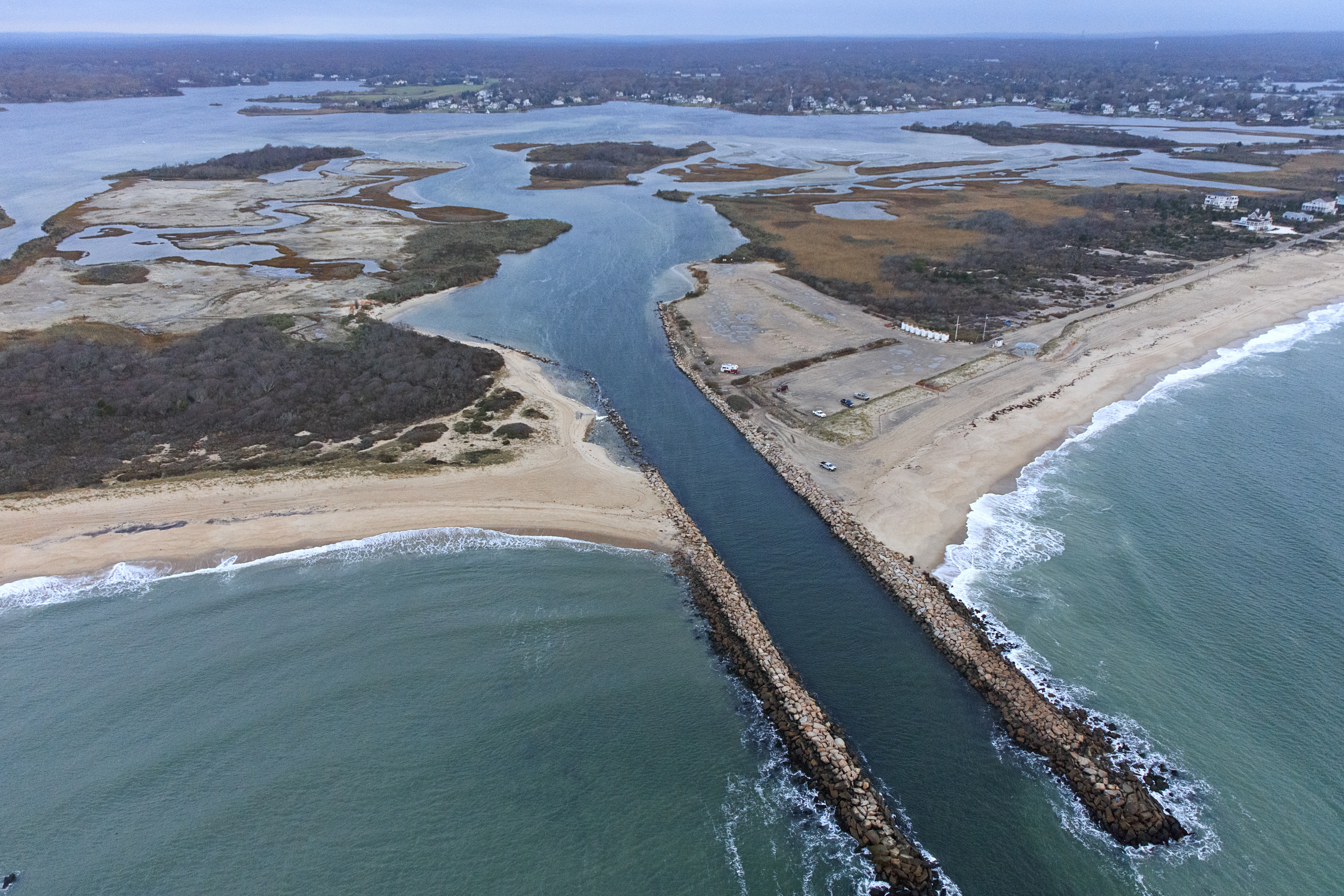
Charlestown's Atlantic-facing beaches — including the barrier-beach East Beach and the more accessible Charlestown Town Beach — are the town's biggest seasonal draw, with swimming, surfing, and quiet stretches that feel a world away from busier Rhode Island hotspots. At the western edge of town, the Charlestown Breachway doubles as a working jetty, a surf-fishing spot, and the dock for ferries to Block Island, putting day-tripping to the island within easy reach of any Charlestown address.
For a change of pace, the historic seaport of Mystic, Connecticut is roughly a 35-minute drive west, while the Victorian village of Watch Hill and Misquamicut State Beach sit just a few miles to the west in neighboring Westerly.
Charlestown appeals to short-term rental guests who want the Rhode Island coast without the crowds of Narragansett or Newport. Its combination of ferry access, refuge and state-park recreation, and proximity to Providence, Newport, the Connecticut border, and Block Island gives it a year-round mix of beach, nature, and day-trip appeal that suits couples, families, and quiet getaways alike.
Want to know if a property in Charlestown is a good investment?
Enter an address to get instant revenue potential and comps.