
Aibonito, Puerto Rico
Want to see how Aibonito compares to other top cities in Puerto Rico? Explore all city regulations in Puerto Rico. →
Aibonito, PR
Generally Investor Friendly
STR Regulations for Aibonito, Puerto Rico
Overview: Are Short‑Term Rentals Allowed in Aibonito?
Yes. Short‑term rentals (STRs)—rentals of less than 90 days—are allowed in Aibonito, Puerto Rico. Aibonito does not have city‑specific STR ordinances in place; therefore, operators must follow Commonwealth‑level rules and standard permitting and tax obligations. In short, STRs are permitted statewide subject to registration, licensing, and tax compliance, with enforcement primarily through the Puerto Rico Tourism Company (PRTC). (Sources: 1, 3, 4)
What do Airbnb hosts actually earn in Aibonito?
Aibonito hosts earn a median $16,177/year with $136 ADR and 43% occupancy.
Top performers pull in $28,964+ per year.
See the full Aibonito market breakdownStarting a Short‑Term Rental Business in Aibonito: Step‑by‑Step
- Plan the venture and property use
- Verify the property’s use designation (residential vs commercial) with the Office of Management and Permits (OGPe). In many cases, STRs are considered commercial activity and require a use permit. If you will rent more than 30% of a housing unit as an STR in a residential area, a commercial use permit is required. (Source: 4)
- Confirm zoning suitability with municipal planning/zoning authorities. (Source: 4)
- Formalize the business
- Form a legal entity (e.g., LLC) to separate personal and business liabilities. (Source: 1)
- Obtain Puerto Rico Merchant Registration (Registro de Comerciantes) from the Treasury Department. (Source: 1)
- Obtain required permits and registrations
- Apply for the Single Permit (Permiso Único) through OGPe, which consolidates the Use Permit with Fire, Sanitary, and Environmental Compliance certificates. (Source: 1; background context: 4)
- Register with the Puerto Rico Tourism Company (PRTC) as an innkeeper (hostelero). This is a legal requirement to operate STRs. (Source: 1; lodging regulation context: 4)
- Set up tax and compliance processes
- Establish procedures to collect and remit the 7% room occupancy tax on stays under 90 days; note that some platforms (e.g., Airbnb) may collect this tax on your behalf. Maintain accurate records. (Source: 1; Act 272–2003 context: 4)
- Insurance and risk management
- Secure host liability insurance and confirm your homeowners policy explicitly covers STR activities. (Source: 1)
- Launch and operate
- Prepare the property (safety equipment, signage, emergency information) and ensure someone is on call for guest services. (Source: 4)
- Optimize listing and operations: professional photography, detailed descriptions, prompt guest communication, and consistent cleanliness. (Source: 1)
- Monitor compliance: noise control, parking, and community rules to avoid disrupting the residential nature of the area. (Source: 4)
Note: Municipal oversight varies. Dorado and San Juan have local STR ordinances; Aibonito does not. Always reconfirm current requirements with PRTC and OGPe before opening. (Sources: 2, 4)
Required Documents, Permits, Licenses, and Guidelines
- Legal/financial
- Business formation documents (e.g., LLC operating agreement)
- Puerto Rico Merchant Registration Certificate (Registro de Comerciantes) (Source: 1)
- Permits and compliance
- OGPe Single Permit (Permiso Único) covering:
- Use Permit (for STR/commercial use)
- Fire Prevention Certificate
- Sanitary License
- Certification of Environmental Compliance (as applicable) (Source: 1)
- PRTC innkeeper registration (hostelero) and ongoing compliance with lodging regulations (Source: 1; 4)
- OGPe Single Permit (Permiso Único) covering:
- Operational standards (PRTC lodging rules)
- On‑call responsible person for guest services
- Fire extinguisher and safety signage
- Noise control and no disruption of residential character
- Parking requirements and community rule compliance (Source: 4)
- Financial
- Process to collect and remit 7% room occupancy tax (Source: 1; Act 272–2003 context: 4)
- Insurance
- Host liability coverage; ensure homeowners policy includes STR coverage (Source: 1)
Specific STR Regulations: City (Aibonito), County (PR), and State (PR)
- Aibonito (municipal)
- No city‑specific STR ordinance identified in the provided content; Aibonito appears in municipal listings but no local rules are cited. (Source: 2)
- Operators should confirm any municipal permits or business licenses with local authorities. (Source: 2)
- County‑equivalent (municipal examples for context)
- Dorado requires an annual license (fees starting at $1,000 depending on unit count and classification). (Source: 4)
- San Juan requires licensing (e.g., $100/year shared units, $500/year non‑shared units) and a municipal STR registry. (Source: 1; 4)
- Isabela has proposed licensing and restrictions; verify status before proceeding. (Source: 4)
- State of Puerto Rico (Commonwealth)
- Definition: STRs are “every facility, building or part of a building leased for a period of less than ninety (90) days, devoted to the lodging of people for pay.” (Act 272–2003) (Source: 4)
- PRTC lodging regulation 8856 requires registration as an innkeeper, routine inspections, on‑call services, noise/parking controls, and prohibits disrupting residential community character. (Source: 4)
- Occupancy (room) tax: 7% on rentals under 90 days; PRTC oversees enforcement and collection. Platforms may remit on your behalf; verify processes. (Source: 1; 4)
- Use and permitting: STRs are considered commercial; if more than 30% of a housing unit is used for STR in a residential area, a commercial use permit is required. (Source: 4)
- Condominiums: The Condominium Act (Act 129–2020) allows prohibition or restriction of STRs in master deeds/bylaws; owners’ councils can regulate STR operations. (Source: 4)
- Proposed legislation: Multiple bills (e.g., HB 1557, HB 1446) aim to refine oversight, licensing, registries, and municipal roles; none is shown as enacted in the provided content—monitor updates. (Source: 4)
Contact Information: Local Authority in Charge of STRs (PRTC)
- Puerto Rico Tourism Company (PRTC)
- Phone: (787) 721‑2400 (main) (Source: 1)
- Website: discoverpuertorico.com (Source: 1; 4)
- OGPe (Office of Management and Permits)
- Phone: (787) 765‑2929 (general information) (Source: 1; permitting context)
- Aibonito Municipality
- No STR‑specific office or contacts are provided in the content. Operators should contact the municipal planning/permits office for local confirmation. (Source: 2)
Links to Source Pages
- Short‑Term Rentals in PR: Regulations and Tips (Christie’s International Real Estate PR): christiesrealestatepr.com/blog/short-term-rentals-pr-real-estate (Source: 1)
- Lodge Compliance – Puerto Rico page (municipal links, including Aibonito): www.lodgecompliance.com/states/puerto-rico (Source: 2)
- PR Real Estate FB Group Post (general reference): www.facebook.com/groups/prrealestate/posts/4144592055801166/ (Source: 3)
- Hispanic Federation Report (STR policy, definitions, PRTC Reg. 8856, proposed legislation, municipal examples): www.hispanicfederation.org/images/pdf/REPORT_Short-Term-Rentals_v1.pdf (Source: 4)
Practical Investor Checklist for Aibonito
- Verify zoning/use with OGPe; obtain Single Permit if STR is considered commercial use
- Register as an innkeeper with PRTC; confirm tax collection/remittance processes
- Obtain Merchant Registration from PR Treasury
- Implement PRTC lodging standards: safety equipment, on‑call contact, noise/parking controls
- Secure appropriate insurance (host liability + homeowners policy endorsement)
- Maintain records for taxes and inspections; review municipal requirements if/when Aibonito adopts local rules
If you are evaluating multiple municipalities, note that Dorado and San Juan have established municipal STR regimes with fees and registries; Aibonito does not. (Sources: 1, 4)
Next step
Found a property in Aibonito?
Paste any address and get estimated revenue, cash-on-cash return, and comparable STR performance in under 5 minutes. 3 free analyses per day.
Free brief
Get the free Aibonito STR Investment Brief
Revenue data, top neighborhoods, seasonal trends, and the key regulations for Aibonito, Puerto Rico in one email.
Aibonito
Market Saturation Score
Photos of Aibonito



Overview of Aibonito
Aibonito is a small mountain municipality nestled in the central Cordillera Central of Puerto Rico, a US territory in the Caribbean. Often called the "Ciudad de las Flores" or City of the Flowers, the town sits at one of the highest elevations on the island, giving it a noticeably cooler climate than the coastal areas. With a population of roughly 25,000 residents, Aibonito has the relaxed pace of a traditional Puerto Rican mountain town, where flower-filled balconies, narrow streets, and panoramic mountain views define daily life. It is best known for hosting one of the Caribbean's most colorful annual flower festivals and serves as a gateway to the forested highland region of the island's interior. The nearest major city is San Juan, located approximately 50 miles to the north, with typical drive times of around an hour and a half depending on traffic and mountain road conditions.
Just a short drive southwest of Aibonito lies Toro Negro State Forest, a sprawling protected area in the central mountains that draws hikers, birdwatchers, and nature lovers. Within its boundaries rises Cerro de Punta, the highest peak in Puerto Rico, along with waterfalls, picnic areas, and cool trails through dense cloud forest. The forest is roughly 20 to 30 minutes from Aibonito by car, making it a popular day trip for visitors staying in the area. Cooler temperatures and frequent mist give the forest a distinctive atmosphere compared to the rest of the island.
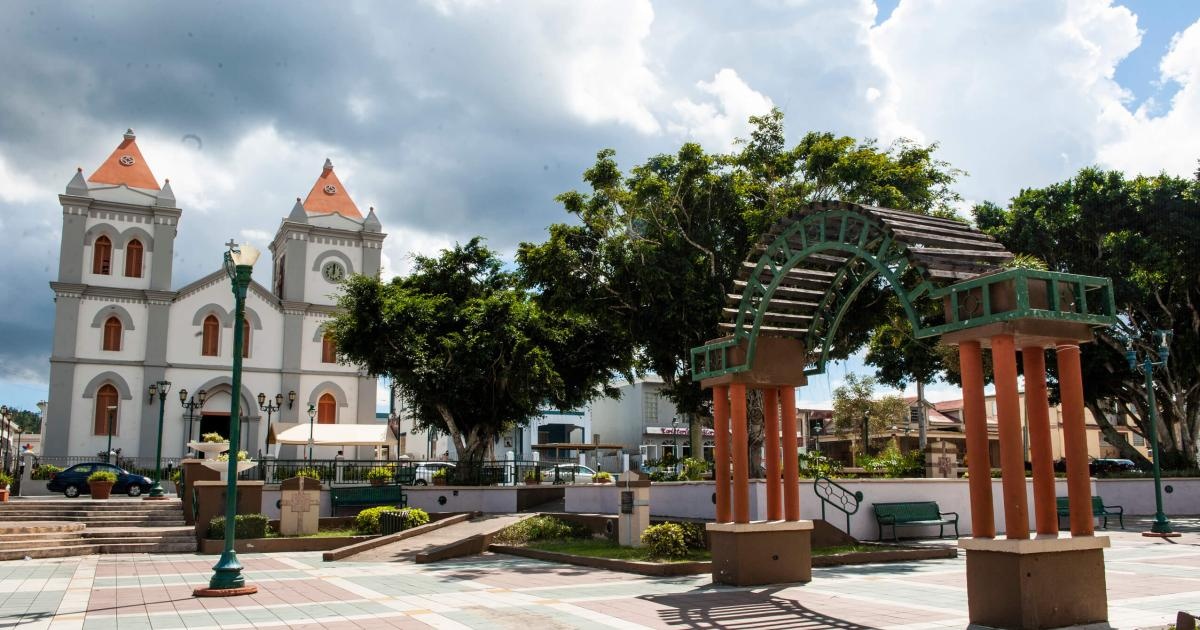
Aibonito's most celebrated tradition is the Festival de las Flowers, an annual celebration typically held in late June or early July that transforms the town with elaborate flower displays, parades, live music, and artisan markets. The festival draws visitors from across Puerto Rico and beyond, making it one of the busiest and most festive periods of the year. Outside of the festival dates, the town's historic central plaza remains a charming gathering spot, surrounded by traditional Spanish colonial-style buildings, small churches, and family-run eateries that showcase Puerto Rican mountain cuisine, including mofongo and locally grown coffee.
Aibonito's appeal as a short-term-rental base lies in its combination of cool mountain weather, authentic small-town character, and proximity to some of the island's most striking natural landscapes. Guests can spend their mornings exploring pine-scented trails and waterfalls in the surrounding state forests, their afternoons wandering the flower-lined streets of town, and their evenings enjoying a quieter, more traditional side of Puerto Rico that feels far removed from the busier coastal resort areas. For travelers seeking a slower, scenic, and culturally rich alternative to beach destinations, Aibonito offers a refreshing highland experience with San Juan, the coast, and the island's central mountains all within easy reach.
Want to know if a property in Aibonito is a good investment?
Enter an address to get instant revenue potential and comps.