
Brownsville, Oregon
Want to see how Brownsville compares to other top cities in Oregon? Explore all city regulations in Oregon. →
Brownsville, OR
Very Investor Friendly
STR Regulations for Brownsville, Oregon
Yes, short-term rentals (STRs) are allowed in Brownsville, Oregon. Brownsville is a small city in Linn County; there are no city-specific STR ordinances or licensing rules provided in the referenced content. As a result, operations are governed by Oregon’s statewide framework and county-level transient room taxes. All STR operators in Brownsville should plan to: register for and remit state/local transient room taxes, comply with Oregon building/safety codes (e.g., smoke/CO detectors, emergency egress, fire extinguishers), and track local updates (Linn County and city). The practical implication: no city STR license is listed here, but state tax compliance and safety codes are mandatory; verify any county or state agency registration details and tax rates before launch.
How to Start a Short-Term Rental Business in Brownsville, OR
Start with due diligence and compliance scaffolding before listing:
- Confirm zoning suitability: Check with Linn County and Brownsville City that the property can be used for overnight lodging. If the property is in a residential area, confirm there are no neighborhood-specific rules or CC&R constraints that would prohibit STRs.
- Align with Oregon building/safety codes: Install and maintain functional smoke alarms in every sleeping room and in adjacent common areas; carbon monoxide alarms outside sleeping areas if fuel-burning appliances or attached garages are present; at least one 2A:10BC fire extinguisher on each level; keep clear emergency egress from sleeping rooms; post emergency contact and evacuation information inside the unit.
- Establish tax registration: Oregon imposes a state transient room tax (TRT) of 1.5%; Linn County imposes an additional 5% TRT, for a combined county TRT of 5% (you will remit only the county rate if you register with the county tax administrator). Register with the Oregon Department of Revenue if required (for state-level tax accounts) and with Linn County for county TRT. If you use a platform (e.g., Airbnb, Vrbo), ask whether the platform will collect and remit taxes on your behalf and whether you remain responsible for any underreported amounts.
- Prepare records: Maintain a logbook of reservations, nightly rates, guests, dates, and gross receipts; retain receipts for all STR-related expenses (utilities, furnishings, cleaning, maintenance) for tax reporting and Oregon subtraction documentation. Separately track local taxes collected versus remitted.
- Tenant screening and policies: If renting part of your home, implement a guest screening process; establish house rules covering occupancy, noise, parking, parties/events, smoking, and safety to reduce nuisance risk.
- Insurance: Obtain short-term rental insurance (general liability and property coverage) with appropriate limits and exclusions. The provided sources did not specify a minimum coverage level, but sufficient liability coverage is strongly recommended.
- Launch operations: Finalize a professional listing with accurate photos, amenities, and house rules; publish occupancy limits and floor plan; make safety information visible; and add the required tax registration information to your listing (as applicable).
What do Airbnb hosts actually earn in Brownsville?
Brownsville hosts earn a median $19,622/year with $176 ADR and 43% occupancy.
Top performers pull in $25,064+ per year.
See the full Brownsville market breakdownRequired Documents, Permits, Licenses, and Guidelines
This section is limited to what is explicitly present in the referenced materials for Oregon/Brownsville. The sources do not list city-specific STR permits or licenses in Brownsville, nor the exact state registration forms or uniform county paperwork. Plan to prepare the following (confirm the exact forms with agencies):
- Personal identification and property ownership documentation (for tax registration).
- A written safety plan and emergency information posted inside the STR unit (Oregon building/safety code best practice).
- Fire extinguisher location and maintenance records; smoke and CO alarm installation and testing records (Oregon building/safety code best practice).
- Guest ledger/records of stays and gross receipts for tax reporting.
- Business expense records for Oregon subtraction (e.g., furnishings, utilities, cleaning, maintenance, HOA fees).
- Transient room tax registrations/accounts: (1) Oregon Department of Revenue (state TRT) if applicable; (2) Linn County tax administrator (county TRT). Contact details are provided below.
- Evidence of STR insurance policy (general liability and property coverage).
Note: The National League of Cities guide suggests permit/licensing and enforcement frameworks used by many cities. While Brownsville-specific permits aren’t listed here, these are common requirements elsewhere and should be considered if city or county policies later change.
Specific Regulations for Short-Term Rentals (City, County, and State)
City-level (Brownsville, OR): The provided materials do not include city-specific STR rules, licensing, occupancy caps, or rental day limits. Investors should confirm there are no newly enacted city restrictions before launch.
County-level (Linn County, OR): The sources include the Linn County transient room tax rate of 5% that applies to lodging stays under 30 days. Counties in Oregon administer and collect TRT; operators typically register with the county tax administrator to remit the county rate.
State-level (Oregon):
- State transient room tax of 1.5% applies to gross receipts for transient lodging (lodging under 30 days). Operators register with the Oregon Department of Revenue as required and remit this tax.
- Building/safety code obligations commonly include smoke alarms, CO alarms, fire extinguisher(s), and emergency egress considerations.
- Oregon allows a subtraction for certain STR expenses on state income tax returns if specific recordkeeping and reporting standards are met; keep detailed records of qualifying expenses.
- If you collect a deposit, Oregon’s Residential Landlord-Tenant Act (ORS Chapter 90) does not govern “transient lodging,” but local or state consumer protection rules may still apply. Refunds of deposits should follow reasonable, documented policies consistent with state law and industry norms.
General safety and conduct best practice: Keep noise at reasonable levels; prohibit disruptive events; enforce parking and occupancy rules; post house rules and emergency information. Violations can trigger local nuisance enforcement even without a city-specific STR ordinance.
Taxes
You are responsible for collecting and remitting:
- Oregon state transient room tax (TRT) at 1.5% of gross receipts for transient lodging.
- Linn County TRT at 5% of gross receipts (note: county rates apply and replace the state portion; confirm with the county administrator exactly how to remit and what forms you will use).
- Federal and state income taxes on STR net income; maintain meticulous records. Oregon may allow a subtraction for certain STR operating expenses; consult Oregon Department of Revenue guidance.
Keep separate records for tax collected versus tax due; reconcile monthly and remit on the schedule set by the agency (county and/or state).
Contact Information
Use the agencies below to verify tax rates, registration steps, and any local updates. Where a website was not provided in the source material, the most authoritative phone contact is listed.
- Oregon Department of Revenue (state TRT questions): 1-800-356-4222
- Linn County Tax Office (county TRT): 541-967-7829 (the most authoritative contact listed in the source; confirm remit schedule and forms with this office)
- City of Brownsville (zoning/land-use questions): 541-466-5666
- Brownsville Rural Fire Protection District (fire safety standards): 541-466-5277
Important: Rates, forms, and filing frequency can change. Confirm before filing.
Source Pages
The analysis reflects only the information present in the references you provided. If official Brownsville or Linn County STR pages exist beyond the provided materials (e.g., permitting, local taxes, code specifics), obtain those links directly from the city or county before making final operational or investment decisions.
Next step
Found a property in Brownsville?
Paste any address and get estimated revenue, cash-on-cash return, and comparable STR performance in under 5 minutes. 3 free analyses per day.
Free brief
Get the free Brownsville STR Investment Brief
Revenue data, top neighborhoods, seasonal trends, and the key regulations for Brownsville, Oregon in one email.
Brownsville
Market Saturation Score
Photos of Brownsville


Overview of Brownsville
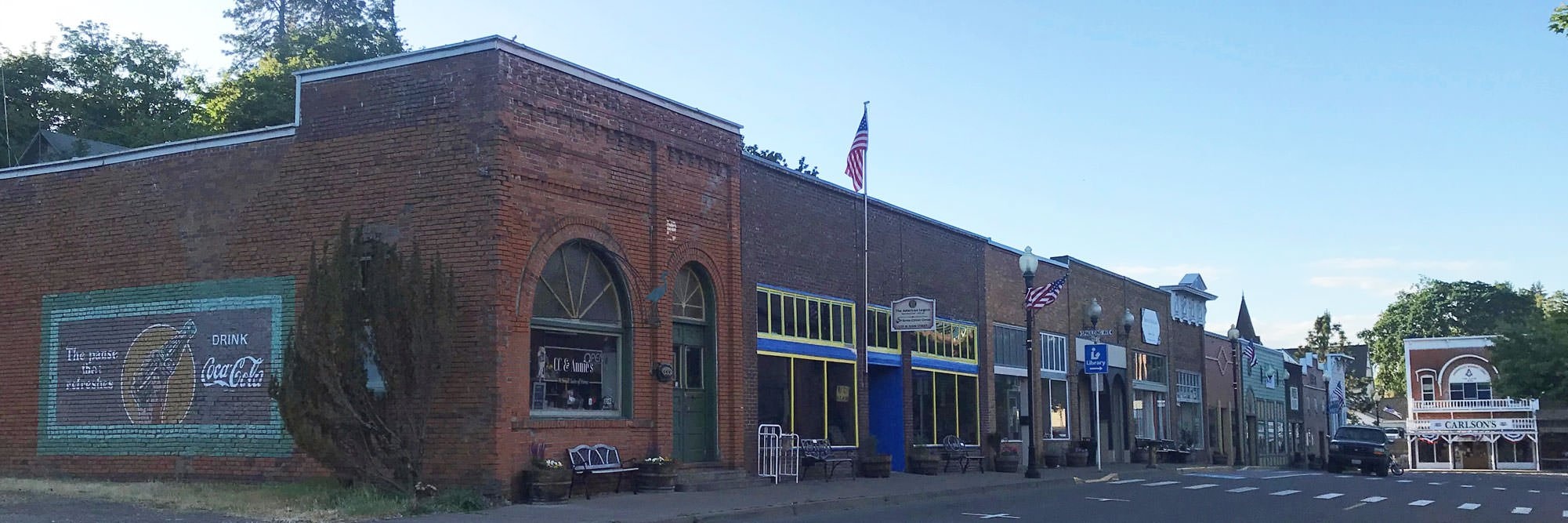
Brownsville is a small city in Linn County, Oregon, situated in the rolling farmland of the southern Willamette Valley along the Calapooia River. With a population of roughly 1,600 residents, it has the feel of a quiet, historic mill town surrounded by open country, pastures, and forested hills. Brownsville is best known for serving as one of the principal filming locations for the 1986 film "Stand By Me," and it sits at the eastern edge of the Willamette Valley, making it a convenient jumping-off point for trips into the Cascade Range. The city lies approximately 100 miles south of Portland and about 20 miles northeast of Eugene, placing it within easy reach of two of Oregon's larger urban centers while retaining a distinctly rural atmosphere.
Just east of town, Foster Reservoir (also called Foster Lake) stretches along the South Santiam River and offers boating, fishing, swimming, and lakeside camping in a quiet, evergreen-fringed setting. The reservoir is a popular warm-weather destination for families and anglers from across the Willamette Valley, and it sits only about 10 minutes from downtown Brownsville, making it a natural day-trip option for visitors staying in the area.
A short drive to the east brings travelers into the foothills of the Cascades and to McDowell Creek Falls County Park, a Linn County-managed preserve known for its series of scenic waterfalls tucked into a mossy old-growth canyon. Hiking trails wind past several named falls, and the park is a favorite for picnicking and easy walks, typically reached in roughly 20 to 25 minutes from Brownsville.
To the west, the city of Corvallis and the larger college town of Eugene offer a change of pace, with Corvallis roughly 30 minutes away and Eugene about 25 minutes southwest. Both provide a wider range of restaurants, breweries, museums, and university events, and Eugene's extensive park system along the Willamette River gives visitors another easy complement to a stay in Brownsville.
Brownsville's appeal for short-term rental investors lies in this blend of small-town quiet, cinematic heritage, and access to a wide range of outdoor and urban experiences. Visitors can spend their mornings exploring waterfalls and lakes in the Cascades, their afternoons wandering the rural streets that doubled as a 1950s Oregon town on film, and their evenings taking a short drive into Eugene or Corvallis for dining and entertainment. That combination of seclusion, scenery, and proximity makes the city a comfortable and distinctive base for travelers looking to experience the less-traveled side of central Oregon.
Want to know if a property in Brownsville is a good investment?
Enter an address to get instant revenue potential and comps.