
Utica, New York
Want to see how Utica compares to other top cities in New York? Explore all city regulations in New York. →
Utica, NY
Generally Investor Friendly
STR Regulations for Utica, New York
Overview: STR Status in Utica, NY
Short-term rentals ARE allowed in Utica, NY. However, they require special approval and must comply with a multi-layered regulatory framework involving city zoning requirements, county registry and taxation, and state registration mandates. The city defines short-term rentals as "the rental or lease of any dwelling unit or dwelling, for a period of 30 days or less, to one entity," with a specific exclusion for motels, hotels, inns, and bed and breakfasts.
What do Airbnb hosts actually earn in Utica?
Utica hosts earn a median $22,140/year with $147 ADR and 59% occupancy.
Top performers pull in $34,700+ per year.
See the full Utica market breakdownHow to Start a Short-Term Rental Business in Utica
Step-by-Step Process
-
Property Acquisition & Zoning Verification
- Identify a suitable property and verify zoning compliance
- Confirm the property is in an appropriate zone for STR operations
- Review any homeowner association (HOA) restrictions that may apply
-
Special Use Permit Application
- Submit an application to the City of Utica Planning Board
- Prepare site plan documentation
- Attend required public hearing
- Pay applicable fees and provide supporting documentation
-
State Registration
- Register with the New York State Department of State (DOS) registry (required starting around March 2025)
- Obtain registration number for your STR unit
-
County Registration & Tax Compliance
- Register with Oneida County's STR registry (effective January 1, 2026)
- Prepare for 5% occupancy tax collection and remittance
- Understand enforcement and penalty structure
-
Ongoing Compliance
- Maintain accurate records
- Submit required reports and taxes
- Renew registrations as required
Required Documents, Permits, Licenses, and Guidelines
City-Level Requirements (Utica)
- Special Use Permit (required for STR operation)
- Site Plan Approval
- Zoning Compliance Documentation
- Public Hearing Participation
County-Level Requirements (Oneida County)
- STR Registry Registration (effective Jan 1, 2026)
- Two-year registration period (renewable)
- 5% Occupancy Tax Collection (hosts responsible for compliance)
- Booking Service Agreements (to ensure tax collection)
State-Level Requirements (New York)
- State STR Registry (effective March 2025)
- Registration Number (required for listing)
- Tax Collection & Remittance (for booking services)
- Data Reporting (monthly/quarterly submissions)
Specific Regulations
City of Utica Zoning Requirements
- Allowed Zoning Districts: STRs are permitted in Residential Mixed (RM), Central Business District (CBD), and Urban Mixed Use (UMU) zones
- Special Use Permit Process: Required under City Zoning Code Section 2-29-125(a) and (b)
- Public Hearing: Mandatory for permit approval
- Definition: Properties rented for 30 days or less to one entity (excludes hotels, motels, inns, bed and breakfasts)
Oneida County Regulations
- Registration Requirement: All STR units must be registered
- Tax Rate: 5% occupancy tax (extends existing hotel tax to STRs)
- Registration Duration: Two-year registration period
- Effective Date: January 1, 2026
- Penalty Structure:
- First and second violations: Warning notices
- Third violation: Up to $200 fine
- Subsequent violations: $500 per day
- Revenue Projections: Estimated $800,000 annually in new tax revenue
New York State Regulations
- Statewide Registry: First-in-the-nation registration system
- Registration Deadline: Around March 25, 2025
- Tax Classification: STRs classified as "hotels" for tax purposes
- Booking Service Requirements: Must verify registrations, collect taxes, provide monthly/quarterly data reports
- Data Sharing: Required reporting of registration numbers, property locations, occupancy details, and guest counts
- Enforcement Authority: Cities, towns, villages, hamlets, and Attorney General have explicit enforcement powers
Contact Information for Local Authority
City of Utica
Planning Board
- Phone: Contact through main City Hall: (315) 733-2121
- Website: City of Utica Planning
- Meeting Location: Common Council Chambers
- Regular Meetings: Planning Board meetings as scheduled
Codes Department
- Phone: (315) 733-2121
- Website: City Codes Department
- Permit Information: Available through Codes Department
Oneida County
Commissioner of Finance
- Registry Administration: Established by County Commissioner of Finance
- Website: Contact through Oneida County government
- Effective Registry Date: January 1, 2026
New York State
Department of State (DOS)
- STR Registry: Registration required starting March 2025
- Website: Available through NY State DOS portal
- Registration Portal: To be established by DOS
Links to Source Pages
Primary Sources
- City of Utica Planning Board Meeting (Jan 18, 2024)
- Oneida County STR Registry and Bed Tax Article
- New York State STR Regulations
Municipal Resources
County Resources
- Oneida County official website (contact for registry details)
- Oneida County Board of Legislators meeting minutes
Important Considerations for STR Investors
Timeline Compliance
- March 2025: State registry requirement begins
- January 1, 2026: County registry and 5% tax take effect
- Ongoing: City special use permit requirements remain in effect
Market Considerations
- Tourism Drivers: Boilermaker Road Race, Utica University Nexus Center events, Adirondack Bank Center activities, Turning Stone Resort events
- Economic Impact: $2.1 billion in direct visitor spending in Oneida County in 2024
- Competition: Traditional hotel market alongside growing STR market
Legal Compliance Strategy
- Secure city special use permit first
- Prepare for state registration requirements
- Budget for county 5% occupancy tax
- Maintain detailed records for multi-jurisdictional compliance
- Consider legal counsel familiar with multi-level STR regulations
This regulatory environment represents a complex but navigable landscape for STR investors, requiring careful attention to timing and compliance across city, county, and state jurisdictions.
Next step
Found a property in Utica?
Paste any address and get estimated revenue, cash-on-cash return, and comparable STR performance in under 5 minutes. 3 free analyses per day.
Free brief
Get the free Utica STR Investment Brief
Revenue data, top neighborhoods, seasonal trends, and the key regulations for Utica, New York in one email.
Utica
Market Saturation Score
Photos of Utica


Overview of Utica
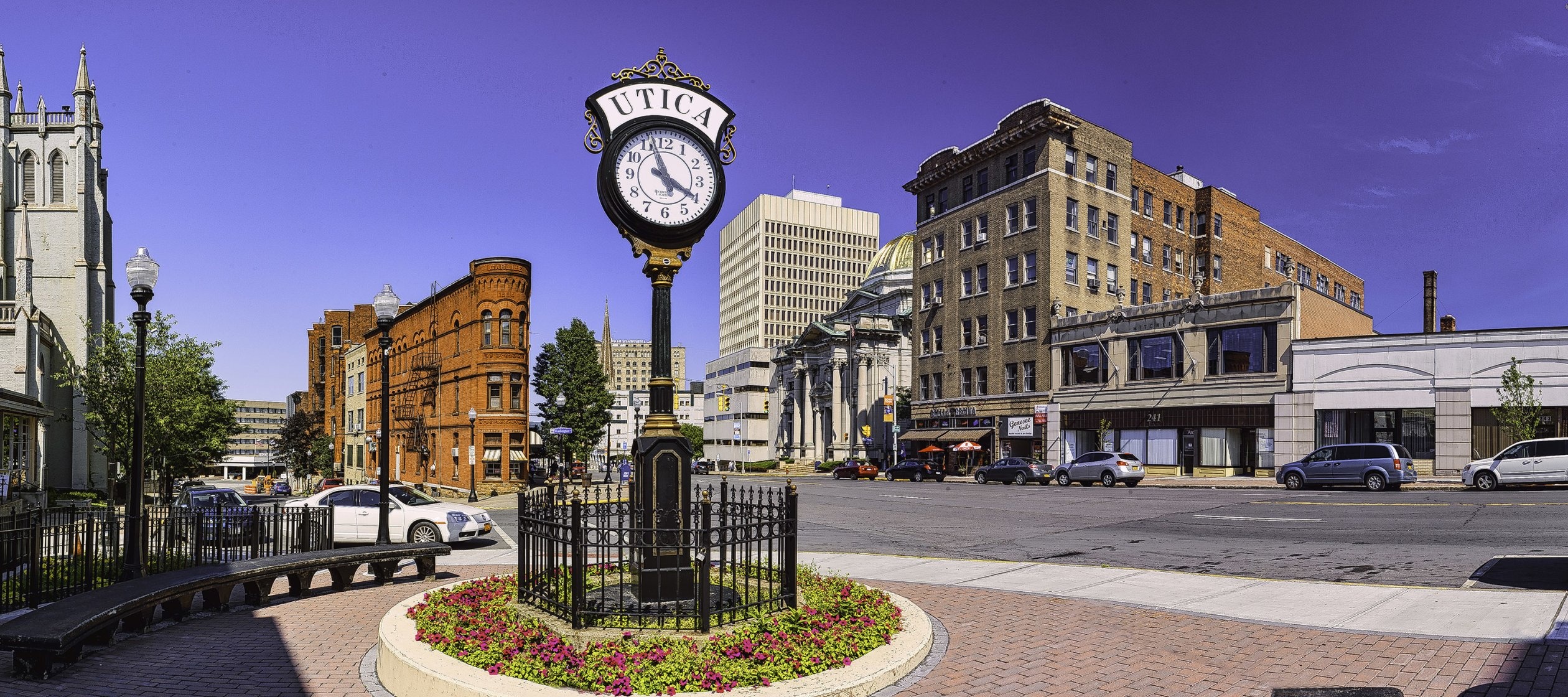
Utica is a city in Oneida County, set in the Mohawk Valley of upstate New York, with a population of roughly 65,000 residents. Once a bustling manufacturing hub along the Erie Canal, the city carries a working-class character softened by a notably diverse population, including one of the largest Bosnian-American communities in the country. The downtown sits along the Mohawk River, and Utica is frequently described as a gateway to the Adirondack Mountains to the north and to the broader recreational opportunities of central New York. It lies approximately 50 miles east of Syracuse, the nearest major city, and is within about 90 miles of Albany.
The Munson-Williams-Proctor Arts Institute anchors the city's cultural life just a short walk from downtown. The museum complex includes a 1960 Philip Johnson-designed modern wing housing a respected collection of European and American paintings, decorative arts, and changing exhibitions, and visitors can easily spend a few hours here before strolling the surrounding historic neighborhood.
About 15 minutes west of Utica, in the neighboring city of Rome, sits Fort Stanwix National Monument. The reconstructed Revolutionary War-era fort marks the site of a pivotal 1777 siege and ties into the larger story of the Battle of Saratoga. The National Park Service operates an informative visitor center and a network of interpretive trails that lead guests around the original fortifications and through the surrounding Oneida County countryside.
To the southwest, the Turning Stone Resort Casino in Verona draws visitors with a mix of gaming, hotel accommodations, championship golf, and headline entertainment roughly 30 minutes from downtown Utica. Run by the Oneida Nation, the property has become one of central New York's largest tourist draws and an easy day trip or overnight side excursion for travelers based in the city.
Outdoor travelers will find that Utica is a practical base for exploring the southern fringes of the Adirondack Park, a vast wilderness preserve that begins about an hour's drive north. From the city, day-trippers can reach state-owned trailheads, lakes, and small mountain towns without committing to a remote-cabin itinerary, returning each evening to a fully serviced urban setting.
Taken together, Utica's compact scale, central Mohawk Valley location, and proximity to both cultural institutions and wild country give short-term rental owners a market that draws a steady mix of regional travelers, outdoor recreationists, casino visitors, and heritage tourists. The combination of an affordable local real-estate base, easy highway access, and a deep bench of nearby attractions makes the city a quietly versatile spot for hosting guests year-round.
Want to know if a property in Utica is a good investment?
Enter an address to get instant revenue potential and comps.