
Windsor, North Carolina
Want to see how Windsor compares to other top cities in North Carolina? Explore all city regulations in North Carolina. →
Windsor, NC
Generally Investor Friendly
STR Regulations for Windsor, North Carolina
Overview: Are Short‑Term Rentals Allowed in Windsor, NC?
Yes—short‑term rentals ( rentals of fewer than 30 days to transient guests) appear to be allowed in the Town of Windsor. This conclusion is based on the following key indicators from the Town’s Unified Development Ordinance (UDO):
- The UDO explicitly references “rooms intended for transient rental” and states that the change‑of‑occupancy provision shall not apply to such rooms (Section 2.20(C)). This implies that operating rooms for short‑term stays does not require a separate change‑of‑occupancy certificate as would otherwise be required when occupancy changes.
- The UDO’s general zoning framework authorizes lodging uses, with specific hotel/motel and bed‑and‑breakfast (B&B) uses permitted in several districts, and with many districts either permitting or allowing B&B as a special use. This establishes lodging as an allowed principal or accessory use in multiple contexts.
- There is no total ban on short‑term rentals in the UDO, and there are no citywide caps on rental nights, occupancy limits, or distance restrictions from other STRs.
Given these points, an STR operated as a lodging use or as an accessory lodging arrangement (e.g., a spare room or ADU) appears permissible across zoning districts in Windsor, provided the operation meets applicable building, fire/safety, zoning, and parking standards and does not violate any HOA covenants or deed restrictions.
Note: This guidance relies on the Town’s UDO. State law provides the baseline framework for STR regulation in North Carolina (e.g., local authority under NC Gen Stat 160D). Investors should also confirm any town‑specific registration or tax collection requirements with the Town Clerk and verify any county occupancy tax rules.
What do Airbnb hosts actually earn in Windsor?
Windsor hosts earn a median $29,022/year with $160 ADR and 58% occupancy.
Top performers pull in $39,840+ per year.
See the full Windsor market breakdownHow to Start a Short‑Term Rental Business in Windsor, NC
- Property Due Diligence and Zoning
- Confirm zoning district and allowable lodging uses:
- C‑1 Central Commercial: Lodging uses permitted (including hotels/motels).
- R‑8 Residential Medium Density: Bed & Breakfast permitted.
- R‑6 Residential Medium Density: Bed & Breakfast Special Use.
- R‑15 Residential Low Density: Bed & Breakfast Special Use.
- AG Agricultural: Lodging uses permitted; include Farm Stay/Inn as permitted or special use in AG.
- LI Light Industrial: Hotels/Motels permitted.
- If the use is not expressly listed as permitted or special in your district, the UDO’s “permitted uses” rule applies: if not listed, it is prohibited (Section 1.12). Engage the UDO Administrator for a use interpretation early.
- Review HOA covenants, neighborhood rules, and any recorded restrictions. Private covenants can limit STRs even when zoning allows them.
- Program and Capacity Planning
- Establish occupancy based on code‑compliant sleeping capacity (bedrooms) and egress requirements. Avoid overcrowding; comply with North Carolina State Building Code (UDO Section 2.12).
- Plan parking to meet UDO parking standards (Article 10). Typical lodging uses often require at least 1 space per guest unit plus staff/owner spaces; confirm with the UDO Administrator and ensure on‑site parking and driveway standards are met.
- Building, Life‑Safety, and Compliance
- New construction or conversion to lodging:
- Apply for building permits and obtain inspections consistent with the North Carolina State Building Code and the Town’s minimum housing code (UDO Section 2.12).
- Maintain smoke and carbon monoxide detectors; install fire extinguishers; post emergency egress plans; ensure egress components (doors, windows, stairs) meet code.
- If you are renting existing sleeping rooms (e.g., rooms within a single‑family home):
- The UDO states the change‑of‑occupancy provision does not apply to rooms intended for transient rental (Section 2.20(C)). Nevertheless, confirm that all applicable safety and code requirements are satisfied (e.g., egress, detectors, minimum housing standards).
- Compliance with ADA is not mandated by the UDO unless other laws require it, but providing accessible features can improve guest satisfaction and marketability.
- Utilities and Site Constraints
- Confirm water, sewer, and stormwater service capacity. For subdivisions, meet utility easement requirements (UDO Section 2.14).
- Driveways and access: ensure driveway widths and intersections with public streets meet UDO standards (Section 2.15). Flag lots are generally prohibited except for water/golf course/recreational access (Section 2.13(G)).
- Flood zones: Windsor has a Flood Damage Prevention Ordinance (Article 15). If the property is in a floodplain, comply with elevation, flood‑proofing, and development requirements; confirm local Floodplain Administrator contact through Town Hall.
- Business and Tax Considerations
- North Carolina sales and use tax: North Carolina imposes a combined state and local sales and use tax rate (currently 7.25% as of 2025), which generally applies to transient accommodations. Registration is required with the NC Department of Revenue.
- Local occupancy taxes: Check if Bertie County and/or the Town of Windsor levy an additional occupancy tax; registration and collection requirements vary by jurisdiction. If applicable, register and remit monthly or quarterly per the local tax collector’s rules. If no local tax applies in Windsor, confirm county policy through Bertie County tax officials.
- Operational Readiness
- Prepare house rules (quiet hours, occupancy limits, parking, smoking), check‑in procedures, guest communications, and safety protocols.
- Establish cleaning and maintenance standards; consider turnover lead times and staffing.
- Set up tax collection/remittance processes and accounting records.
- Consider insurance appropriate for STRs and any applicable licensing under state or local law.
- Review, Submission, and Inspections
- Prepare a package for UDO review (site plan, floor plans, parking layout, life‑safety notes).
- Submit any required applications (e.g., zoning compliance, special use permit if applicable) and building permits as applicable. Pay fees per the Town’s fee schedule (Section 2.19).
- After inspections and approvals, operate in strict accordance with approved plans and UDO standards.
Required Documents, Permits, Licenses, and Guidelines
- Zoning compliance/land use approval:
- For uses expressly permitted (e.g., hotel/motel, B&B where permitted), obtain zoning compliance letter or certificate from the UDO Administrator.
- For special uses (e.g., B&B in R‑6 and R‑15), submit a special use application to the Board of Commissioners, following quasi‑judicial procedures (Article 4).
- Building permits and inspections:
- Required for new construction, structural changes, or conversions to lodging uses.
- Must comply with the North Carolina State Building Code (UDO Section 2.12) and local minimum housing code.
- Certificates of Occupancy:
- Certificates are required for new or altered buildings prior to occupancy (Section 2.20). However, the change‑of‑occupancy provision shall not apply to rooms intended for transient rental (Section 2.20(C)). Confirm scope with the Building Inspector.
- Development approvals and expirations:
- Building permits expire six months after issuance if work has not commenced (Section 4.10(A)); work must not be discontinued for 12 months after commencement.
- Other local development approvals expire one year after issuance unless work has substantially commenced (Section 4.10(B)).
- Vested rights (optional but protective):
- If seeking certainty against future ordinance changes, consider establishing a site‑specific vesting plan (2–5 years), multi‑phase development vesting (7 years), or a development agreement (negotiated duration) (Section 4.10).
- Tax registration and remittance:
- Register with the NC Department of Revenue for sales and use tax (transient accommodations).
- Register for any local occupancy tax (Bertie County/Town of Windsor, if applicable).
- Fees:
- Pay application fees, permit fees, and any inspection fees per the Town’s fee schedule filed with the Town Clerk (Section 2.19).
Specific Regulations: Windsor (City), Bertie County (County), and North Carolina (State)
City of Windsor (Town of Windsor UDO; administrative authority under NCGS 160D)
- Allowed uses and districts:
- C‑1 Central Commercial: Lodging uses permitted (including hotels/motels).
- R‑8 Residential Medium Density: Bed & Breakfast permitted.
- R‑6 Residential Medium Density: Bed & Breakfast Special Use.
- R‑15 Residential Low Density: Bed & Breakfast Special Use.
- AG Agricultural: Lodging uses permitted; Farm Stay/Inn permitted or special use in AG.
- LI Light Industrial: Hotels/Motels permitted.
- One principal building per lot:
- Generally limited to one principal residential building per lot (Section 2.6), with certain allowances for nonresidential multiple principal structures when properly accessed. Accessory Dwelling Units (ADUs) may be allowed subject to zoning conditions; verify with the UDO Administrator.
- Access and parking:
- Lots must have legal access to a public or private street; emergency service access must be feasible (Sections 2.5, 2.13).
- Driveway and curb‑cut standards apply (Sections 2.15–2.16). Curb cuts on state highways require NCDOT approval.
- Off‑street parking and loading standards apply to lodging uses (Article 10).
- Certificates of Occupancy and transient rooms:
- Occupancy change generally requires a CO (Section 2.20), but “rooms intended for transient rental” are exempt from that change‑of‑occupancy requirement (Section 2.20(C)).
- Building and safety:
- North Carolina State Building Code and local minimum housing code apply (Section 2.12).
- Floodplain and stormwater:
- Article 15 Flood Damage Prevention; drainage/easement requirements (Section 2.14).
- Subdivision and development standards:
- Standards for platting, lot configuration, and administrative procedures (Articles 6 and 16).
- Vested rights and permit choice:
- Statutory and negotiated vesting options (Section 4.10). Permit choice applies if rules change during application processing (Section 4.8).
Bertie County
- County‑level occupancy tax may apply to transient accommodations. Confirm applicability and registration requirements with the Bertie County Tax Administrator/Revenue Department.
North Carolina State
- Regulatory framework:
- Towns derive authority to regulate land use and development under NC Gen Stat 160D (UDO Article 1).
- North Carolina State Building Code governs construction and life safety (UDO Section 2.12).
- Sales and use tax generally applies to transient accommodations; register with the NC Department of Revenue.
- No statewide prohibition on short‑term rentals; local governments may regulate through zoning, permits, and taxation.
Contacts
| Agency/Department | Responsibility (STR Context) | Phone | Email | Website | |---|---|---|---|---| | Town of Windsor – Town Clerk | General town information; permits/ordinances; fee schedule; public records | (252) 794‑2431 | townclerk@windsornc.com | windsornc.com | | Town of Windsor – UDO Administrator / Planning | Zoning use determinations; zoning compliance; special use permits; site plan review | (252) 794‑2431 | planning@windsornc.com | windsornc.com | | Town of Windsor – Building Inspector | Building permits; inspections; certificates of occupancy; code compliance | (252) 794‑2431 | building@windsornc.com | windsornc.com | | Windsor Board of Commissioners | Legislative approvals (special use permits; text/map amendments); quasi‑judicial decisions | (252) 794‑2431 | – | windsornc.com | | NC Department of Revenue | Sales/use tax registration; transient accommodation tax guidance | 1‑877‑252‑3052 | – | nc.gov/dor | | Bertie County Tax Administrator/Revenue | County occupancy tax applicability and registration | (252) 794‑5310 | – | co.bertie.nc.us | | NCDOT (District Office
Next step
Found a property in Windsor?
Paste any address and get estimated revenue, cash-on-cash return, and comparable STR performance in under 5 minutes. 3 free analyses per day.
Free brief
Get the free Windsor STR Investment Brief
Revenue data, top neighborhoods, seasonal trends, and the key regulations for Windsor, North Carolina in one email.
Windsor
Market Saturation Score
Photos of Windsor


Overview of Windsor
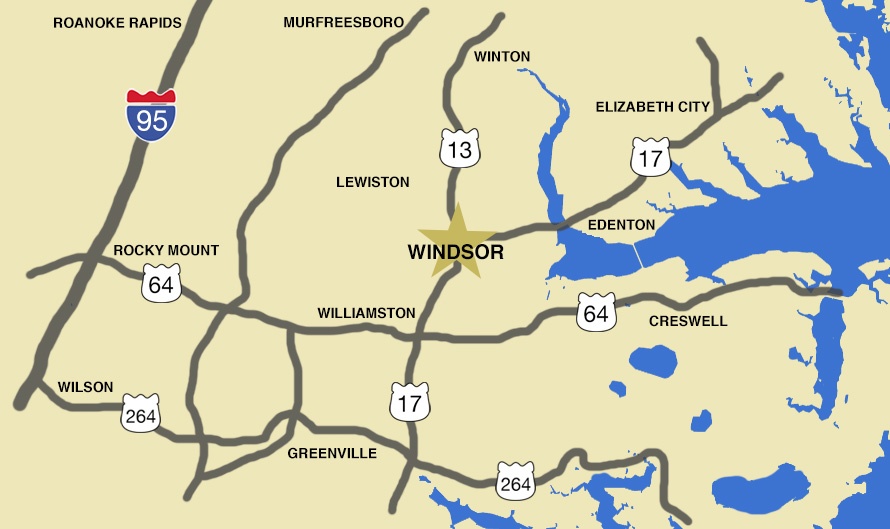
Windsor is a small, quiet town that serves as the county seat of Bertie County in the coastal plain of northeastern North Carolina. With a population of roughly 3,000 residents, the town sits at the confluence of the Cashie and Roanoke rivers, giving it a slow-paced, river-town character defined by mossy live oaks, historic homes, and surrounding farmland. Windsor is best known as a base for exploring the Roanoke River corridor and the broader Inner Banks region, an area rich in wildlife, antebellum history, and small-town Southern charm. It lies about 100 miles east of Raleigh and roughly 75 to 90 miles west of the Outer Banks, placing it within a couple of hours' drive of both the state capital and the Atlantic coast.
History is one of Windsor's strongest draws. Hope Plantation, located just outside town, is a restored early-19th-century Federal-style plantation home that once belonged to North Carolina Governor David Stone. Operated as a state historic site, the property includes the main house, a plantation store, and surrounding grounds that offer a detailed look at plantation life and early state government. It is a short drive from the center of Windsor. A bit farther afield, Somerset Place State Historic Site sits on the shores of Lake Phelps near Creswell, about 40 minutes to the southwest. This former antebellum plantation interprets the lives of both the slaveholding family and the enslaved community who worked the land, with restored buildings set along the water that hint at the area's complex past.
Nature and outdoor recreation are also a major part of the area's appeal. The Roanoke River National Wildlife Refuge stretches for miles along the river corridor and is one of the most important stopover sites for migratory birds on the Atlantic Flyway, with paddling, fishing, and birding opportunities that vary with the seasons. Just a short drive east of Windsor, Pettigrew State Park surrounds the southern end of Lake Phelps and offers hiking, picnicking, and a glimpse of one of North Carolina's largest natural lakes.
Windsor is a compelling base for short-term rentals because of the way it combines genuine small-town atmosphere with access to a surprising range of experiences. Visitors who stay there can spend mornings paddling a quiet stretch of the Roanoke, afternoons touring restored plantation homes, and evenings watching the sun go down over fields and river bends. With Greenville to the southwest, the Outer Banks to the east, and the historic Albemarle region all within reach, Windsor offers travelers a calmer, more affordable alternative to the busier coastal destinations while keeping plenty to do within a short drive.
Want to know if a property in Windsor is a good investment?
Enter an address to get instant revenue potential and comps.