
Roper, North Carolina
Want to see how Roper compares to other top cities in North Carolina? Explore all city regulations in North Carolina. →
Roper, NC
Challenging To Investors
STR Regulations for Roper, North Carolina
Executive Summary
Are Short-Term Rentals Allowed in Roper, NC? Based on the provided county regulations, short-term rentals appear to be allowed but heavily regulated in Washington County, including Roper. Bed and breakfast establishments require special use permits in residential districts, while hotels/motels are permitted in commercial districts. However, no explicit mention of vacation rental regulations or permits was found in the provided documents.
What do Airbnb hosts actually earn in Roper?
Roper hosts earn a median $22,107/year with $161 ADR and 48% occupancy.
Top performers pull in $26,963+ per year.
See the full Roper market breakdownOverview: STR Status in Roper, NC
Roper, North Carolina is located within Washington County and falls under county zoning jurisdiction for areas outside municipal limits. The regulatory framework indicates that:
- Traditional short-term rentals (vacation rentals) are not explicitly defined in the zoning ordinances
- Bed and breakfast establishments are explicitly regulated as special use permits in residential districts
- Hotels and motels are permitted uses in commercial districts
- No specific STR licensing or permit requirements were identified in the provided documents
- Zoning compliance and special use permits are the primary regulatory pathways for hospitality-related lodging
How to Start a Short-Term Rental Business in Roper, NC
Step 1: Determine Zoning Compliance
- Identify your property's zoning district through the Washington County Planning Department
- Verify permitted uses for your specific zoning classification
- Assess whether your intended use aligns with existing permitted or special permit uses
Step 2: Choose Appropriate Regulatory Pathway
Based on your business model:
Bed & Breakfast Model:
- Apply for Special Use Permit in residential districts
- Required in R-A (Rural Areas) and other residential zoning classifications
Hotel/Motel Model:
- Locate in Corridor Commercial (C-C) District
- Hotels/motels are permitted uses (no special permit required)
Vacation Rental Model:
- No explicit pathway found in provided regulations
- May require zoning interpretation or variance application
Step 3: Secure Required Permits
- Building permits for any construction/renovation
- Certificates of Use and Occupancy
- Special Use Permit (if required for your use type)
Required Documents, Permits, Licenses, and Guidelines
Building and Zoning Permits
Building Permits Required:
- For any construction, enlargement, structural alteration, or relocation
- Must include building plans, specifications, and site plans
- Applications reviewed by County Code and Planning Coordinator
Certificates of Use and Occupancy Required:
- Before occupancy for new buildings
- After alterations or change in use for existing buildings
- Temporary certificates may be issued for site-related improvements
- Both Building Official and Planning Coordinator approval required
Special Use Permits (if applicable):
- Required for bed & breakfast establishments in residential districts
- Application includes:
- Preliminary site plan
- Description of proposed use and operations
- Compatibility statement with Land Use Plan
- Additional documentation as requested
Business Licensing Requirements
- No specific STR business license requirements identified in provided documents
- Standard business registration may be required at state/county level
- Home occupation permits may be relevant for small-scale operations
Operational Documentation
- Safety compliance with NC State Building Codes
- Fire safety regulations and clearances
- Health department permits if applicable
- Insurance documentation (recommended)
Specific Regulations for Short-Term Rentals
Zoning District Regulations
R-A (Rural Areas) District:
- Bed and breakfast lodgings: Allowed by special use permit only
- Density: Maximum 2.0 units per developable acre for residential subdivisions
- Minimum lot area: 20,000 square feet
- Height limits: 45 feet for residential buildings
- Setbacks: 35 feet front, 15 feet side, 10 feet rear
C-C (Corridor Commercial) District:
- Hotels and motels: Permitted use (no special permit required)
- Bed & breakfast establishments: Allowed by special permit
- Minimum lot area: 30,000 square feet
- Height limits: 35 feet maximum
- Setbacks: 20 feet front, 20 feet side, 25 feet rear
Special Use Permit Requirements
For Bed & Breakfast Operations:
- Must demonstrate compatibility with surrounding residential areas
- Adequate public services required (water, sewer, fire protection)
- No adverse effects on neighborhood character
- Compliance with all district dimensional requirements
- Additional conditions may be imposed by County Commissioners
Standards Applied:
- Harmony with Land Use Plan and Growth Opportunities Plan
- Adequate public services and infrastructure
- Compatibility with adjacent properties
- Protection of ecological, scenic, or historic features
- Traffic and parking adequacy
- Noise and operational impact assessment
Home Occupation Regulations
If operating as a small-scale STR:
Permitted Home Occupation Uses:
- Must be clearly incidental to residential use
- Conducted by family members plus maximum one non-family employee
- No external alterations to dwelling appearance
- No external storage or display of goods
- No hazardous materials or equipment
- Reasonable delivery frequency
- Limited group activities (max 2 students for tutoring, etc.)
Prohibited Uses:
- Tourist homes explicitly listed as prohibited home occupation
- Day care for more than 5 non-related children
- Commercial retail operations
- Auto repair or similar intensive uses
Noise and Operational Regulations
General Compliance:
- Must comply with Washington County Noise Ordinance
- No interference with radio/television reception
- Reasonable hours of operation
- No noxious odors, dust, or emissions
- Adequate parking for guests
Accessory Use Limitations
STR as Accessory Use:
- Dwellings may be accessory uses in residential districts if:
- Located inside principal dwelling, OR
- Detached garage apartment, OR
- Occasional sleeping accommodations as guesthouse
- Setbacks must comply with district requirements
- No single family dwelling shall be divided into more than two units
State-Level Regulations (North Carolina)
North Carolina Building Codes
- Compliance required with current NC State Building Codes
- Inspections required for building permits
- Life safety standards for guest occupancy
- Accessibility requirements where applicable
North Carolina Land Use Statutes
- Chapter 153A-160D authority for county zoning (referenced in ordinance)
- 160D legislation impacts on special use permits and variances
- Coastal Management Act may apply to waterfront properties
Contact Information
Washington County Planning Department
Primary Contact:
- Julie Bennett, Clerk to the Board/Administrative Assistant
- Phone: (252) 793-5823
- Email: jbennett@washconc.org
- Website: washconc.org/
Additional Contacts
Washington County Website: washconc.org/
- Ordinances: washconc.org/ordinances/
- County Manager's Office for general inquiries
- Planning Board for zoning matters
Roper Town Hall (if town-specific regulations apply):
- Not provided in content - recommend direct contact
- Located within Washington County jurisdiction
Source Documents and Links
Primary Regulatory Documents
- Washington County Zoning Ordinance (July 1, 2021): washconc.org/wp-content/uploads/2022/04/2021-Zoning-Ordinance-Updated-for-7-1-2021-160-D-changes.pdf
- County Ordinances Page: washconc.org/ordinances/
- Noise Ordinance: washconc.org/wp-content/uploads/2022/04/Noise-Ordinance.pdf
- Building Code Compliance: Referenced in zoning ordinance Article II
Important Regulatory Sections
- Article II, Section U: Home Occupations
- Article III-A: R-A District regulations and bed & breakfast provisions
- Article III-B: C-C District regulations and hotel/motel provisions
- Article V: Special Use Permits process and standards
- Article II, Section L: Certificates of Use and Occupancy requirements
Key Permit Applications
- Special Use Permit applications: Contact Planning Coordinator
- Building permits: County Building Department
- Site plan requirements: Article 10 references (not provided in content)
Disclaimer: This guide is based solely on the provided regulatory documents. Specific property circumstances, recent ordinance amendments, or local interpretations may require additional compliance steps. Contact Washington County Planning Department for definitive guidance on your specific property and intended use.
Next step
Found a property in Roper?
Paste any address and get estimated revenue, cash-on-cash return, and comparable STR performance in under 5 minutes. 3 free analyses per day.
Free brief
Get the free Roper STR Investment Brief
Revenue data, top neighborhoods, seasonal trends, and the key regulations for Roper, North Carolina in one email.
Roper
Market Saturation Score
Photos of Roper

Overview of Roper
Roper is a small town in Washington County, in the Inner Banks region of eastern North Carolina. With a population of roughly 500 residents, it has the quiet, unhurried feel of a rural coastal-plain community. Situated along the Roanoke River near where it broadens into the Albemarle Sound, Roper serves as a peaceful gateway to a region defined by colonial and Native American history, expansive natural areas, and the wide tidal waters of the Albemarle. The town lies approximately 30 miles northeast of Greenville, the nearest city with a regional airport and a full range of services, and roughly 90 miles northwest of the Outer Banks beaches, putting it in striking distance of two very different North Carolina experiences.
Just a short drive south of Roper, Pettigrew State Park protects more than 16,000 acres of pocosin forest, cypress swamps, and the shores of Lake Phelps, one of the largest natural lakes in North Carolina. Visitors come for fishing, canoeing, and birdwatching, as well as to explore the area's deep Native American and early colonial history. The park's trail network and boat ramps offer a tranquil introduction to the wild ecosystems that shape the surrounding landscape.
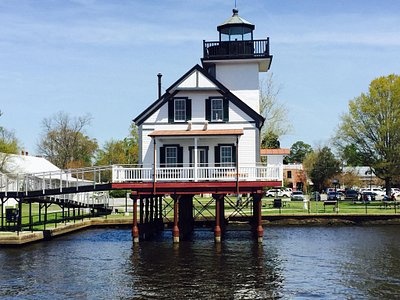
The county seat of Washington County, Plymouth, lies just a few miles southwest of Roper along the Roanoke River. The small downtown retains a sense of the town's river-port past and is home to the Roanoke River Lighthouse, a recent reconstruction of an 1887 screwpile lighthouse, as well as the Port O' Plymouth Museum. Plymouth's riverfront and modest historic district offer a low-key stop for travelers interested in the area's maritime and cultural heritage.
South of Roper, Somerset Place State Historic Site interprets a large antebellum plantation that once stretched to the shores of Lake Phelps. The site features reconstructed outbuildings, former slave quarters, gardens, and a plantation house, telling the layered story of the enslaved people, free Black community, and enslavers who lived and worked on the property in the decades before the Civil War. Walking trails, interpretive programs, and the lakeside setting make it both an important historical destination and a quiet place to spend a half day.
With its quiet rural setting, direct access to the Albemarle Sound, and proximity to one of North Carolina's most distinctive state parks, Roper offers travelers a slower, more reflective base from which to explore the Inner Banks. Birdwatchers, paddlers, anglers, and history-minded visitors are drawn to the area year-round, while the region's small towns provide a sense of place that has largely faded from the busier North Carolina coast. For short-term rental owners, that combination of natural beauty, historical depth, and easy reach to both Greenville and the Outer Banks makes Roper a quietly appealing alternative to the state's more crowded destinations.
Want to know if a property in Roper is a good investment?
Enter an address to get instant revenue potential and comps.