
Burnsville, North Carolina
Want to see how Burnsville compares to other top cities in North Carolina? Explore all city regulations in North Carolina. →
Burnsville, NC
Generally Investor Friendly
STR Regulations for Burnsville, North Carolina
Overview: Are Short-Term Rentals Allowed in Burnsville, NC?
Yes, short-term rentals are explicitly allowed in Burnsville, North Carolina. Yancey County, which encompasses Burnsville, officially permits short-term rental operations. The regulatory environment is characterized as having "low" regulations, offering investors significant operational flexibility. The Yancey County Board of County Commissioners lifted its recommended prohibition of short-term rentals effective May 12, 2020, permanently authorizing these operations within the jurisdiction.
What do Airbnb hosts actually earn in Burnsville?
Burnsville hosts earn a median $23,748/year with $175 ADR and 50% occupancy.
Top performers pull in $34,326+ per year.
See the full Burnsville market breakdownHow to Start a Short-Term Rental Business in Burnsville, NC
Starting an STR business in Burnsville involves several key steps tailored to the local regulatory landscape:
1. Business Planning and Market Analysis
- Burnsville's STR market demonstrates strong performance metrics including an average daily rate of $215, occupancy rate of 35.3%, and median annual revenue of $19,859
- The market shows 239 active listings with peak revenue occurring in December and lowest in February
- Target guest demographics are primarily domestic travelers (98%) from Charlotte and Raleigh markets
- Property types should focus on entire homes/apartments (95% of market) with 2-3 bedrooms representing 50.6% of listings
2. Property Acquisition and Setup
- Prioritize properties with 2-3 bedrooms for optimal market positioning
- Focus on scenic mountain cabin properties or downtown Burnsville locations
- Ensure properties include essential amenities: smoke alarm, heating, hot water, coffee maker, free parking on premises
- Consider properties accommodating 6+ guests (52.3% of market) for larger group appeal
3. Licensing and Registration Process
- Register with Yancey County government as the overseeing authority
- Comply with all North Carolina state business mandates
- Submit monthly lodging tax sales reports within 25 days of month's end
- Complete annual permit renewals as required
4. Tax Registration and Compliance
- Register for North Carolina sales tax through the state Department of Revenue
- Establish process for monthly lodging tax collection and remittance
- Coordinate with booking platforms for automatic tax collection where applicable
5. Marketing and Operations
- Leverage the low regulatory environment for competitive positioning
- Set minimum stay requirements aligning with market preferences (2 nights is standard at 41.9% of listings)
- Consider extended-stay options (30+ nights represent 29.2% of market)
- Implement moderate cancellation policies (37.3% market standard)
Required Documents, Permits, Licenses, and Guidelines
Primary Permits and Licenses
- Yancey County Business License: Required for STR operations
- North Carolina Sales Tax Registration: Mandatory for tax collection and remittance
- Annual STR Permit: Subject to renewal requirements
- Zoning Compliance Verification: Ensure property meets local zoning requirements
Required Documentation
- Property Ownership/Title Documentation: Legal proof of property ownership
- Business Registration Documents: Establish legal business entity
- Insurance Documentation: Liability and property insurance coverage
- Guest Registration Records: Maintain detailed guest logs (refer to state requirements)
- Monthly Lodging Tax Reports: Filed within 25 days of month-end
- State Sales Tax Returns: Filed according to NC Department of Revenue schedules
Safety and Compliance Guidelines
- Fire Safety Compliance: Smoke alarms, fire extinguishers, escape routes
- Health Department Guidelines: Follow NC DHHS cleaning and sanitizing protocols
- Building Code Compliance: Ensure all safety inspections current
- Neighbor Notification: Courtesy notification to adjacent property owners recommended
Operational Guidelines
- Occupancy Limits: Comply with property-specific and state-mandated limits
- Noise Regulations: Adhere to local quiet hours and noise ordinances
- Waste Management: Follow county guidelines for trash and recycling collection
- Emergency Contact Information: Maintain 24/7 contact availability for guests
Specific Regulations for Short-Term Rentals
Yancey County Level Regulations
- Business Operation Authorization: STRs legally permitted since May 2020
- State Mandate Compliance: Must follow all North Carolina business operation requirements
- County Oversight: Yancey County government maintains regulatory authority
- Cleaning Protocols: Must follow NC Department of Health and Human Services guidelines
North Carolina State Level Regulations
- Business Registration: Required for all commercial STR operations
- Sales Tax Collection: State sales tax (4.75%) plus applicable local taxes
- Lodging Taxes: County and local lodging taxes where applicable
- Health and Safety Standards: State-mandated property standards and inspection requirements
- Guest Privacy Laws: Compliance with North Carolina guest privacy protection statutes
- Advertising Requirements: Truth in advertising for rental properties
- Insurance Requirements: Liability insurance mandates for commercial operations
Municipal Considerations
- Zoning Compliance: Verify STR use is permitted in property's zoning district
- Building Permits: ADU (Accessory Dwelling Unit) construction requires proper permits
- Setback Requirements: ADU properties must comply with building and setback requirements
- Parking Requirements: Ensure adequate parking for guest capacity
Regulatory Environment Characteristics
- Low Regulation Level: Burnsville market classified as "low regulation" environment
- Operational Flexibility: Few restrictions on STR operations compared to other jurisdictions
- Tourism-Focused Market: Regulations designed to support tourism industry growth
- Peak Season Operations: Regulations accommodate high tourist volume periods
Contact Information for Local Authority
Primary Regulatory Authority
Yancey County Government
Oversight Authority for STR Operations in Burnsville
Website: www.yanceycountync.gov
Note: County government maintains regulatory authority over short-term rentals
Burnsville Town Government
Town of Burnsville
2 Town Square Burnsville, NC 28714
Phone: (828) 682-2420
Fax: (828) 682-7757
Website: townofburnsville.org
After Hours Emergency: (828) 682-2420
State-Level Contacts
North Carolina Department of Health and Human Services
Website: www.ncdhhs.gov
COVID-19 Guidelines and Cleaning Protocols
North Carolina Department of Revenue
Sales Tax Registration and Compliance
Website: www.ncdor.gov
Key Administrative Departments
Yancey County Planning and Zoning Department
Zoning compliance verification
Contact through county website
Yancey County Tax Department
Lodging tax collection and reporting
Contact through county website
Source Links
- Yancey County STR Announcement - May 12, 2020
- Yancey County Government Official Website
- Town of Burnsville Official Website
- North Carolina Department of Health and Human Services
- North Carolina Department of Revenue
- Burnsville STR Market Analysis (AirROI)
- Lodge Compliance - Yancey County Information
Important Note for Investors: This guide is based on publicly available information as of 2025. Regulations can change, and investors should verify current requirements with local authorities before making investment decisions. The low regulatory environment in Burnsville presents opportunities, but compliance with state and county requirements remains essential for successful operations.
Next step
Found a property in Burnsville?
Paste any address and get estimated revenue, cash-on-cash return, and comparable STR performance in under 5 minutes. 3 free analyses per day.
Free brief
Get the free Burnsville STR Investment Brief
Revenue data, top neighborhoods, seasonal trends, and the key regulations for Burnsville, North Carolina in one email.
Burnsville
Market Saturation Score
Photos of Burnsville


Overview of Burnsville
Burnsville is a small mountain town tucked into the Blue Ridge Mountains of western North Carolina, where it serves as the county seat of Yancey County. With a population of roughly 1,600 residents, the town has the unhurried feel of a traditional Appalachian community, surrounded by forested ridgelines, rushing rivers, and an active local arts scene centered around its walkable downtown square. Burnsville functions primarily as a gateway to some of the highest terrain in the eastern United States, including the slopes of Mount Mitchell, and it sits about 35 miles northeast of Asheville, the nearest major city. Travelers typically reach it by following US-19 through a winding, scenic corridor that climbs steadily into the Black Mountains.
The headline attraction in the area is Mount Mitchell State Park, which protects the highest peak east of the Mississippi River at 6,684 feet. The park is roughly a 30- to 40-minute drive from downtown Burnsville along NC-80, and it offers a paved road to a summit observation tower, picnic areas, and several short trails through spruce-fir forest. Because the mountain often sits above the clouds, visitors come for the cool temperatures and the sweeping views over the Blue Ridge, making it a major draw for hikers, leaf-lookers, and stargazers during the warmer months.
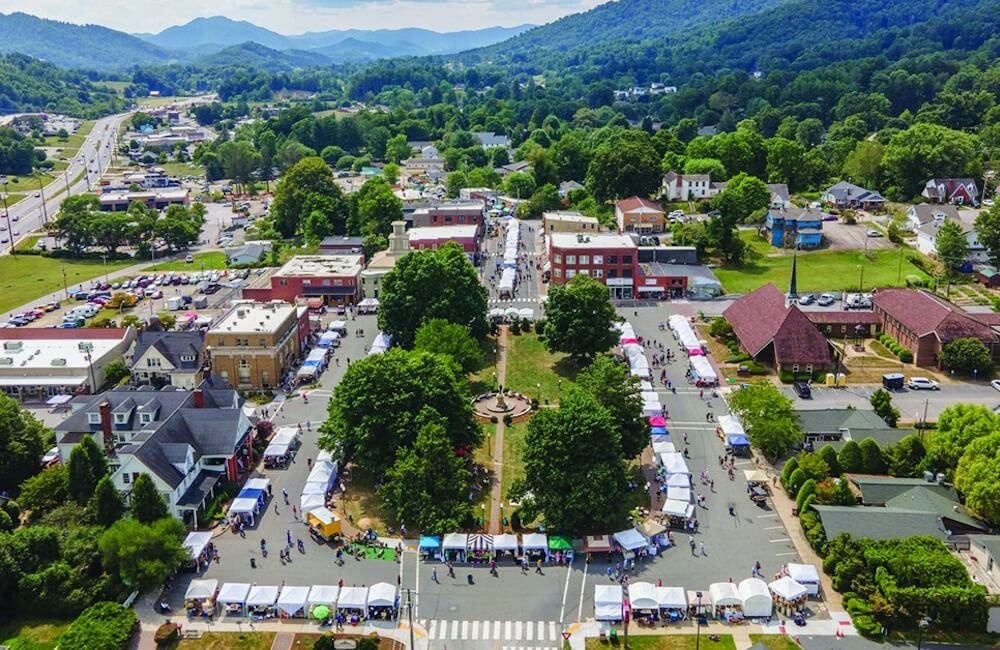
Burnsville itself is anchored by its historic town square, where the 1908 Yancey County Courthouse stands alongside a cluster of independently owned galleries, antique shops, and cafés. The town has cultivated a reputation as a regional hub for artists and craftspeople, and the surrounding rural roads pass potters' studios, farm stands, and small vineyards that are open to visitors on a casual basis. A walkable downtown and an active calendar of festivals, including the long-running Burnsville Fall Leaf Festival, give the town a liveliness that belies its modest size.
Just beyond the town limits, the South Toe River and the broader Pisgah National Forest provide a network of hiking trails, fly-fishing spots, and camping areas that draw outdoor enthusiasts year-round. The Pisgah National Forest extends across much of Yancey County, with access points only a short drive from town, and the river corridor below Burnsville is popular for tubing and trout fishing in the warmer seasons. Together, these natural surroundings make the wider area a year-round outdoor playground.
Burnsville's combination of small-town character, a walkable arts-oriented downtown, and immediate access to Mount Mitchell, Pisgah National Forest, and the broader Blue Ridge make it an appealing base for a short-term rental. Visitors who want a quieter alternative to busier mountain destinations like Asheville or Boone find that Burnsville offers genuine Appalachian atmosphere alongside some of the most dramatic high-elevation scenery in the eastern United States, supporting steady demand across hiking seasons, fall color tours, and summer escapes.
Want to know if a property in Burnsville is a good investment?
Enter an address to get instant revenue potential and comps.