
Morris, Minnesota
Want to see how Morris compares to other top cities in Minnesota? Explore all city regulations in Minnesota. →
Morris, MN
Generally Investor Friendly
STR Regulations for Morris, Minnesota
Overview: Are Short-Term Rentals Allowed in Morris, MN?
Yes—short-term rentals are permitted in Morris, MN. The city’s Residential Rental Property Registration & Licensing Ordinance (administered by the Stevens County Housing & Redevelopment Authority) applies to all rental properties, including short-term rentals. Property owners must register each rental property, pass an initial inspection, pay license fees, and renew annually. Current licenses must be posted at the property. Inspections occur on a 4‑year cycle, with the first inspection upon initial licensing.
Additionally, zoning in unincorporated Stevens County addresses “Vacation/Private Home Rental” specifically as a transient use (any stay fewer than 30 consecutive days), and the use must align with district allowances. Operators outside Morris city limits should confirm district-level permissibility and any applicable land use permits, conditional use permits, or shoreland rules. Sources: Morris Rental Licensing Program (HRA); Stevens County Zoning Ordinance (definitions and shoreland management).
What do Airbnb hosts actually earn in Morris?
Morris hosts earn a median $23,816/year with $184 ADR and 57% occupancy.
Top performers pull in $32,060+ per year.
See the full Morris market breakdownHow to Start a Short-Term Rental Business in Morris
Step-by-step process:
-
Confirm Zoning Eligibility
- In Morris city limits: residential rental use is allowed subject to licensing and inspection. If your property is located in unincorporated Stevens County, confirm the zoning district permits “one-family dwellings” or allows “Vacation/Private Home Rental” by right, permit, or conditional use. For lakes/rivers, see “Shoreland Districts & Uses” below.
-
Register and License the Property (City of Morris)
- Apply through the Stevens County Housing & Redevelopment Authority (HRA).
- Submit application, pay fees, and request an inspection.
- Once inspection passes and fees are paid, the license is mailed to you.
- Post the current license at the property.
- Renew annually; the 4‑year inspection cycle begins at initial licensing.
-
Prepare for Inspection
- Ensure the property meets health and safety standards (e.g., working smoke detectors, egress, sanitation).
- Make any necessary repairs prior to inspection to avoid delays.
-
Compliance: Advertising and Operations
- Do not advertise or rent until registration, inspection, and license issuance are complete.
- Maintain compliance for ongoing operations and renewals.
-
If Outside Morris City Limits (Unincorporated County)
- Confirm zoning compliance for transient lodging (Vacation/Private Home Rental).
- If needed, obtain a Land Use Permit or Conditional Use Permit per district rules.
- If on shorelands, secure shoreland permits as applicable and comply with setbacks/development standards.
-
Ongoing Compliance
- Keep the license posted and up to date.
- Maintain records, respond to inspections, and complete annual renewals.
Source: Morris Rental Licensing Program (HRA) guidance.
Required Documents, Permits, Licenses, and Guidelines
Local licensing (Morris city limits)
- Registration application (HRA).
- Payment of license fees.
- Passing inspection report (initial; 4‑year cycle thereafter).
- Annual license renewal confirmation.
Zoning (unincorporated Stevens County)
- Land Use Permit: may be required for new or altered structures/use activities (see Section 17).
- Conditional Use Permit: may be required for certain transient or commercial lodging uses, depending on district (see Section 15).
- Shoreland permits/approval: required for structures ≥120 sq ft, additions, sewage systems, and certain grading/filling activities (see Section 7.3.11–3.12).
Advertising requirements
- City of Morris: you must not advertise or rent until registration, inspection, and license issuance are complete. Current license must be posted at the property.
Compliance and recordkeeping
- Maintain documentation of license, inspection approvals, permit decisions, and renewal correspondence.
- For shoreland properties, maintain copies of shoreland permits and compliance certificates.
Source: Morris Rental Licensing Program; Stevens County Zoning Ordinance.
Specific Regulations: City, County, and State
Morris (City) Rental Licensing Program (Stevens County HRA)
- Applies to all rental properties, including STRs.
- Properties must be registered, inspected, and licensed before advertising or renting.
- License mailed after passing inspection and paying fees.
- Current licenses must be posted at the property.
- Annual license renewal required.
- Inspections are on a 4‑year cycle; first inspection occurs when a property becomes a rental.
Stevens County Zoning Ordinance—County-Level Rules (Unincorporated Areas)
- Jurisdiction: applies to areas outside incorporated municipalities (Section 3.A).
- Definitions:
- Vacation/Private Home Rental: a dwelling unit (not part of an approved commercial planned unit development/hotel/motel/resort) rented out on a transient basis, defined as any period fewer than 30 consecutive days (Section 4.B.143).
- Dwelling Unit: includes rental or timeshare accommodations such as motel, hotel, and resort rooms and cabins (Section 4.B.44).
- Permitting structure:
- Land Use Permits: required for specific activities; applications submitted to the Planning & Zoning Administrator (Section 17).
- Conditional Use Permits (CUP): required for certain uses; processed with public notice and findings (Section 15).
- Interim Uses: temporary use permits (Section 15A).
- Variances: per Minnesota Statutes Chapter 394; used to address practical difficulties, not to authorize prohibited uses (Section 24).
- Enforcement and penalties:
- Violations are misdemeanors; punishable as defined by law (Sections 2.3, 21, 26).
- APO (Administrative Penalty Order) up to $500 per parcel may be issued (Section 4.B.8).
Shoreland Management Districts and Uses
- Shoreland Jurisdiction:
- Applies within 1,000 feet of lakes/ponds/flowages and 300 feet of rivers/streams or to the landward extent of floodplain, whichever is greater (Section 4.B.122; Section 7.2.1).
- Permits Required in Shorelands:
- Structures ≥120 sq ft, additions (including decks), sewage systems, and many grading/filling activities require permits (Section 3.1).
- Sewage treatment systems must conform; additions may require reconstruction/replacement of nonconforming systems (Sections 3.12, 5.8).
- Land Use Allowances in Shoreland Districts (Selected):
- S‑1 Special Protection: Residential one‑family dwellings generally prohibited; may be allowed by conditional use only if replacing an existing, legally constructed dwelling (no discontinuance). Guest cottages not allowed. Private garages and some residential uses may be conditional.
- S‑2 Residential‑Recreation: One‑family dwellings allowed (P or C depending on lake classification). Guest cottages allowed by conditional use. Residential PUDs allowed by conditional use.
- S‑3 Water‑Oriented Commercial: Transient lodging uses (e.g., commercial planned unit developments, resorts, surface water‑oriented commercial) allowed by conditional use; check classification allowances in the district table.
- Shoreland Setbacks/Standards:
- Setbacks, height limits, and standards vary by district and lake classification; confirm with the County Planning & Zoning Administrator (Sections 4–7).
- Variances/Conditional Uses:
- Must conform to Minn. Stat. Chapter 394 and shoreland purposes; cannot circumvent intent or authorize prohibited uses (Sections 3.3, 7.3.31).
State-Level Notes (Minnesota Statutes)
- Zoning enabling and variance authority: Minnesota Statutes Chapter 394 (counties).
- Short-term rental licensing (statewide framework): Minnesota Statutes § 116N (effective dates vary; verify current requirements with the state).
- Local ordinances may be more restrictive than state law; in conflicts, the stricter rule governs (Section 3.C).
Important: The content provided does not include city-specific STR provisions beyond rental licensing. The County zoning rules clarify that “Vacation/Private Home Rental” is a defined transient use. Property owners should confirm whether any local health, fire, or nuisance provisions further regulate STR operations (e.g., quiet hours, parking, occupancy limits) when they apply.
Contact Information (Local Authority)
Stevens County Housing & Redevelopment Authority (HRA)—Morris Rental Licensing Program
- Address: 100 South Columbia Ave, Morris, MN 56267
- Phone: 320‑208‑6559
- Program website (Licensing): www.ci.morris.mn.us/rhc/
- Notes:
- Translation services available; assistance provided at the office.
- Email not listed in the provided content.
Stevens County Planning & Zoning (County Zoning & Shoreland Administration)
- Responsible for land use permits, conditional use permits, variances, and shoreland management (Sections 7.3, 17, 15, 24).
- Contact details are not included in the provided content; contact the County Courthouse or Planning & Zoning office for current phone/email.
Links to Source Pages
- Morris Rental Licensing Program (HRA): www.ci.morris.mn.us/rhc/
- Stevens County Zoning Ordinance (Nov 17, 2020; adopted PDF): www.co.stevens.mn.us/DocumentCenter/View/2722/Stevens-County-Zoning-Ordinance-11-17-2020-PDF?bidId=
Quick Checklist for STR Operators
-
City of Morris
- Register with HRA before any advertising.
- Pay fees and pass initial inspection.
- Post current license at the property.
- Renew annually; comply with 4‑year inspection cycle.
-
Stevens County (unincorporated)
- Confirm zoning district allows transient lodging.
- Obtain Land Use Permit or Conditional Use Permit if required.
- If on shorelands, obtain required permits; meet setbacks and sewage standards.
-
Ongoing Compliance
- Maintain licenses and permit records.
- Respond to inspections and renewals.
- Ensure advertising does not precede registration/licensing.
Note: The provided materials focus on registration/licensing and zoning. If you plan to operate in a shoreland area or in unincorporated county, consult directly with the Planning & Zoning office for district‑specific requirements and any additional local health or nuisance standards.
Next step
Found a property in Morris?
Paste any address and get estimated revenue, cash-on-cash return, and comparable STR performance in under 5 minutes. 3 free analyses per day.
Free brief
Get the free Morris STR Investment Brief
Revenue data, top neighborhoods, seasonal trends, and the key regulations for Morris, Minnesota in one email.
Morris
Market Saturation Score
Photos of Morris


Overview of Morris
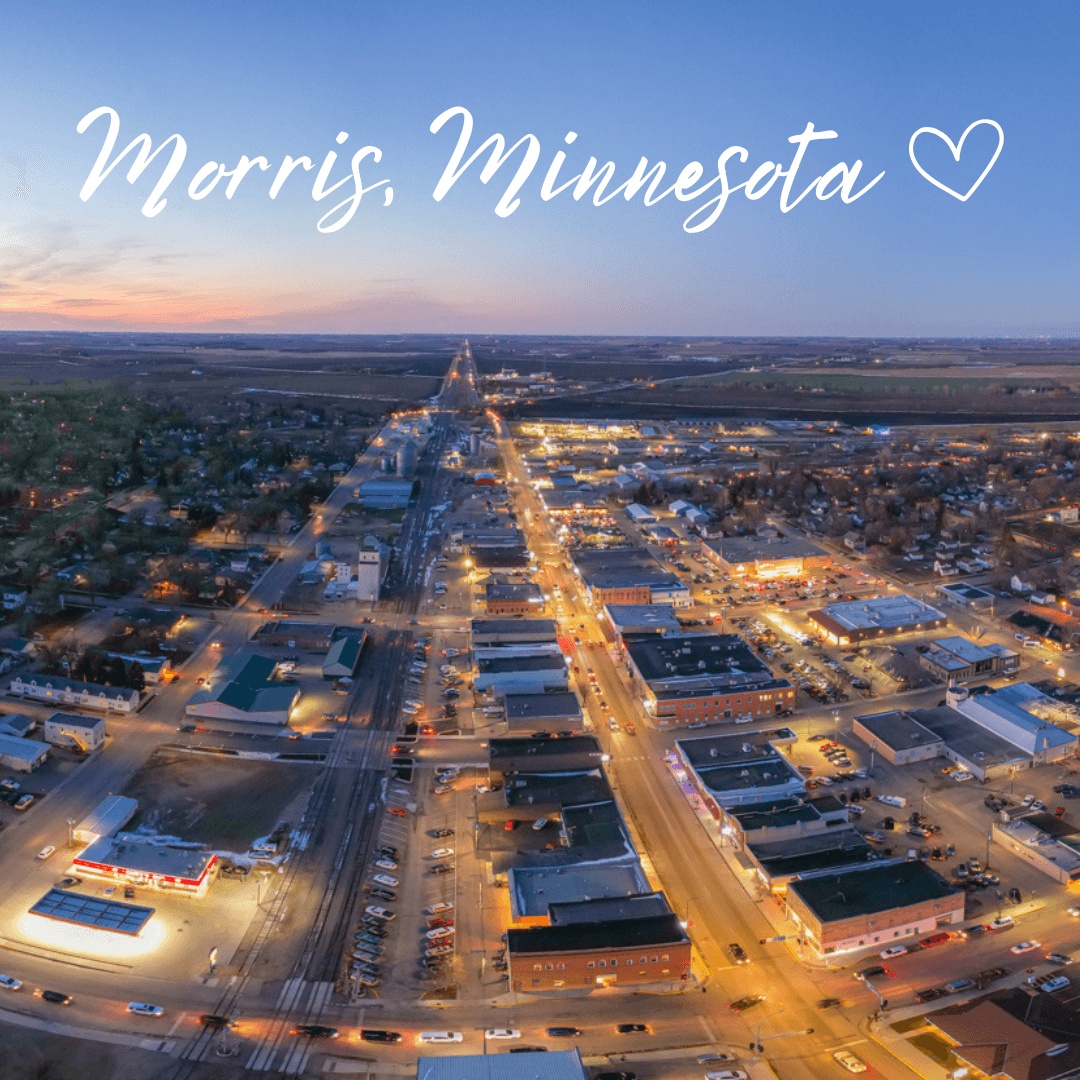
Morris is a small city in west-central Minnesota and serves as the county seat of Stevens County. With a population of roughly 5,000 residents, it has the feel of a quiet prairie college town, anchored by the presence of a well-regarded public liberal arts university. The community is surrounded by some of the most open agricultural landscape in the state, with corn and soybean fields stretching to the horizon in every direction, and it functions as a friendly base for visitors exploring the lakes, rivers, and small towns of western Minnesota. Morris sits about 150 miles west of the Minneapolis–Saint Paul metro area, reached by a roughly two-and-a-half-hour drive along I-94 and Highway 59.
A short drive from downtown, the University of Minnesota Morris is the cultural and intellectual heart of the community. The campus is known for its prairie-style architecture, its commitment to sustainability, and a steady schedule of public lectures, music performances, and art exhibitions that draw visitors from across the region. Tourists passing through often pause to walk the wooded paths around the campus or to catch a performance at the university's performing arts center.
To the east, about twenty miles down the road near the town of Starbuck, Glacial Lakes State Park offers more than 2,800 acres of rolling hills, oak savanna, and quiet lakes shaped by the last ice age. The park's trails are popular for hiking, horseback riding, and mountain biking, and the relatively undeveloped lakes provide peaceful settings for fishing and paddling. It is one of the more distinctive natural areas in western Minnesota and a common day trip for visitors staying in Morris.
A bit farther afield, roughly forty miles to the southwest, Lac qui Parle State Park sits along the Minnesota River where it widens into a long, marshy lake. The park is known for excellent waterfowl watching, especially during spring and fall migrations, and for its quiet shoreline campsites. Combined with the surrounding wildlife management area, it offers some of the best birding in the region.
For short-term rental investors and travelers alike, Morris is an appealing small-town base because it combines the amenities of a college community with easy access to some of the most unspoiled outdoor spaces in southern and western Minnesota. Visitors come for the university events, hunting and fishing seasons, and the slow-paced prairie experience, and they tend to use Morris as a hub from which to explore nearby state parks, the Pomme de Terre River valley, and the broader lake country of the region.
Want to know if a property in Morris is a good investment?
Enter an address to get instant revenue potential and comps.