
Corinth, Kentucky
Want to see how Corinth compares to other top cities in Kentucky? Explore all city regulations in Kentucky. →
Corinth, KY
Generally Investor Friendly
STR Regulations for Corinth, Kentucky
Overview: Are short‑term rentals allowed in Corinth, KY? Yes—short‑term rentals (STRs) are allowed in Corinth. Corinth does not have its own STR ordinance (as of the cited source). In unincorporated Grant County, where Corinth is located, you must obtain a Short‑Term Rental Property Permit from the Grant County Fiscal Court before operating. If your property falls within any incorporated city limits that have their own STR rules, those city rules would apply instead. Note: small portions of Corinth’s postal area may extend into neighboring jurisdictions (e.g., Boone County), but the subject city itself is within Grant County and is subject to county‑level regulation in the absence of a municipal ordinance.
How to start a short‑term rental business in this market
- Confirm jurisdiction and rule set
- Verify the property is inside Corinth (unincorporated Grant County). If inside city limits (e.g., Williamstown, Dry Ridge, Crittenden), follow that city’s STR ordinance.
- If inside unincorporated Grant County (Corinth), follow Grant County’s STR requirements.
- Permit and licensing pathway (unincorporated Grant County)
- Apply for and obtain a Short‑Term Rental Property Permit from the Grant County Fiscal Court.
- Obtain any required business/occupational license as directed by Grant County.
- If you list on hosting platforms (Airbnb, VRBO, etc.), include the STR permit/business license number as required by platform policy and local law.
- Annual renewal
- STR permits must be renewed each year (see fee details below).
- Additional practical steps
- Secure appropriate general liability insurance and comply with safety codes.
- Set up processes for collecting/remitting the Grant County transient room tax (3%).
- Implement occupancy, parking, and conduct rules consistent with county ordinances.
- Maintain on‑call emergency contact and guest information brochure as required by local rules.
Required documents, permits, licenses, and guidelines Documents commonly required for a Grant County STR permit (unincorporated areas):
- Completed STR permit application.
- Proof of general liability insurance as required by the county.
- Proof of business/occupational license (if applicable).
- Any documentation required by the county for listing/advertising compliance.
- Documentation for collecting/remitting the 3% transient room tax.
Example structure (informational):
- Application form and fee (initial and renewal).
- Affidavit/certification that the applicant will comply with the International Building Code (Kentucky Amendments), NFPA 1124 (as adopted), and all other applicable state, federal, and local laws.
- Safety self‑inspection checklist (smoke detectors, CO detectors, fire extinguisher, egress information).
- Emergency contact information and local responsible party contact details.
- Site plan and parking diagram (off‑street, paved).
- Insurance certificate evidencing required liability coverage.
Note: Exact forms for Grant County were not provided in the source set; use the above as the typical document set and request the current application packet from the Grant County Fiscal Court.
Permits and licenses
- Grant County (unincorporated Corinth)
- Short‑Term Rental Property Permit (initial $25; annual renewal $25).
- Business/occupational license as required by Grant County.
- If located in an incorporated city (e.g., Williamstown, Dry Ridge, Crittenden), follow that city’s separate licensing and permitting requirements.
Specific regulations: Corinth (unincorporated Grant County)
- STR definition and maximum stay
- Grant County treats STRs as rentals of ten days or less.
- Zoning and land use
- STRs must be lawful primary dwellings; not allowed in RVs, tents, garages, boats, or other non‑primary structures.
- Occupancy limits
- Enforce the dwelling’s maximum legal occupancy per adopted codes and ordinances; state max 10 occupants unless further limited by local rules.
- Parking and traffic management
- Provide off‑street parking on a paved surface as required; ensure parking does not encroach on public rights‑of‑way; one space per guest room is typical if applicable.
- Spacing/concentration limits
- No STR within 1,000 feet of another approved STR (measured property‑line to property‑line).
- Safety and building compliance
- Working smoke detectors, at least one working carbon monoxide detector/alarm, and a working fire extinguisher. Evacuation plan recommended.
- Insurance
- Maintain general liability insurance; specific minimums and additional coverages may apply per county ordinance.
- Advertising and signage
- No external signage advertising an STR. Include allowed occupancy and vehicle count in ads and contracts.
- Local responsible party and guest brochure
- Provide a local contact who can respond within one hour. Supply guests with emergency numbers, parking/noise/trash rules, and other required information.
- Taxes
- Grant County assesses a 3% transient room tax on STR rentals. The county withholds a 3% collection fee and remits the remainder to the Grant County Tourism and Convention Commission.
- Violations and penalties
- Operating without a permit/license, advertising without a permit, non‑compliance with codes, failure to pay transient taxes, or allowing non‑guest activities can result in civil fines and enforcement action.
City‑level details (reference for nearby Grant County cities)
- Williamstown
- STRs require proper zoning and an occupational license; fire‑safety inspection with checklist. Application fee $250; annual renewal $150 ($250 for multi‑unit).
- Dry Ridge
- Moratorium on new STR applications was in effect until December 31, 2023, subject to council modification.
- Crittenden
- STRs require an occupational license; application/renewal fees $25 each; inspection walk‑through required; application may be filed online but inspection is in‑person.
- Corinth
- No city STR ordinance as of the cited source; operates under county rules.
State‑level Kentucky considerations (general/illustrative examples)
- Short stays and occupancy caps
- Example ordinance (City of Frankfort): STRs limited to 29 consecutive days for the same occupant; occupancy capped at two times the number of bedrooms plus four; caps on non‑owner‑occupied STRs in certain districts (e.g., Special Capital District at 5% of dwelling units; Special Historic District capped at eight non‑owner‑occupied units). Owner‑occupied STRs may rent up to 24 days per year while absent and still qualify as owner‑occupied.
- Health and safety
- Evacuation plan and smoke detectors per adopted building/residential codes; no external signage; one parking space per contract; noise and nuisance rules enforced.
- Licensing and enforcement
- Annual registration and $250 regulatory license fee per STR unit in Frankfort; citations for violations: $100 first offense, $25 per day for each subsequent day of uncorrected violation, potential license revocation.
- Enforcement architecture
- Departments of Planning and Community Development typically enforce; Board of Adjustment hears conditional use matters.
Contact information (key local authorities)
- Grant County Fiscal Court
- Address: 101 E Pike St., Second Floor, Cynthiana, KY 41031 (per Grant County News article header)
- Phone: (859) 334‑2100
- Grant County Judge/Executive Office
- Phone: (859) 824‑3211
- Grant County Tourism and Convention Commission
- Phone: (859) 824‑8753
- City of Frankfort (reference example)
- Planning and Community Development, P.O. Box 697, Frankfort, KY 40602; Phone: (502) 352‑2094; Fax: (502) 875‑8502
Links to source pages
- Boone County (unincorporated) STR framework (for context; not directly applicable to Corinth unless property sits within Boone County’s unincorporated area): www.boonecountyky.org/government/short-term_rental_units/index.php
- Grant County News feature article detailing local STR rules and municipal actions, including Corinth’s lack of a city ordinance: www.pmg-ky3.com/grantco/grant-countys-str-dilemma/article_153269a3-a9da-532d-ba19-28f3bf3ea27f.html
- City of Frankfort STR application form (state‑level reference example): www.frankfort.ky.gov/DocumentCenter/View/1915/Short-Term-Rental-Application?bidId=
If your parcel is within city limits (for example, Williamstown, Dry Ridge, or Crittenden), obtain and follow that city’s STR ordinance and permitting process in place of county rules. For Corinth (unincorporated Grant County), start with the Grant County STR permit and comply with the county’s spacing, safety, parking, insurance, and tax requirements. If a small portion of your parcel falls within Boone County’s boundaries, confirm the jurisdictional coverage with the appropriate county offices before filing.
What do Airbnb hosts actually earn in Corinth?
Corinth hosts earn a median $27,805/year with $173 ADR and 60% occupancy.
Top performers pull in $38,875+ per year.
See the full Corinth market breakdownNext step
Found a property in Corinth?
Paste any address and get estimated revenue, cash-on-cash return, and comparable STR performance in under 5 minutes. 3 free analyses per day.
Free brief
Get the free Corinth STR Investment Brief
Revenue data, top neighborhoods, seasonal trends, and the key regulations for Corinth, Kentucky in one email.
Corinth
Market Saturation Score
Photos of Corinth

Overview of Corinth
Corinth is a small community in Grant County, Kentucky, set in the rolling farmland of the state's northern Bluegrass region. With only a few hundred residents, it has the feel of a quiet rural crossroads, surrounded by horse pastures, woodlots, and the gentle hills that define this part of Kentucky. The community serves as a peaceful gateway to one of the most-visited destinations in the region, the Ark Encounter in the county seat of Williamstown. Corinth sits roughly 50 miles south of Cincinnati, Ohio, and approximately 45 miles north of Lexington, placing it within easy driving distance of two much larger metropolitan centers.
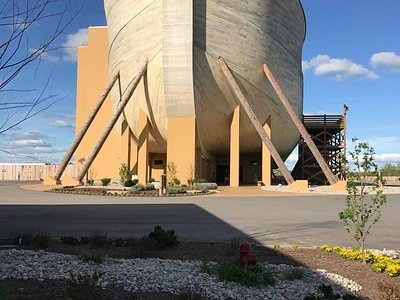
Just a short drive from Corinth, the Ark Encounter in Williamstown has become one of Kentucky's most recognizable attractions. Built to a biblical scale, the timber structure draws visitors from across the country and pairs naturally with its sister attraction, the Creation Museum, located farther north in Petersburg. The Ark Encounter grounds include exhibits, a zoo, and restaurants, and the attraction tends to draw multi-day stays, which is welcome news for short-term rental owners in the surrounding communities. The drive from Corinth to the Ark is roughly ten to fifteen minutes.
A bit farther afield, Big Bone Lick State Park in Union, Kentucky, offers a very different kind of experience. The park is famous for its Ice Age fossil beds, where mastodon and bison bones were first unearthed in the eighteenth century, and it features walking trails, a museum, and a campground. The drive from Corinth is around an hour, making it a feasible day trip for visitors who want to combine their stay with a bit of Kentucky natural history.
For those willing to venture a little farther, Lexington, Kentucky, is a major draw in its own right. The city is home to the Kentucky Horse Park, a working horse farm and museum complex, as well as a vibrant downtown, distillery tours along the Bourbon Trail, and the University of Kentucky. The drive from Corinth to Lexington takes about 45 to 50 minutes along the I-75 corridor.
Corinth's appeal for short-term rental investors comes down to location and access. The community itself is small and quiet, but it sits within a short drive of the Ark Encounter, one of the busiest faith-based attractions in the United States, as well as the broader attractions of northern Kentucky and the Bluegrass region. Travelers looking for an alternative to chain hotels in Williamstown or along the I-75 corridor can find a more pastoral base here, and the proximity to both Cincinnati and Lexington makes it a convenient stop for road-trippers and families exploring the region.
Want to know if a property in Corinth is a good investment?
Enter an address to get instant revenue potential and comps.