
Pittsburg, Kansas
Want to see how Pittsburg compares to other top cities in Kansas? Explore all city regulations in Kansas. →
Pittsburg, KS
Challenging To Investors
STR Regulations for Pittsburg, Kansas
Overview: Are Short-Term Rentals Allowed in Pittsburg, KS?
From the provided zoning document, short‑term rentals (STRs)—meaning rentals of fewer than 30 days—are not explicitly addressed. STRs typically involve “lodging for transients” and may be considered a hotel/boarding/rooming activity. Those uses are generally not permitted in residential districts and are often only allowed in specific commercial or lodging‑oriented zones under conditional use procedures.
Interpretation for investors:
- Operating a short‑term rental for transients in the City’s residential districts is likely prohibited or, at best, uncertain without an explicit STR framework.
- If you propose an STR, expect it to be treated as a lodging use and to require zoning approval or relocation to a zone that permits lodging uses.
- City‑specific STR rules were not present in the provided document; therefore, this guide provides state‑level context and zoning pathways within Pittsburg.
Action plan:
- Confirm whether STRs are permitted as a lodging use in your intended zone. If not, you may need to rezone, seek a conditional use permit, or relocate to an appropriate commercial district.
- Contact the local zoning authority (Zoning Administrator) to confirm interpretations for STRs.
Source reference:
- Zoning Ordinance and Subdivision Regulations (2016) — Pittsburg, KS www.pittks.org/wp-content/uploads/2018/07/Zoning-Manual-SubDivision-Regulations-2016.pdf
What do Airbnb hosts actually earn in Pittsburg?
Pittsburg hosts earn a median $18,597/year with $112 ADR and 52% occupancy.
Top performers pull in $27,531+ per year.
See the full Pittsburg market breakdownHow to Start a Short-Term Rental Business in Pittsburg, KS
- Select a compliant property and zone
- STRs in Pittsburg should be evaluated against the lodging definitions in the zoning code. Lodging for transients is typically not allowed in residential districts and often requires a commercial setting or special approvals.
- If your parcel is in a residential district, consider whether an STR can qualify as an allowed home occupation. Lodging is generally not considered “incidental and secondary” to a dwelling and is usually prohibited as a home occupation.
- Determine the approval pathway
- Permitted Use Path: Some commercial or mixed‑use districts may allow lodging; verify whether short‑term stays are included in “hotel,” “boarding,” or “rooming house” uses.
- Conditional Use Path: Many lodging uses (e.g., boarding houses, hotels) are conditional uses requiring a public hearing and approval by the Zoning Administrator (CUP).
- Rezoning Path: If lodging is not permitted in the subject district, you may apply to rezone the property to a district where lodging is allowed.
- Planned Unit Development (PUD) Path: For mixed sites, a PUD can embed lodging provisions.
- Prepare for zoning compliance
- Submit a site plan for review if lodging use is permitted by conditional use or PUD. The Planning and Zoning Commission reviews plans (Article 23).
- Prepare parking and loading plans. Lodging uses typically require off‑street parking (see Article 25).
- Meet bulk and dimensional standards (height, lot coverage, yard setbacks) per district (Article 28–29).
- Design and operational planning
- Screening and buffering may be required for lodging developments adjacent to single‑family or two‑family residences (see RP‑3 performance standards).
- Plan trash enclosure areas and signage that comply with district sign regulations (Article 27).
- Securing business permits
- Business license registration: Register your STR business with the City, even if a separate STR license is not required (confirm with City).
- State sales tax: Kansas imposes sales tax on lodging. Register with the Kansas Department of Revenue for sales/use tax.
- Transient guest tax: Kansas imposes a transient guest tax on lodging. Coordinate reporting with state and local authorities as required.
- Pre‑opening checklist
- Final zoning approvals (CUP, rezoning, or PUD, if applicable).
- Building inspections and code compliance per the Building Code and related technical codes adopted by the City.
- Occupancy and fire approvals (as applicable to lodging uses).
- Adoption of required parking/loading and signage per zoning.
Required Documents, Permits, Licenses, and Guidelines
Zoning and Planning
- Conditional Use Permit (CUP) if lodging is a conditional use in your chosen district.
- Rezoning application if lodging is not currently allowed on the parcel.
- Planned Unit Development (PUD) application (if pursuing a PUD for mixed lodging).
- Site Plan per Article 23 (Plan Approval Guidelines).
- Evidence of compliance with performance standards (Article 24).
- Parking and loading plans per Articles 25 and 26.
- Signage plan per Article 27.
- Bulk and height plan per Articles 28–29 (and supplementary regulations per Article 30).
- Screening plan (if required).
Business and Tax
- City business license/registration (confirm local requirements).
- Kansas Department of Revenue sales/use tax registration.
- Transient guest tax registration and reporting (as required).
- Employer tax accounts if you hire staff (state and federal).
Building and Life Safety
- Building permit (and related sub‑permits) if any alterations occur.
- Plan review approval per the adopted Building Code.
- Fire and occupancy approvals applicable to lodging uses.
- Confirmation of compliance with accessibility and safety codes where required.
Operational Controls
- Guest occupancy management policies and safety protocols.
- Local trash/recording enforcement compliance plans.
- Clear guest communication about parking and quiet hours.
Source reference:
- Zoning Ordinance and Subdivision Regulations (2016) — Pittsburg, KS www.pittks.org/wp-content/uploads/2018/07/Zoning-Manual-SubDivision-Regulations-2016.pdf
Specific Regulations for Short-Term Rentals in Pittsburg, Crawford County, and Kansas
City of Pittsburg (from provided documents)
- Lodging uses are not explicitly listed as permitted in residential districts. Residential districts are limited to single‑family, two‑family, group homes, and specified accessory uses.
- Definitions:
- Hotel: A building providing sleeping accommodations for transients with or without meals.
- Boarding or Rooming House: A dwelling where roomers/lodgers/boarders are housed without individual cooking facilities.
- Districts:
- R‑1A/1B/1C (Single‑Family Residential): Use is restricted to single‑family dwellings and residential‑design manufactured homes; lodging uses not permitted.
- R‑2 (Two‑Family Residential): Allows R‑1B uses plus two‑family dwellings and group residence; lodging uses not permitted.
- RP‑3 (Planned Medium Density Residential): Allows R‑2 uses, condos, low‑rise apartments, townhouses; lodging uses would require CUP/Permitted Use if explicitly recognized. Article 24 performance standards apply; screening required for developments >4 units adjacent to single‑ or two‑family residences.
- RP‑4 (Planned Apartment House): Allows RP‑3 uses (except single‑family) and apartment houses/multifamily dwellings; lodging uses typically not singled out as permitted unless specified by CUP/Permitted Use in the commercial plan or PUD.
- Commercial Districts (CP‑O/1/2/3/4): Lodging uses often require conditional use and plan approval; confirm specific language for transient lodging.
- Planned/Commercial Office (CP‑O): Office‑oriented; lodging likely not permitted or only under CUP.
- Planned Neighborhood Commercial (CP‑1): Permitted conditional uses may include lodging; verify with Planning and Zoning.
- Planned General Commercial (CP‑2): Lodging uses often permissible under CUP.
- Planned Highway Service Commercial (CP‑3): Transient lodging common; CUP/Permitted Use may apply.
- Planned Central Business District (CP‑4): Core downtown lodging; check permitted uses and CUP requirements.
- Industrial Districts (IP‑1/2/3, AP): Lodging uses are generally incompatible unless an overlay or conditional use is granted.
- Airport Overlay (AO), Downtown Overlay (DO), University Overlay (UO), Floodplain (FP): Overlay rules may add conditions. Floodplain requires compliance with flood hazard regulations.
Conditional Uses and Accessory Uses
- Where lodging is allowed by CUP, expect conditions for parking, screening, noise, and traffic management (see Articles 23–30).
- Guest House as an accessory use is explicitly limited: no kitchen facilities, no separate utilities, and not rented or used as a separate dwelling.
Kansas (state‑level highlights relevant to STRs)
- Transient lodging sales tax applies to short‑term rentals (sales tax).
- Transient guest tax may apply; reporting may be required by local jurisdictions that have adopted such a tax.
- State building and fire safety codes govern lodging uses and occupancy standards.
- Kansas Building Code (as adopted by the City) and related codes apply to structural, electrical, mechanical, and plumbing aspects.
County-level regulations
- County zoning could apply to annexed lands until rezoning occurs. County ordinances govern unincorporated areas; investors operating outside City limits must comply with county zoning and permitting. City ordinances govern within city limits.
Source references:
- Zoning Ordinance and Subdivision Regulations (2016) — Pittsburg, KS www.pittks.org/wp-content/uploads/2018/07/Zoning-Manual-SubDivision-Regulations-2016.pdf
Contact Information: Local Authority in Charge of STRs (Zoning and Permitting)
Primary local authority: Zoning Administrator and Planning and Zoning Commission
- Zoning Administrator
- Administers the Zoning Ordinance.
- Oversees CUPs, plan approvals, rezoning, and interpretations.
- Planning and Zoning Commission
- Reviews site plans for lodging developments and conditional uses.
- Provides recommendations and approvals per Articles 23 and 35 (Administration).
Important: The provided document does not include specific phone, email, or website contact details. Contact the City’s Planning/Zoning Department (Pittsburg, KS) through official city channels for current information and permitting requirements.
Source reference:
- Zoning Ordinance and Subdivision Regulations (2016) — Pittsburg, KS www.pittks.org/wp-content/uploads/2018/07/Zoning-Manual-SubDivision-Regulations-2016.pdf
Source Links and Official Documents
- Zoning Ordinance and Subdivision Regulations (2016) — Pittsburg, KS: www.pittks.org/wp-content/uploads/2018/07/Zoning-Manual-SubDivision-Regulations-2016.pdf
Key Articles referenced in this guide:
- Article 1: Title, Purpose, Definitions (lodging-related definitions; zoning districts; administration)
- Article 23: Plan Approval Guidelines
- Article 24: Performance Standards
- Article 25: Parking Regulations
- Article 26: Off-Street Loading Regulations
- Article 27: Sign Regulations
- Article 28: Heights, Area, Bulk
- Article 29: Supplementary Height, Area, Bulk Regulations
- Article 30: Supplementary Use Regulations (Conditional Uses, Accessory Uses)
- Article 35: Administration (including Zoning Administrator role)
Notes on State-Level STR Laws
If city-specific STR regulations are not present, Kansas remains relatively permissive on short‑term rentals, subject to:
- Sales tax on lodging (apply to bookings).
- Transient guest tax where applicable.
- Local zoning and building code compliance (fire safety, occupancy, accessibility).
- Neighborhood protections (quiet hours, parking, occupancy limits) via city codes, covenants, and enforcement.
Practical Next Steps
- Confirm lodging permissions in your intended district.
- If lodging is not permitted, prepare a rezoning or CUP application.
- Develop a site plan meeting Articles 23–30 requirements.
- Complete city business registration and state tax registrations.
- Secure building permits and life safety approvals before opening.
Important caveat: Because short‑term rentals are not explicitly covered in the provided materials, investors should seek written confirmation from the Zoning Administrator regarding how STRs will be classified (e.g., as a hotel/boarding use) and what approvals apply in their specific location.
Next step
Found a property in Pittsburg?
Paste any address and get estimated revenue, cash-on-cash return, and comparable STR performance in under 5 minutes. 3 free analyses per day.
Free brief
Get the free Pittsburg STR Investment Brief
Revenue data, top neighborhoods, seasonal trends, and the key regulations for Pittsburg, Kansas in one email.
Pittsburg
Market Saturation Score
Photos of Pittsburg


Overview of Pittsburg
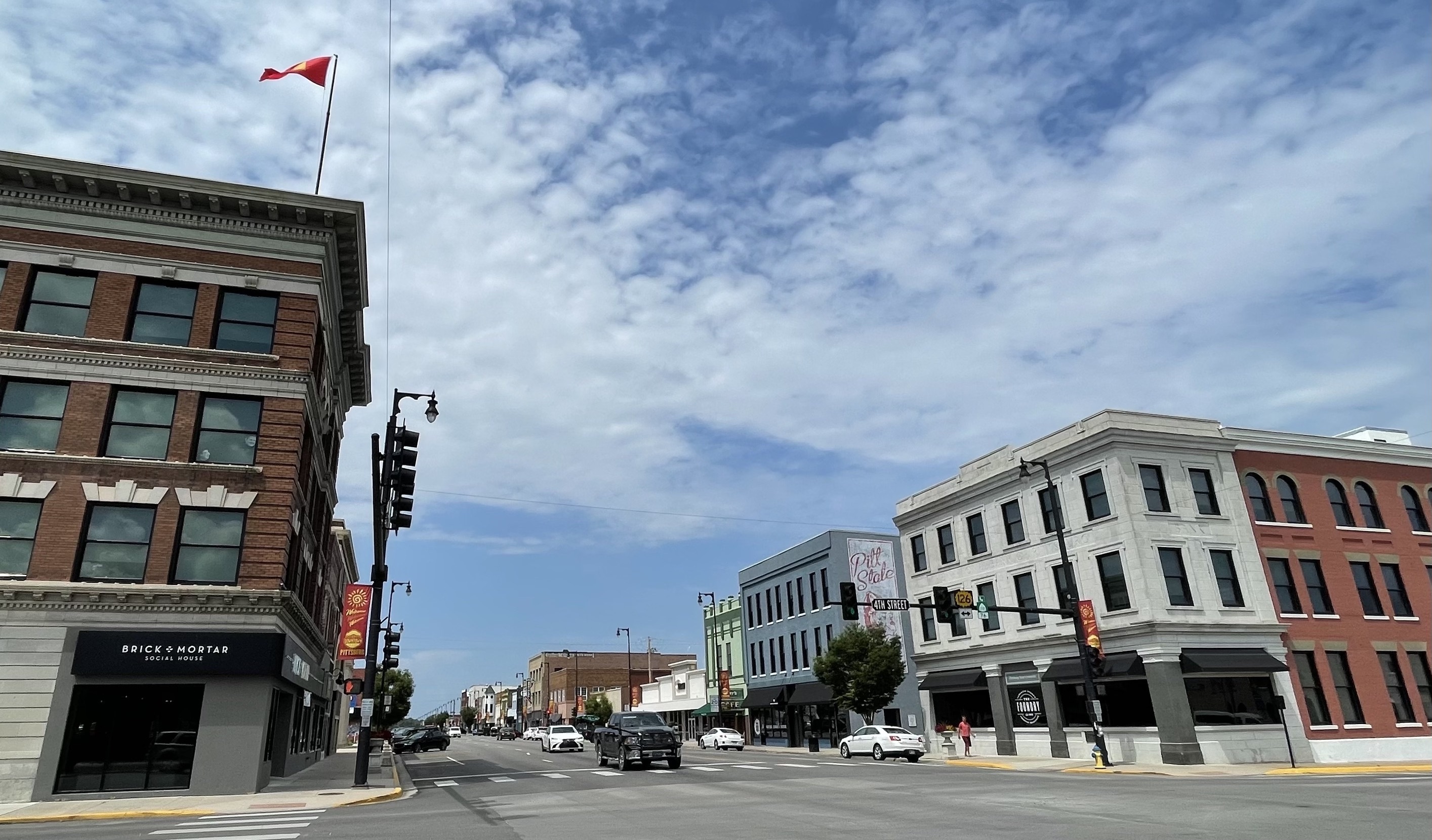
Pittsburg sits in the rolling hills of southeastern Kansas, serving as the seat of Crawford County and a regional hub for the surrounding agricultural and former mining landscape. With a population of approximately 20,000, the city carries the laid-back feel of a Midwestern college town, anchored by Pittsburg State University and the steady hum of campus life, Division II athletics, and community events that draw visitors throughout the year. Its brick storefronts, small-town rhythm, and proximity to the Ozark foothills make it a comfortable stopover for travelers crossing the four-state region, and it lies roughly 120 miles south of Kansas City along the historic Route 69 corridor.
One of the city's defining institutions is Pittsburg State University, home to the Gorillas athletic programs and a respected college of arts and sciences. The campus hosts regular games, concerts, and graduation ceremonies that bring family members and alumni into town, creating a dependable baseline of short-term-rental demand throughout the academic year. Visitors can stroll the tree-lined grounds, attend performances at the Bicknell Family Center for the Arts, and explore the university galleries without ever needing to leave the city.
Just a short drive east of Pittsburg, in neighboring Newton County, Missouri, the George Washington Carver National Monument preserves the childhood homestead of the famous agricultural scientist, with a roughly one-mile nature trail, a visitor center, and a working plantation garden that interprets the landscape Carver grew up in. It is the kind of stop that fits easily into a longer road trip through the Ozarks and is about a 40-minute drive from downtown Pittsburg.
Southeast of Pittsburg, about 35 miles away, lies Joplin, Missouri, the largest city in the region and a useful anchor for broader excursions. Visitors passing through the area often pair a stay in Pittsburg with a day exploring Joplin's revitalized downtown, its Route 66 heritage, and Schifferdecker Park, or continue south toward Table Rock Lake and the broader Ozark region for boating, hiking, and fishing getaways that draw weekend travelers from across the Midwest.
The region's coal- and zinc-mining past is still visible in the small mining communities, memorials, and museums scattered across Crawford County, offering a thread of heritage tourism that appeals to genealogy travelers and history enthusiasts tracing their family roots in southeast Kansas. Combined with outdoor recreation in the surrounding state parks, the university's year-round event calendar, and the convenient midpoint position between Kansas City, Tulsa, and the Ozarks, Pittsburg offers short-term-rental owners a steady mix of visiting-family traffic, road-trippers, and outdoor travelers looking for an affordable base in a quiet, authentic corner of the central United States.
Want to know if a property in Pittsburg is a good investment?
Enter an address to get instant revenue potential and comps.