
Greenfield, Indiana
Want to see how Greenfield compares to other top cities in Indiana? Explore all city regulations in Indiana. →
Greenfield, IN
Challenging To Investors
STR Regulations for Greenfield, Indiana
Important note on sources: The provided materials include a 2025 Planned Unit Development (PUD) ordinance that prohibits short‑term rentals within the specific development (The Villas at Hawk’s Tail), a Greenfield general FAQ page that states STRs are allowed with a permit, a Facebook group post with no usable content, and a Massachusetts STR regulatory guide that is not applicable to Indiana. Where city- or county-specific details are unavailable in the provided documents, I’ve flagged them explicitly and provided a plan to obtain definitive answers.
1) Are short‑term rentals allowed in Greenfield, IN?
- City-wide status: The Greenfield FAQ page indicates that short‑term rentals are permitted subject to obtaining a permit and complying with code requirements. The page is therefore the explicit, authoritative statement that STRs are allowed in Greenfield with conditions. This answers the “allowed or not” question definitively at the municipal level.
- Site-specific example: Within The Villas at Hawk’s Tail PUD (Ordinance No. 2025/04), short‑term rentals (e.g., Airbnb/VRBO) are expressly prohibited. Rental of dwellings for less than twelve (12) months is also prohibited unless the HOA Board grants a hardship exception. This highlights that even when STRs are permitted city-wide, PUDs, subdivisions, HOA covenants, and other private instruments may impose stricter prohibitions or limits.
Bottom line: Yes, Greenfield allows short‑term rentals under city rules and permitting; however, individual properties—especially those within PUDs or with restrictive covenants—may be prohibited.
2) How to start a short‑term rental business in Greenfield, IN (practical steps)
- Confirm zoning and land use eligibility:
- Verify your property’s zoning district and whether STRs are a permitted use (either by right or by special exception). The Greenfield FAQ indicates an STR permit is required; you should confirm with the City that your property’s zoning allows the intended use and occupancy.
- If your property is part of a PUD, HOA, or subdivision with covenants, review the recorded restrictions. As demonstrated by The Villas at Hawk’s Tail, such documents can prohibit STRs even where the underlying zoning might be neutral.
- Engage the City’s permitting process:
- Identify the permitting authority (likely Planning/Zoning and Building/Code Enforcement). Apply for any STR or related permits before listing the property for short‑term stays. The FAQ implies an STR permit process exists; request the application and checklist, including plan review timelines and fees.
- Prepare for safety and code compliance:
- Ensure the property meets applicable building/fire/life-safety standards for transient occupancy where applicable. For homes converted to short‑term rental use, the City may require occupancy classifications (e.g., R‑1 transient lodging vs. single-family dwelling) and may require additional safety features (e.g., smoke alarms, carbon monoxide alarms, egress, fire extinguishers, and—depending on occupancy classification—sprinklers or alarms).
- Inspections: Expect occupancy and safety inspections. Do not operate until approvals and final inspections are completed.
- Special sites: If your STR includes pools or hot tubs, additional safety and operational requirements may apply.
- Taxes and registrations:
- State sales and use tax: Indiana generally applies sales tax to short‑term rental transactions. If you furnish lodging for fewer than 30 days per stay, you should register with the Department of Revenue (DOR) and collect/remit state sales tax.
- County innkeeper’s/admissions tax: Indiana counties may impose a local innkeeper’s or admissions tax (commonly 5%). Hancock County’s rate, if any, was not provided in your materials. Confirm with the Hancock County Treasurer/Auditor whether a county innkeeper’s tax applies to STRs, then register and collect as required.
- Income tax: Report STR income for federal and Indiana state income tax purposes. Consider using a registered tax professional for compliance.
- Insurance:
- Obtain appropriate liability coverage. Coordinate with your lender or property management company (if any) to ensure policy terms cover transient rentals.
- Operations:
- Adopt guest policies (quiet hours, occupancy limits, parking, trash/recycling). Provide a local contact or emergency contact. Maintain logs if required by permit conditions.
- Verify local trash/recycling pickup rules; arrange service accordingly to avoid violations.
- Listings: Comply with platform policies (e.g., Airbnb, VRBO) and ensure your permit number (if required) and local contact are included in listings.
3) Required documents, permits, licenses, and guidelines
Based on the Greenfield FAQ and standard municipal practice (confirm exact requirements with the City):
- City short‑term rental permit
- Application, site plan, floor plan, photos, owner/agent information, occupancy limits, safety measures
- Fees and review timelines
- Possibly annual renewal and inspections
- Building/fire/life-safety approvals
- Occupancy classification review and compliance
- Smoke/CO alarm compliance, egress, fire extinguishers
- Additional features if classified as transient lodging (R‑1)
- Zoning determination (as applicable)
- If special exceptions or conditional use approvals are required in your zoning district, seek them before applying for the STR permit
- PUD/HOA/CC&Rs approval
- Written confirmation that STRs are allowed within your subdivision or association
- State registrations
- Indiana DOR sales tax account (for lodging transactions)
- County taxes
- Hancock County innkeeper’s/admissions tax registration (if applicable)
- Business operations
- Guest policies (quiet hours, parking, occupancy), safety instructions, emergency contacts
- Local contact or property manager identification (if required by permit)
4) Specific regulations for STRs in Greenfield, Hancock County, and Indiana
- Greenfield (municipal)
- Status: STRs allowed subject to permitting (per Greenfield FAQ)
- Confirm any specific rules directly with the City (occupancy caps, parking, noise, inspections, renewal, fees)
- Hancock County
- No county-specific STR rules were provided in your materials. Counties may levy an innkeeper’s/admissions tax—commonly 5%—on lodging; confirm Hancock County’s rate and applicability to STRs with the County Treasurer/Auditor.
- Indiana (state)
- Sales/use tax: Generally applies to short‑term rental transactions; register with DOR.
- Other regulatory categories (e.g., state health, fire safety) apply as with any lodging operation; confirm any specialized state requirements if applicable to your property type.
- Note: The FRCOG Massachusetts guide is not applicable to Greenfield/Indiana.
5) Contact information (Greenfield, local authority in charge of STRs)
Because the provided materials include only general City offices and a direct page that lists an STR permit, use the following approach:
- Primary contact for STRs and permits:
- City of Greenfield, Planning/Zoning Department (and/or Code Enforcement as indicated by the City)
- Phone: (317) 477‑1300
- Address: 10 S. State Street, Greenfield, IN 46140
- Email: planning@greenfield.in.gov
- Website: www.greenfieldin.org/planning
- Building/fire/life-safety and inspections:
- City of Greenfield, Building/Code Enforcement Department
- Phone: (317) 477‑1300
- Address: 10 S. State Street, Greenfield, IN 46140
- Website: www.greenfieldin.org
- Taxes:
- Indiana Department of Revenue (DOR): www.in.gov/dor
- Hancock County Treasurer/Auditor: Confirm county innkeeper’s/admissions tax and registration requirements
For exact department contacts and addresses in Greenfield, check the City’s contact directory or call the Planning/Zoning Department main line at (317) 477‑1300.
6) Links to source pages
- www.greenfieldin.org/phocadownload/Council/Mar-12-2025/5%20-%20ordinance%20no.%202025-04%20pud%20district%20from%20ss%20on%203-7-2025.pdf
- Establishes site-specific prohibition on STRs within The Villas at Hawk’s Tail PUD; provides extensive development standards and confirms covenants/CC&Rs apply (including STR prohibition and rental restrictions).
- www.greenfieldin.org/
- City website; use to locate STR permitting and Planning/Zoning contact details.
- frcog.org/wp-content/uploads/2021/05/Short-Term-Residential-Rentals-Final-June-2021-6-3-21.pdf
- Massachusetts-focused STR regulatory guide; provided contextually only (not applicable to Greenfield/Indiana).
- www.facebook.com/groups/118756611200/posts/10163224631456201/
- Post contains no usable content for Greenfield STR regulation.
7) What to verify immediately (priority actions)
- Confirm Greenfield’s STR permit application, checklist, occupancy limits, parking/quiet requirements, renewal cycle, and fees.
- Confirm whether your zoning district allows STRs (by right or special exception) and whether any neighborhood overlays or PUD restrictions apply.
- Confirm Hancock County’s innkeeper’s/admissions tax rate and registration requirements (if any) and register with the County if applicable.
- Confirm state sales tax registration and collection obligations for short‑term rentals through Indiana DOR.
- If your property is part of a PUD or HOA, obtain written confirmation that STRs are permitted; otherwise, consider alternative investment locations.
This guide reflects only the information provided in your materials and Flagship Municipal Online Support content. City-specific permitting details and any Hancock County tax requirements must be confirmed directly with Greenfield and the County before listing or operating an STR.
What do Airbnb hosts actually earn in Greenfield?
Greenfield hosts earn a median $21,866/year with $147 ADR and 54% occupancy.
Top performers pull in $35,011+ per year.
See the full Greenfield market breakdownNext step
Found a property in Greenfield?
Paste any address and get estimated revenue, cash-on-cash return, and comparable STR performance in under 5 minutes. 3 free analyses per day.
Free brief
Get the free Greenfield STR Investment Brief
Revenue data, top neighborhoods, seasonal trends, and the key regulations for Greenfield, Indiana in one email.
Greenfield
Market Saturation Score
Photos of Greenfield


Overview of Greenfield
Greenfield, Indiana sits in the heart of Hancock County, where it serves as the county seat and is home to approximately 23,000 residents. This small city blends a classic Midwestern small-town atmosphere with easy access to a major metropolitan area, located roughly 25 miles east of Indianapolis. Greenfield is best known for its deep connection to beloved "Hoosier Poet" James Whitcomb Riley, who spent his formative childhood years there in the mid-1800s, and the town proudly carries forward that literary heritage through annual festivals, museum tours, and a charming historic downtown.
The Riley Birthplace and Museum stands as the city's marquee cultural attraction, preserving the early home of James Whitcomb Riley, whose nostalgic poems about rural Indiana life made him one of the most popular American poets of the late 19th and early 20th centuries. The museum offers guided tours of the home and exhibits about Riley's life and the era in which he lived, and it sits just a short walk from the city center. Visitors can explore the period rooms and learn how this small Indiana town shaped the voice behind poems such as "Little Orphan Annie" and "The Raggedy Man."
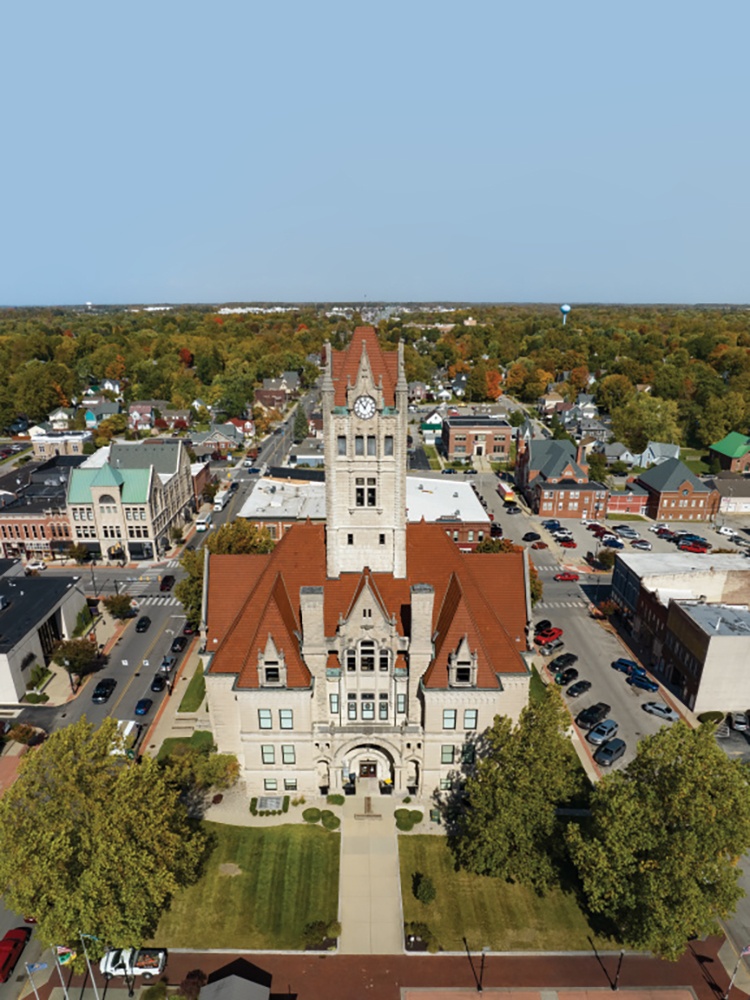
Downtown Greenfield centers around the historic Hancock County Courthouse, a stately 19th-century building anchoring a traditional town square lined with locally owned shops, cafes, and the shaded paths of Riley Park. The square is a popular gathering place for community events, including the annual Riley Days festival each October, which celebrates the poet's legacy with parades, art shows, and family activities. The walkable downtown gives visitors a sense of the kind of tight-knit community that inspired Riley's affectionate portraits of small-town Midwestern life.
Just 25 miles to the west, Indianapolis offers a full slate of major metropolitan attractions, from the Indianapolis Motor Speedway and the Children's Museum of Indianapolis to the Indianapolis Zoo and the museums lining the downtown canal. Greenfield's position along the I-70 corridor makes it a practical base for travelers who want to experience the energy of the city during the day and retreat to quieter, more affordable lodging at night. Sports fans, convention attendees, and families visiting the Indiana State Fairgrounds all find Greenfield a convenient alternative to staying in the heart of the city.
Greenfield offers short-term rental investors a compelling combination of small-town charm, a recognized cultural identity, and proximity to one of the Midwest's largest cities. Visitors who come for the Riley heritage often extend their stays to explore downtown's independent businesses, attend seasonal festivals, and use the city as an affordable, relaxed base for Indianapolis events, sports, and conventions. The balance of a walkable historic core, family-friendly attractions, and convenient interstate access makes Greenfield an appealing option for travelers seeking a quieter Indiana experience with all the amenities of a major city within a short drive.
Want to know if a property in Greenfield is a good investment?
Enter an address to get instant revenue potential and comps.