
Grinnell, Iowa
Want to see how Grinnell compares to other top cities in Iowa? Explore all city regulations in Iowa. →
Grinnell, IA
Generally Investor Friendly
STR Regulations for Grinnell, Iowa
Grinnell, Iowa: Short-Term Rental (STR) Compliance Guide
Overview: STR Status in Grinnell, IA
Yes, short-term rentals appear to be allowed in Grinnell. Grinnell’s Rental Inspection Program applies broadly to “all rental homes, hotels, and motels,” and does not explicitly prohibit short‑term rentals. The program uses a general definition of “rental property” (any non–owner‑occupied dwelling used for habitation), which includes properties rented on a transient or lodging basis. If you operate an STR, you will be treated as a rental property owner under Grinnell’s registration and inspection rules.
Note: Verify zoning or other use-specific restrictions (e.g., in certain districts or for historic properties) that might limit lodging uses. The city’s building and planning department can confirm zoning constraints for your specific property.
What do Airbnb hosts actually earn in Grinnell?
Grinnell hosts earn a median $19,795/year with $155 ADR and 43% occupancy.
Top performers pull in $22,656+ per year.
See the full Grinnell market breakdownHow to Start an STR Business in Grinnell
- Step 1: Prepare the unit(s) to meet the 2015 International Property Maintenance Code (IPMC) as adopted by the city.
- Step 2: Register each rental unit and pay the one-time $10 registration fee per unit. Registration is required annually between April 1 and May 1 (renewals at no charge if ownership has not changed). New or converted properties, or property with a change in ownership, must register within 30 days of conversion/transfer.
- Step 3: Schedule and complete an inspection. Inspection fees are $50 for the first unit plus $15 for each additional unit at the same property. Inspection scheduling can be done when notified by the city or initiated at your option by contacting the inspector.
- Step 4: Correct violations within the required timelines (life-safety issues must begin remediation within 48 hours and be fully corrected within 90 days; all other violations must be corrected before the second inspection).
- Step 5: Post‑inspection compliance and ongoing cycle management: Re‑inspection frequency depends on the number of violations (less than 6 violations → re‑inspection in 3 years; 6–10 violations → re‑inspection in 2 years; >10 violations → re‑inspection in 1 year). Pass the checklist, retain your certificate, and maintain compliance going forward.
- Step 6: Notify tenants and ensure access for inspections; ensure your owner’s representative is at least 18 years old and has keys for all portions of the property. Failure to appear for a scheduled inspection results in a $50 “No Show” fee.
- Step 7: If required, retain copies of life‑safety documentation, smoke/CO detector information, and owner/agent certifications for your records; these help you pass future inspections.
Required Documents, Permits, Licenses, and Guidelines
- Registration:
- Rental Housing Registration Form (paper or online).
- Owner and owner’s representative contact information.
- One-time $10 registration fee per unit.
- Annual renewal between April 1–May 1 (no charge if ownership unchanged).
- Inspections:
- Scheduling and consent to inspect under the IPMC; inspector notice sent by the city or initiated by owner.
- Inspection fee ($50 first unit; +$15 for each additional unit).
- Compliance with the city’s rental inspection checklist (see below).
- Certificates and Policy Acknowledgments:
- Rental Property Certificate issued upon passing or temporary certificate with time-bound remediation.
- Consent to inspection per the city’s Administrative Policy (granting permission to enter).
- Tenant Notification and Access:
- Ensure tenants are notified of inspection dates and that animals are confined during inspections (failure to confine animals halts the inspection; a re‑inspection fee will be required).
- Compliance with State Building Codes and Local Ordinances:
- 2015 International Property Maintenance Code (IPMC) — Ordinance 1467.
- Building Code Board of Appeals — Ordinance 1468.
- Rental Inspection Program — Ordinance 1469.
- Rental Code Program Administrative Policy.
- Reporting:
- Respond to complaints filed through the Rental Housing Complaint Form if applicable; resolve within required timelines.
City of Grinnell Rental Inspection Checklist Highlights (IPMC 2015)
Compliance expectations for exterior, interior, mechanical, electrical, plumbing, and fire safety systems include but are not limited to the following (items marked in red on the official checklist are life safety items):
Exterior/Structure
- House numbers at least 4 inches tall and 0.5 inch wide; unit numbering per property.
- No peeling exterior paint.
- Structural members and foundation walls in good condition.
- Sound, water‑tight roof.
- Decks, stairways, porches, balconies, and handrails structurally sound.
- Chimneys maintained and safe.
- Insect screens provided April–October.
- Doors and hardware in good working order.
- Basement openings rodent‑protected.
- Security devices (windows, doors, hatchways) functional.
- Proper grading/drainage; no nuisance discharge to sanitary sewer.
- Sidewalks/driveways in proper repair per city code.
- Free of weeds/grass >8 inches, noxious plants, and volunteer trees.
- Free of junk, rubbish, and garbage; no junk vehicles.
- No unsafe storage of combustible material.
- Off‑street parking sufficient per zoning (e.g., two spaces per dwelling unit plus one per bedroom beyond two).
- Exterior property areas do not contain indoor furniture.
Interior/Structure
- Interior and equipment maintained in good repair and structurally sound.
- Sanitary condition throughout.
- Interior surfaces (windows, doors, walls, ceilings, floors) in good, clean, sanitary condition.
- Stairs, handrails, and guards maintained and sound.
- Occupant loads per adopted ordinance.
Plumbing
- Fixtures maintained in good working order.
- Each dwelling unit must include a bathtub/shower, lavatory, water closet, and kitchen sink.
- Privacy and interior locking devices in bathrooms/toilets in multi‑unit dwellings.
- Proper connection to public or approved private water system.
- Drainage of roofs/paved areas not discharged into sanitary sewer.
Electrical
- 120/240‑volt, single‑phase service with minimum 60‑amp capacity.
- Electrical equipment in good condition; replace equipment exposed to water.
- No visible electrical hazards.
- At least two separate receptacles per habitable space.
- Laundry rooms with grounding‑type or GFCI receptacles.
- Lighting in public halls, stairways, toilet rooms, kitchens, bathrooms, laundry, and boiler/furnace rooms.
- No permanent use of flexible extension cords.
- GFCI outlets within 6 feet of water sources.
Mechanical
- Heating facilities capable of maintaining 68°F in habitable rooms, bathrooms, and toilet rooms.
- Cooking appliances and portable unvented fuel‑burning heaters cannot provide required heat.
- Tenants must be allowed to control heating facilities unless an agreement otherwise is in place.
Fire Safety
- Dual‑sensor smoke alarms on each floor, in each sleeping room, and immediately outside sleeping areas.
- Safe, continuous, unobstructed path of travel to public way.
- ABC‑rated fire extinguisher, properly inspected and tagged within 75 feet of the unit’s main entrance.
- Carbon monoxide alarm immediately outside sleeping rooms where CO sources exist or unit has an attached garage.
- Fire alarm and suppression systems properly installed, operational, and tested where required.
- Fire‑resistance ratings maintained in new construction/renovation as required.
City and County Regulations for Short-Term Rentals
City of Grinnell
- Rental Registration: Required annually April 1–May 1; one-time $10 per unit; new/converted properties and ownership transfers register within 30 days; late fee $25/day up to $1,500 after July 1.
- Inspections: Required; fee $50 first unit + $15 each additional unit at same property; re‑inspection cadence determined by violations found (<6 → 3‑year; 6–10 → 2‑year; >10 → 1‑year); major violations begin remediation within 48 hours and are corrected within 90 days; all other violations corrected before second inspection.
- Major Violations: Life‑safety issues; immediate remediation plans required within 2 business days; non‑compliance may result in certificate revocation and immediate vacation orders.
- Fees: No fee for first re‑inspection; $50 for subsequent re‑inspections; $50 “No Show” fee for missed inspections; if not paid within 14 days, municipal infraction may apply.
- Tenant Complaints: Written complaint required; inspections triggered within 10 business days; life‑safety complaints trigger re‑inspection within 48 hours (excluding weekends/holidays); if complaint has merit and violations found, owner pays $50 re‑inspection fee; if no merit and no violations, tenant may pay $100 fee; frivolous complaints may incur doubling of fees.
- Penalties: Municipal infractions — $100 first offense; $250 second; $500 third and each additional.
- Appeals: File within 60 days of initial inspection; City Manager hears within 30 days; ruling within 10 days; subsequent appeal to Building Code Board of Appeals or Public Safety Board within 10 days.
- Administration: The program is managed by the Building & Planning Department under the Building & Planning Director; policy references the 2015 IPMC and local ordinances (1467, 1468, 1469).
Poweshiek County
- The provided content does not include county-specific STR regulations. Check with county offices if you operate outside city limits or if county health/zoning rules apply.
State of Iowa
- The provided materials do not include Iowa state-level STR licensing requirements. Iowa does not mandate a statewide short‑term rental license; STRs are primarily governed by local ordinances and zoning. Iowa’s statewide smoking ban (Iowa Code 142D) applies to lodging facilities, which generally applies to STR units if they meet the definition of a “place of employment” or “public place” where smoking is prohibited. Always verify with the city and confirm whether your STR is considered a lodging facility under state law.
Contact Information (Local Authority for STR/Rental Inspections)
- Building & Planning Department (Program Administrator)
- Director: Tyler Avis
- Email: tavis@grinnelliowa.gov
- Phone: (641) 236‑2600
- Fax: (641) 236‑2626
- Address: 520 4th Avenue, Grinnell, IA 50112
- Hours: Monday–Friday, 8:00 am–4:30 pm
Key Documents and Direct Links
- Rental Inspection Program overview: www.grinnelliowa.gov/401/Rental-Inspection-Program
- Rental Code Program Administrative Policy: www.grinnelliowa.gov/DocumentCenter/View/2070/Rental-Code-Program
- Rental Housing Registration Form (download): www.grinnelliowa.gov/DocumentCenter/View/2072/Rental-Housing-Registration-Form
- Rental Unit Registration Form (online): www.grinnelliowa.gov/FormCenter/Building-Planning-5/Rental-Unit-Registration-Form-44
- Rental Inspection Checklist (download): www.grinnelliowa.gov/DocumentCenter/View/2067/Inspection-Checklist
- Ordinance 1467 — International Property Maintenance Code: www.grinnelliowa.gov/DocumentCenter/View/2069/Ordinance-1467-Intl-Property-Maintenance
- Ordinance 1468 — Building Code Board of Appeals: www.grinnelliowa.gov/DocumentCenter/View/2071/Ordinance-1468-State-Building-Code
- Ordinance 1469 — Rental Inspection Program: www.grinnelliowa.gov/DocumentCenter/View/2068/Ordinance-1469-Rental-Inspection-Program
- Rental Housing Appeal Form: www.grinnelliowa.gov/DocumentCenter/View/2066/Rental-Housing-Appeal-Form
- Rental Housing Complaint Form: www.grinnelliowa.gov/DocumentCenter/View/2065/Rental-Housing-Complaint-Form
- Rental Program Presentation (Sept. 2019): www.grinnelliowa.gov/DocumentCenter/View/2112/Rental-Program-Presentation
- Grinnell zoning map: www.grinnelliowa.gov/338/Zoning-Map
- City of Grinnell — Rental & Equipment Fees and Policies (reference for city fee structures; includes program rates): grinnell.granicus.com/MetaViewer.php?view_id=1&clip_id=100&meta_id=11985
- Summer Housing in Grinnell (student-oriented; general sublet information; not STR-specific): career.grinnell.edu/resources/summer-housing-in-grinnell/
Best Practices for STR Operators in Grinnell
- Register each unit and keep ownership/contact details current.
- Maintain documentation that demonstrates compliance with IPMC life-safety items (smoke/CO alarms, fire extinguisher, electrical/plumbing systems).
- Establish reliable tenant communication and access protocols for inspections; identify a capable on-site representative ≥18 years old.
- Track your inspection cycle and plan proactive maintenance to reduce violations and extend re‑inspection intervals.
- Use the city’s checklists as a pre‑inspection audit tool to identify and remediate issues early.
- Respond promptly to complaints and city notices; escalate remediation plans for life-safety items within 48 hours.
- Budget for inspection fees, potential re‑inspection fees, and municipal infraction penalties to avoid operational disruptions.
This guide reflects the city’s publicly available materials and administrative policies as of the date of this analysis. Given the variability of local zoning and programmatic updates, consult the Building & Planning Department before initiating operations or making changes to your property.
Next step
Found a property in Grinnell?
Paste any address and get estimated revenue, cash-on-cash return, and comparable STR performance in under 5 minutes. 3 free analyses per day.
Free brief
Get the free Grinnell STR Investment Brief
Revenue data, top neighborhoods, seasonal trends, and the key regulations for Grinnell, Iowa in one email.
Grinnell
Market Saturation Score
Photos of Grinnell


Overview of Grinnell
Grinnell is a small city in Poweshiek County in central Iowa, with a population of approximately 9,000 residents. The community is best known as the home of Grinnell College, a highly regarded liberal arts institution whose presence gives the town a distinctly academic, walkable character. Grinnell sits roughly 55 miles east of Des Moines, the nearest major city, along the Interstate 80 corridor that connects Iowa's two largest metropolitan areas. It serves as a quiet, charming gateway to central Iowa's rolling farmland, small-town heritage, and outdoor recreation.
Grinnell College is the cultural and intellectual anchor of the community. Founded in the mid-nineteenth century, the college is a selective liberal arts school whose campus includes the Faulconer Gallery, an acclaimed college art museum, along with wooded walking paths that are open to the public. Visitors come to town for college events, performances, lectures, athletic contests, and reunions, providing a steady stream of year-round guests. The leafy campus sits within easy walking distance of the central business district, which keeps visitor traffic concentrated and walkable.
A short drive west of Grinnell brings visitors to Rock Creek State Park, a popular outdoor recreation area known for its lake, woodlands, and rolling prairie. The park offers fishing, boating, swimming, camping, and several miles of hiking trails, drawing outdoors enthusiasts from across central Iowa. It is a particularly appealing destination for short-term rental guests looking for a day in nature without venturing far from town, and the park sees heavy use during the warm-weather months.
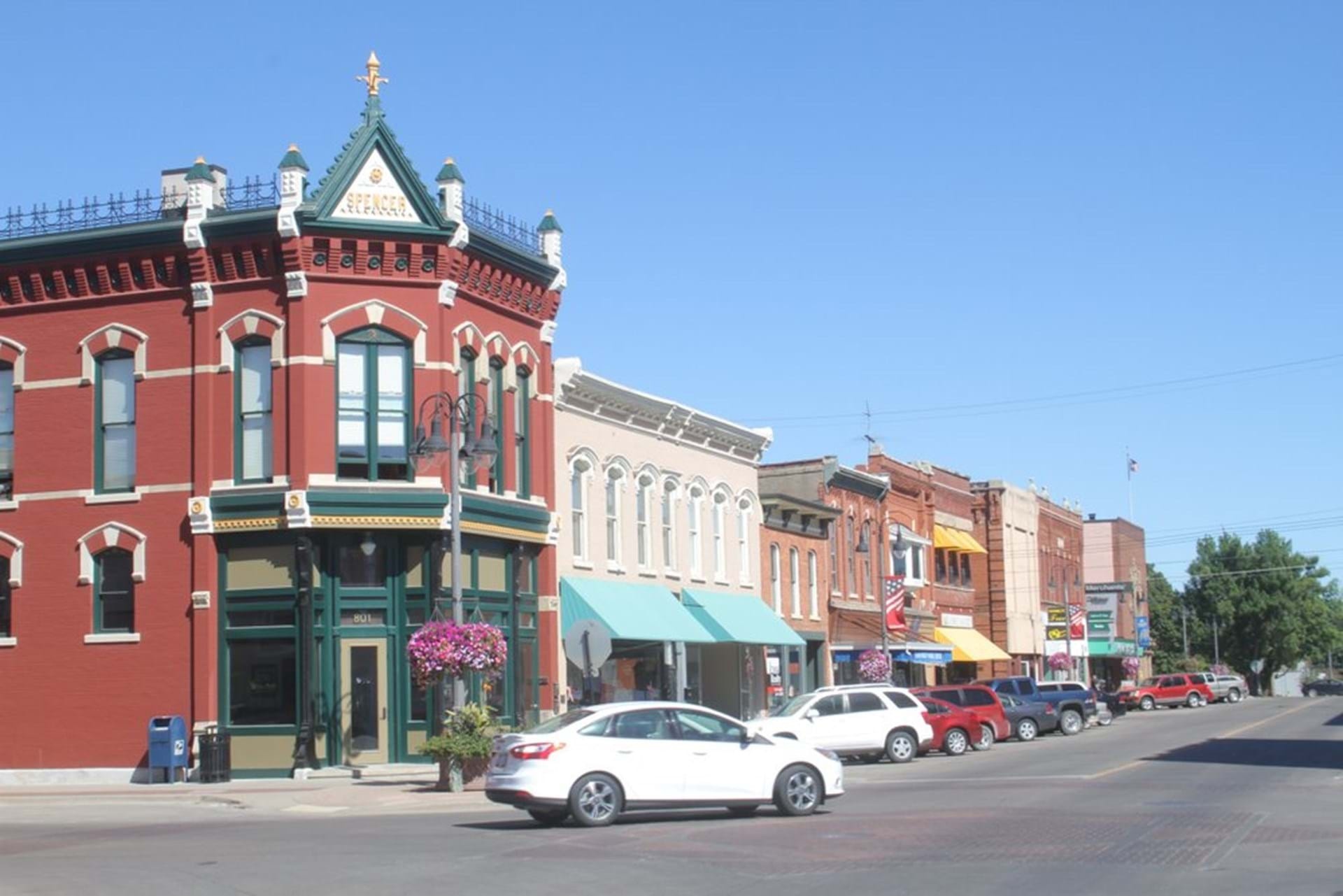
Downtown Grinnell centers on a compact, walkable commercial square ringed by locally owned shops, restaurants, and historic brick buildings. The area reflects the town's late-nineteenth-century origins as a railroad community, and several structures contribute to the downtown's historic character. Visitors can browse bookstores and boutiques, dine at locally owned eateries, and enjoy a pace of life that feels unhurried. The downtown's intimacy makes it easy for guests to park once and explore on foot.
For those interested in motorsports, the Iowa Speedway in nearby Newton is about a 20-minute drive west along I-80 and hosts NASCAR, IndyCar, and other racing events that draw large crowds during race weekends. This makes Grinnell a convenient, more affordable base for race fans who prefer a quieter alternative to staying in Newton itself. The town's central Iowa location also positions guests within easy day-trip distance of Des Moines attractions, the Amana Colonies, and the broader Iowa landscape.
Grinnell combines academic charm, small-town hospitality, and convenient access to both Des Moines and Iowa City, making it a compelling base for short-term rental investors. Its mix of year-round college visitors, summer lake-goers heading to Rock Creek State Park, race fans during Iowa Speedway events, and travelers exploring central Iowa's scenic byways creates a diversified demand pattern. The walkable downtown, historic architecture, and proximity to Interstate 80 make the town both easy to operate in and attractive to a wide range of guests.
Want to know if a property in Grinnell is a good investment?
Enter an address to get instant revenue potential and comps.