
Saint James City, Florida
Want to see how Saint James City compares to other top cities in Florida? Explore all city regulations in Florida. →
Saint James City, FL
Generally Investor Friendly
STR Regulations for Saint James City, Florida
Executive summary
- Are STRs allowed? Yes—short‑term rentals are legal in Saint James City, Florida. Saint James City does not currently impose city‑specific STR regulations; operation is governed by state law (primarily Florida DBPR for vacation rental licensing) and applicable state and county tax rules. Investors should verify periodically for local changes. (Sources: Checkmate Rentals; Lodge Compliance)
How to start a short‑term rental business in Saint James City
- Confirm your operating model
- Rentals shorter than 30 days: Florida Department of Business and Professional Regulation (DBPR) vacation rental license is required for the property. If you host guests in your own home and remain on‑site for the entire stay, the license is not required (hosted rentals are exempt). (Lodge Compliance)
- Rentals 30–90 days: A state license is not required, but this still constitutes a short‑term rental for tax purposes. You must register and collect/remit applicable state sales tax and local tourist taxes. (Lodge Compliance)
- Obtain the DBPR Vacation Rental License (if applicable)
- File the DBPR application, pay the fee (varies by county/unit count), provide property details, complete human trafficking awareness training (for applicable staff), and—if applicable—obtain a balcony inspection certificate. (Lodge Compliance)
- Register for taxes
- Register with the Florida Department of Revenue (DOR) for a sales tax certificate to collect/remit:
- State sales tax (6%) and any applicable discretionary sales surtax.
- Local tourist development taxes (transient rentals taxes) administered by Lee County Tax Collector. (Lodge Compliance)
- Register with the Florida Department of Revenue (DOR) for a sales tax certificate to collect/remit:
- Set up tax collection and remittance
- Collect the 6% state sales tax plus discretionary surtax and any local tourist development tax on each booking. File returns and remit to DOR and the county as required. (Lodge Compliance)
- Compliance and risk controls
- Align with Florida’s 2023 legislation allowing local governments to suspend vacation rental registrations for violations related to noise, parking, or trash, and to set occupancy limits—your operation must comply. Maintain adequate insurance and follow HOA/condo rules where applicable. (Lodge Compliance)
- Operational readiness
- Optimize the listing with high‑quality photos, accurate descriptions, and competitive/dynamic pricing aligned to the market’s seasonality.
- Provide essential amenities: Wi‑Fi, air conditioning, and TV are expected by guests in this market.
- Establish housekeeping, maintenance, and 24/7 guest communication protocols. (Checkmate Rentals; AirROI)
Required documents, permits, licenses, and guidelines
- DBPR Vacation Rental License (for rentals < 30 days and where the host is not on‑site for the full stay)
- Property details and proof of ownership/authority.
- Human trafficking awareness training documentation (as required).
- Balcony inspection certificate, if applicable. (Lodge Compliance)
- Florida DOR Sales Tax Certificate
- Registration application (online) and ongoing filing obligations for sales tax collection/remittance. (Lodge Compliance)
- Tax collection/remittance
- State sales tax (6%) plus discretionary sales surtax.
- Local tourist development taxes (Lee County) administered by the Tax Collector. (Lodge Compliance)
- Insurance and safety
- Maintain appropriate property liability and property damage coverage; adhere to safety standards (e.g., working smoke alarms, safe balconies where applicable). (General practice; reinforced by Lodge Compliance balcony note)
- HOA/condo/community rules
- Confirm that STRs are allowed by your community’s governing documents; obtain written approval where required. (Lodge Compliance)
Specific regulations for STRs in this city, county, and state
- City level (Saint James City)
- No Saint James City–specific STR ordinances identified in the provided sources. Investors should monitor local government updates for any future changes. (Checkmate Rentals)
- County level (Lee County)
- Tourist development taxes apply to transient rentals; administered by the Lee County Tax Collector. Hosts must register and remit county lodging taxes in addition to state sales tax. (Lodge Compliance)
- State level (Florida)
- Definition: Short‑term rental is any residential rental/lease with a term of less than 90 days; DBPR defines specific applicability thresholds. (Lodge Compliance)
- Licensing:
- Rentals shorter than 30 days require a DBPR vacation rental license (unless the rental is a hosted stay where the host is on‑site the entire time).
- Rentals advertised or rented more than three times per year for short periods may also require DBPR licensing—confirm current thresholds with DBPR. (Lodge Compliance)
- Taxes:
- State sales tax (6%) and discretionary sales surtax.
- Local transient rental/tourist development taxes (Lee County).
- Providers charging for stays of six months or less are generally considered transient rental accommodations providers and must register with DOR for sales tax. (Lodge Compliance)
- Local government enforcement powers (2023 law):
- Local governments may suspend vacation rental registrations for violations related to noise, parking, or trash, and may set occupancy limits. Hosts must maintain compliance to avoid suspensions. (Lodge Compliance)
- Homestead exemption risk:
- Leasing a homestead residence for short periods may jeopardize Florida homestead tax exemption; consult a tax advisor. (Lodge Compliance)
- Length of stay:
- No specific state minimum length‑of‑stay restriction for STRs; however, local jurisdictions may impose their own rules. (Lodge Compliance)
Contact information (local authority in charge of STRs)
- City level
- No city‑specific STR authority identified. For any future ordinances, monitor Saint James City/Lee County communications. (Checkmate Rentals)
- County level (Lee County—Tourist Development Tax)
- Lee County Tax Collector – Tourist Development Tax
- Website: leetax.org
- Phone: 239‑533‑4723 (Lee County Tax Collector main line)
- Location: 2480 Thompson St., 2nd Floor, P.O. Box 2190, North Fort Myers, FL 33918
- Lee County Tax Collector – Tourist Development Tax
- State level (Licensing and Sales Tax)
- Florida Department of Business and Professional Regulation (DBPR) – Vacation Rentals
- Phone: 850‑487‑1395
- Website: dbpr.state.fl.us
- Florida Department of Revenue (DOR) – Sales Tax
- Phone: 877‑357‑3725
- Website: flrevenue.org (Sales tax registration and filing)
- Florida Department of Business and Professional Regulation (DBPR) – Vacation Rentals
Links to source pages
- Checkmate Rentals – Saint James City STR overview and management guidance
- Lodge Compliance – Florida STR rules; licensing, taxes, and local enforcement context
- AirROI – Saint James City market analysis and STR environment overview
- Lodge Compliance – Saint James City local regulation index (listed jurisdiction)
Practical investor checklist
- Confirm licensing applicability based on your stay durations and hosting model.
- Secure DBPR vacation rental license (if required) and complete any training/certifications.
- Register for a DOR sales tax certificate and set up tax collection (state + county).
- Establish a compliant tax remittance cadence for state and local lodging taxes.
- Validate HOA/condo/building rules and obtain any necessary approvals.
- Install and maintain safety features; verify insurance coverage limits.
- Optimize pricing and listing content against Saint James City seasonality and amenities expectations (Wi‑Fi, A/C, TV).
- Implement operational SOPs (housekeeping, maintenance, guest communications, noise/parking/trash management) to mitigate enforcement risk.
What do Airbnb hosts actually earn in Saint James City?
Saint James City hosts earn a median $21,269/year with $220 ADR and 50% occupancy.
Top performers pull in $34,109+ per year.
See the full Saint James City market breakdownNext step
Found a property in Saint James City?
Paste any address and get estimated revenue, cash-on-cash return, and comparable STR performance in under 5 minutes. 3 free analyses per day.
Free brief
Get the free Saint James City STR Investment Brief
Revenue data, top neighborhoods, seasonal trends, and the key regulations for Saint James City, Florida in one email.
Saint James City
Market Saturation Score
Photos of Saint James City
Overview of Saint James City
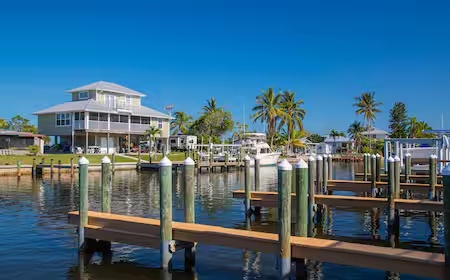
Saint James City is a small unincorporated community situated on the southern end of Pine Island in Lee County, Florida, in the southwestern part of the state. With a modest year-round population, the community has the laid-back character of an old Florida fishing village, where working shrimp boats, mangrove-lined shores, and quiet seafood spots define the rhythm of daily life. It sits near the southern tip of Pine Island, the largest island along Florida's Gulf Coast, and serves as a quiet gateway to Pine Island Sound, the Intracoastal Waterway, and a chain of smaller barrier islands and keys that lie just offshore. Saint James City lies roughly twenty to thirty miles northwest of downtown Fort Myers, the nearest major city, and is reached via a short drive across the Caloosahatchee Bridge from Cape Coral and a scenic crossing through the colorful fishing village of Matlacha.
One of the marquee draws of the area is Cayo Costa State Park, a largely undeveloped barrier island reached by passenger ferry from the southern end of Pine Island. The park offers miles of white-sand beach, shaded trails through pine flatwoods and mangroves, and excellent shelling and wildlife viewing on the Gulf side. The ferry ride from nearby Pineland, about a ten- to fifteen-minute drive north of Saint James City, typically takes around thirty minutes.
Just to the north lies the village of Matlacha, a vibrant, paint-splashed fishing community known for its brightly colored cottages, small art galleries, and seafood restaurants. Roughly a fifteen-minute drive over a small drawbridge, Matlacha is also a launching point for the Pine Island Aquatic Preserve, a network of mangrove islands and seagrass flats popular with kayakers, paddlers, and birdwatchers exploring the inland waters of the sound.
To the south and east of Saint James City, boaters and day-trippers can reach Cabbage Key, a small historic island accessed by boat or water taxi, long known for its rustic inn and tradition of serving a famous "cheeseburger in paradise" atop a small shell mound with views over the surrounding waters. The island lies a short boat ride across Pine Island Sound.
For travelers seeking a broader beach and wildlife experience, the islands of Sanibel and Captiva lie just across the causeway system to the south and are home to the J.N. "Ding" Darling National Wildlife Refuge, one of the largest undeveloped mangrove estuaries in the country and a renowned spot for birdwatching, kayaking, and a four-mile scenic wildlife drive. Reaching the refuge from Saint James City typically takes about forty-five minutes to an hour by car, depending on traffic across the bridges.
Saint James City appeals to short-term rental visitors because it offers something increasingly rare on Florida's Gulf Coast: a quiet, authentic small-island atmosphere within easy reach of world-class beaches, state parks, and wildlife areas. Its position at the southern tip of Pine Island places it at the doorstep of Pine Island Sound's boating and ferry routes, while the road network through Matlacha connects it to the dining, shopping, and recreational opportunities of greater Lee County. For travelers who want to pair slow, sunset-over-the-bay evenings with day trips to some of Southwest Florida's most beloved natural attractions, Saint James City makes a memorable and distinctive base.
Want to know if a property in Saint James City is a good investment?
Enter an address to get instant revenue potential and comps.