
Orlando, Florida
Want to see how Orlando compares to other top cities in Florida? Explore all city regulations in Florida. →
Orlando, FL
Challenging To Investors
STR Regulations for Orlando, Florida
Overview: Are Short-Term Rentals Allowed in Orlando, FL?
Short-term rentals are explicitly allowed in Orlando, FL, but with significant restrictions and regulatory requirements. The City of Orlando defines short-term rentals as stays of less than 30 days and has implemented a comprehensive regulatory framework that distinguishes between different types of temporary lodging arrangements.
Important: Orlando has strict limitations on whole-home rentals. Individual homeowners may NOT rent their entire home under City of Orlando home sharing law (e.g., Airbnb, VRBO). Only partial rentals where the owner lives on-site are permitted for stays under 30 days.
What do Airbnb hosts actually earn in Orlando?
Orlando hosts earn a median $42,611/year with $200 ADR and 71% occupancy.
Top performers pull in $63,156+ per year.
See the full Orlando market breakdownHow to Start a Short-Term Rental Business in Orlando
Step 1: Determine Your Property's Jurisdiction
First, verify that your location is within the City of Orlando limits. Search for your address at www.ocpafl.org and look at "Municipality." If it says "Unincorporated," contact Orange County Government about its short-term rental laws.
Step 2: Understand Permissible STR Categories
Orlando categorizes short-term rentals into five distinct types with different requirements:
1. Home Share (Owner-Occupied Partial Rental)
- Rent up to half of bedrooms while living on-site
- 1-29 day stays
- Host must be present during guest stays
- Single booking at a time
- Maximum 4 unrelated persons per booking or 2 persons per room (whichever is less)
2. Bed & Breakfast
- Owner-occupied facility with "continental" breakfast service
- 1 day to seasonal stays
- Maximum 2 rooms/lodging units in residential districts
- Maximum 8 rooms/lodging units in non-residential districts
- 9+ rooms classified as hotel/motel
3. Group Housing
- Owner-occupied, 7+ day minimum stays
- Kitchen facilities required
- Includes hostels, boarding houses, dormitories
- No direct care or supervision provided
4. Commercial Dwelling Unit
- Entire living space rental
- 7-29 day minimum stays
- Requires appropriate zoning and Business Tax Receipt
5. Hotel/Motel
- 1-7 day stays
- Commercial operation requiring Business Tax Receipt
- Includes timeshares and condotels
Step 3: Verify Zoning Compliance
Use the city's zoning portal at orlando.gov/zoning to confirm your property's zoning district allows your intended STR category. Not all uses are permitted in all zoning categories.
Step 4: Complete Required Inspections
Ensure all living spaces are properly inspected and permitted. DIY conversions (garage enclosures, etc.) require final inspection approval before renting.
Required Documents, Permits, Licenses, and Guidelines
Home Share Registration Requirements
Essential Documents:
- Home Sharing Registration application
- Two forms of proof of primary residency
- Total bedroom count verification
- If tenant-operated: notarized permission from property owner
- If in HOA: approval letter from homeowners association
Permits and Licenses:
- Home Sharing Registration (annual renewal required)
- Proof of registration must be linked to all online advertising
Fees:
- First year: $275
- Subsequent years: $100 (owner-occupied) or $125 (non-owner occupied)
Bed & Breakfast Requirements
Essential Documents:
- Business Tax Receipt (orlando.gov/permits)
- Zoning compliance verification
- Owner-occupancy documentation
Permits and Licenses:
- Business Tax Receipt required
- Potential special approvals from City Planning
Commercial Dwelling Unit/Hotel/Motel Requirements
Essential Documents:
- Business Tax Receipt
- Zoning Official Letter of Determination
- Commercial use permits
General Requirements for All STR Types
- Compliance with building and fire codes
- Proper permitting for any structural modifications
- Tax registration with appropriate authorities
- Insurance coverage verification
Specific Regulations: City, County, and State Level
City of Orlando Regulations
Home Sharing Limitations:
- No whole-home rentals under 30 days allowed for individual homeowners
- 50% bedroom limit: Only up to half of bedrooms may be rented
- Single booking rule: Only one booking permitted at a time
- Owner presence required: Host must live on-site and be present during stays
- HOA compliance: Written approval required from homeowners associations
- Advertising requirements: Registration proof must be displayed in all online listings
Occupancy Limits:
- Maximum 4 unrelated persons per booking
- Maximum 2 persons per room (whichever is less)
- Single booking only (no multiple simultaneous guests)
Prohibited Activities:
- Operating as "group homes" (evidence includes partitions, multiple locks, individually kept equipment)
- Renting entire units without appropriate commercial zoning and permits
- Multiple simultaneous bookings
Orange County (Unincorporated Areas) Regulations
- Only approximately 4% of Orange County is zoned for short-term rentals
- County collects tourist development taxes on STRs
- Different regulatory framework applies to unincorporated areas
- Contact Orange County Comptroller (www.occompt.com) for county-specific requirements
Florida State Regulations
- Florida statutes govern broader hospitality industry standards
- State tax collection requirements for temporary accommodations
- Compliance with Florida's landlord-tenant laws for longer-term rentals (30+ days)
- Business registration and tax obligations at state level
Contact Information for Local Authorities
City of Orlando - Primary Contact
City Planning Division
- Phone: 407.246.2269
- Email: cityplanning@orlando.gov
- Website: orlando.gov/Initiatives/Home-Sharing-Registration
City Hall Address: 400 South Orange Avenue Orlando, Florida 32801 Phone: 407.246.2121 Hours: Monday-Friday 8 a.m. to 5 p.m.
Code Enforcement Division
For reporting violations or compliance issues:
- Phone: 407.246.2686
- Website: orlando.gov/Report-a-Problem/Report-a-Code-Enforcement-Violation
Business Tax Receipts
- Website: orlando.gov/permits
- Application Portal: digitalpermits.orlando.gov
Orange County (Unincorporated Areas)
Orange County Comptroller
- Website: www.occompt.com
- Contact for county-specific STR regulations outside city limits
Important Links to Source Pages
Official City of Orlando Resources
- Short-Term Rentals Fact Sheet
- Home Sharing Registration
- Apply for Home Sharing Registration
- City Code of Ordinances
- Business Tax Receipt Applications
- Zoning Portal
Property and Zoning Information
Compliance and Enforcement
Investment Considerations and Best Practices
Market Viability
- Orlando's STR market is highly regulated with significant limitations on whole-home rentals
- Home sharing (partial rentals) represents the primary opportunity for individual investors
- Commercial operations (7+ day minimums) may offer alternative pathways for entire property investments
Compliance Risks
- Strict enforcement of home sharing limitations
- Regular inspections required
- Significant penalties for non-compliance
- HOA restrictions may further limit operations
Due Diligence Requirements
- Verify zoning compliance before purchase
- Review HOA bylaws for STR restrictions
- Confirm all permits and registrations are transferable
- Assess property tax implications of rental use modifications
This regulatory framework requires careful planning and strict adherence to maintain legal STR operations in Orlando. Investors should engage with city planning officials early in the due diligence process to ensure full compliance with all applicable regulations.
Next step
Found a property in Orlando?
Paste any address and get estimated revenue, cash-on-cash return, and comparable STR performance in under 5 minutes. 3 free analyses per day.
Free brief
Get the free Orlando STR Investment Brief
Revenue data, top neighborhoods, seasonal trends, and the key regulations for Orlando, Florida in one email.
Orlando
Market Saturation Score
Photos of Orlando


Overview of Orlando
Orlando is a major city in central Florida and the county seat of Orange County, with a city population of approximately 310,000 residents and a much larger metropolitan area that extends across several surrounding counties. Known affectionately as "The City Beautiful," Orlando carries a warm, sun-soaked character shaped by year-round mild weather, sprawling lakes, and a service economy built largely around tourism and hospitality. The city is best known internationally as the home of Walt Disney World and as the gateway to Central Florida's constellation of theme parks, but it also serves as a commercial, medical, and cultural hub for the region. Orlando sits roughly in the middle of the Florida peninsula, about 250 miles north of Miami and about 85 miles northeast of Tampa, with both Atlantic and Gulf coasts reachable within a day's drive.
Walt Disney World Resort is the headline attraction of the region and the primary driver of tourism to Orlando. Encompassing four major theme parks, two water parks, and a sprawling shopping and entertainment district, the resort draws tens of millions of visitors each year and is located about 20 miles southwest of downtown Orlando, typically a 25-to-35-minute drive depending on traffic. Universal Orlando Resort offers a different flavor of theme-park experience, with Universal Studios Florida, Islands of Adventure, and the Volcano Bay water park clustered together just a few miles from International Drive. The Universal complex is roughly 10 miles southwest of downtown, a drive of around 20 minutes. SeaWorld Orlando adds an additional marine-focused theme park just to the south of the city, and the entire I-Drive tourist corridor is lined with attractions, restaurants, and outlet shopping that cater to visitors who want variety beyond the big-name parks.
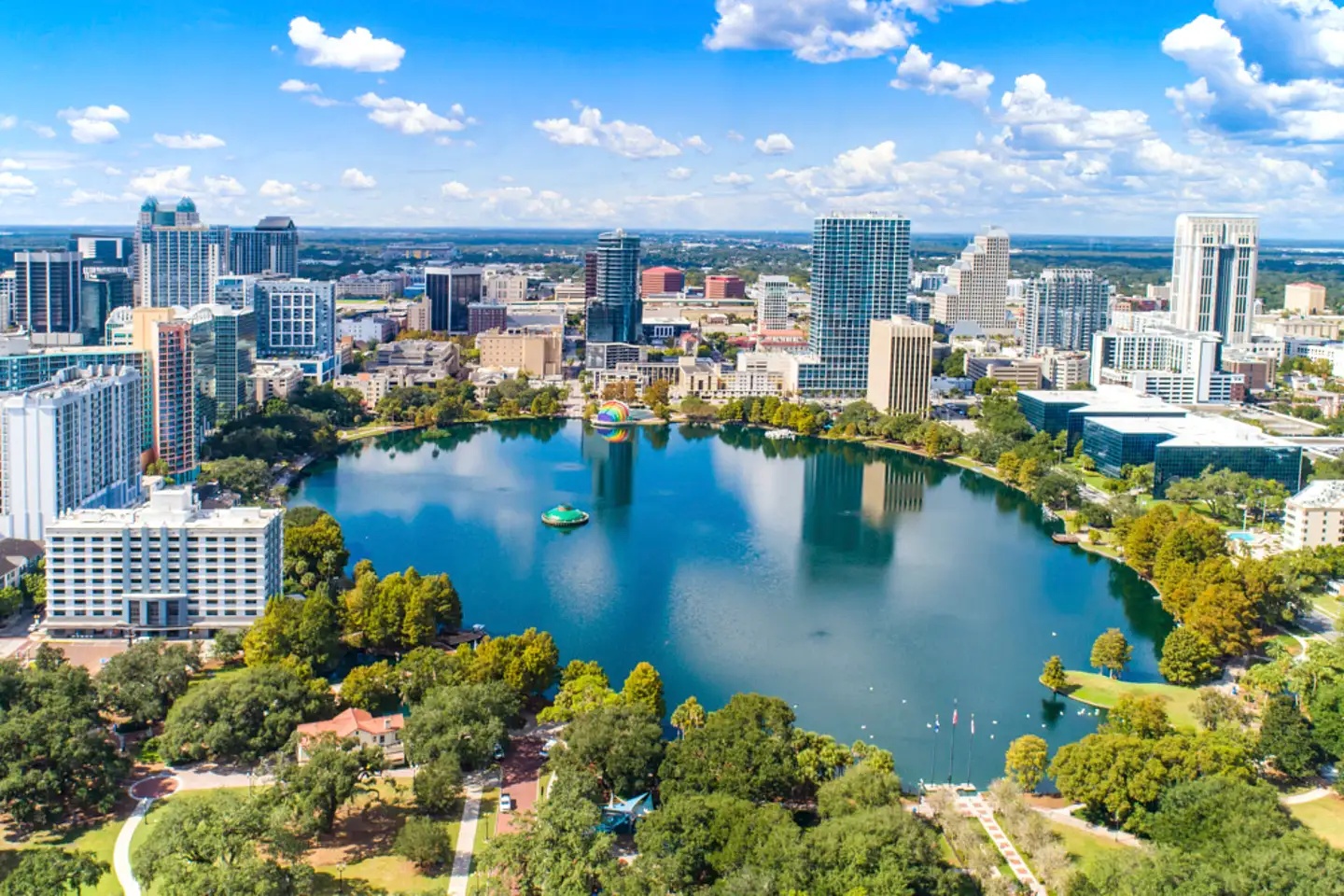
Outside the theme-park bubble, Lake Eola Park anchors downtown Orlando with a swan-boat-filled lake, a paved walking path, and a frequent schedule of outdoor events. It sits within walking distance of the central business district and the Dr. Phillips Center for the Performing Arts, making it a popular gathering spot for both residents and visitors. Just northeast of Orlando, the city of Winter Park offers a quieter counterpoint with brick-lined streets, Park Avenue boutiques and cafés, the Charles Hosmer Morse Museum of American Art, and boat tours along its chain of lakes; it is roughly a 15-minute drive from the heart of Orlando. A bit farther afield, the Kennedy Space Center on Florida's Space Coast is approximately an hour's drive east, offering a full day of exhibits, rocket displays, and the chance to view active launch facilities along the Atlantic coast.
Orlando's combination of consistent visitor demand, a deep bench of family-friendly attractions, a pleasant climate, and easy access to beaches, springs, and other Florida destinations makes it a particularly strong market for short-term rentals. Owners can serve theme-park tourists during peak travel periods while also capturing weekend and event-driven demand from the downtown core and Winter Park, giving the city a rare mix of year-round appeal and diverse guest profiles.
Want to know if a property in Orlando is a good investment?
Enter an address to get instant revenue potential and comps.