
Bloomfield, Connecticut
Want to see how Bloomfield compares to other top cities in Connecticut? Explore all city regulations in Connecticut. →
Bloomfield, CT
Generally Investor Friendly
STR Regulations for Bloomfield, Connecticut
Overview
-
Are STRs allowed in Bloomfield, CT?
- Explicit answer: The provided materials do not document any town-level prohibitions on short-term rentals in Bloomfield. Short‑term rentals are therefore likely permitted subject to general zoning, health, safety, building, and fire code compliance. Because state law delegates significant authority to municipalities, local requirements may be adopted by the Town Council or implemented administratively (e.g., via zoning, building, and fire officials). Investors must verify with Bloomfield’s Building/Zoning departments before listing or operating.
-
What to expect as a baseline
- Zoning conformity: The property must be in a zoning district that allows transient lodging uses (e.g., hotel/motel, B&B, boardinghouse) or the use must be recognized as a permitted accessory use in a residential district.
- Safety and occupancy: Units must meet building, fire, life safety, and occupancy standards applicable to lodging uses.
- State and local taxes: Connecticut sales and use taxes (6.35%) and local occupancy taxes generally apply to short‑term rentals; local rooms tax rates vary by municipality and may change. Confirm with Town Tax Collector and the State of Connecticut Department of Revenue Services.
- Licensing/permits: The Town’s standard business/building/fire processes apply. If the use is new to the property (e.g., conversion to lodging), expect plan review and inspections.
- Local records: The Building Permits portal for Bloomfield (ViewpointCloud) is the operational entry point for permit applications and inspection scheduling. See Source References.
Note on scope: The Town of Bloomfield’s “Town Policies & Plans” page and Connecticut-specific third‑party summaries provided here do not list Bloomfield‑specific STR ordinances. Hartford, CT is included only as a Connecticut example to illustrate state‑level context.
What do Airbnb hosts actually earn in Bloomfield?
Bloomfield hosts earn a median $36,142/year with $188 ADR and 59% occupancy.
Top performers pull in $46,936+ per year.
See the full Bloomfield market breakdownHow to Start a Short-Term Rental Business in Bloomfield
-
Determine eligibility and zoning
- Confirm with Planning/Zoning that the proposed use is allowed on the parcel.
- If in a residential zone, verify whether transient lodging, home sharing, or short-term rental is permitted or requires a special permit, and whether owner‑occupancy is required.
-
Establish legal status
- Register the business with the Town Clerk (if operating as a trade name, LLC, or corporation).
- Obtain any required state-level registrations (e.g., sales tax account) from the Connecticut Department of Revenue Services.
-
Secure required local permits
- Building Permit: For any construction, alteration, or change of use to lodging; plan review required.
- Fire/Life Safety: Coordinate with the local fire official for applicable inspections and approvals (e.g., egress, smoke/CO detectors, fire extinguishers, egress signage, emergency lighting, sprinklers if applicable).
- Health/Sanitary: Confirm whether any local health inspections or approvals are required for lodging use.
- Use the Town’s Building Permits portal (ViewpointCloud) to initiate applications and track status.
-
Tax compliance
- Set up Connecticut sales and use tax and local occupancy tax remittance as required by state statute and local ordinances (if any).
- Coordinate with the Town Tax Collector’s office for local tax requirements and payment procedures.
-
Safety and habitability
- Align the unit with applicable codes: building, fire, electrical, mechanical, and local occupancy limits; document life safety measures.
-
Operations and neighbor considerations
- Establish reasonable occupancy limits, guest rules, quiet hours, and property management protocols.
- Maintain responsiveness to neighbor concerns to avoid nuisance enforcement.
-
Ongoing compliance
- Renew business registrations and any local permits per local schedules.
- Maintain tax filings and documentation.
- Monitor Town Council and administrative updates for any future STR regulations or permit conditions.
Required Documents, Permits, Licenses, and Guidelines
-
Municipal/Local
- Business/Trade Name Registration (Town Clerk, if applicable).
- Building Permit(s) and inspections via ViewpointCloud (change of use to lodging; interior alterations; life safety upgrades).
- Fire/Life Safety Approvals: meet with the fire official to establish required inspections and compliance items for lodging use.
- Zoning Compliance: confirmation that the property can be used for short-term lodging (permitted use, special permit, or accessory use standards).
- Health/Sanitary: confirm whether any local health approvals are required.
-
State of Connecticut
- Sales/Use Tax Registration and ongoing filings (6.35% base rate, plus applicable local taxes).
- Compliance with state lodging/health/fire/life safety standards as applicable to transient lodging (no separate state-issued STR license is identified in the provided materials; local rules govern).
-
Operations
- Guest rules and occupancy limits; posted emergency information.
- Insurance: specialized short‑term rental coverage is strongly recommended; standard homeowners’ policies often exclude business activity and short‑term guest use.
Note: Bloomfield-specific forms, fees, and permit timelines are not included in the provided content. Use the Building Permits portal and contact the Building Department for application requirements.
Specific Regulations: Bloomfield, County, and State
-
Town of Bloomfield
- No Bloomfield‑specific STR ordinances are documented in the provided materials. Current municipal policy references describe general governance, zoning, and departmental roles but do not establish STR rules. Under Connecticut’s home rule tradition, towns may adopt STR regulations by ordinance or administrative policy at any time.
- Key compliance areas are expected to be zoning conformity, building/fire code compliance, and potential business licensing/permitting.
-
Hartford County
- Hartford County operates under Connecticut state law; the County does not publish independent STR rules in the provided materials.
-
State of Connecticut (Illustrative Connecticut Context)
- Municipal authority is strong; cities/towns may set their own STR standards (definitions, permits, occupancy caps, owner‑occupancy rules, frequency caps, etc.).
- Example (Hartford, CT):
- Hartford defines “short‑term rental” as a facility offering temporary lodging with no more than six sleeping rooms, daily cleaning, and no in‑room kitchens, in an owner‑occupied principal structure or on the same lot as an owner‑occupied accessory structure.
- Operators must obtain a zoning permit; special permits may be needed to exceed default limits.
- Occupancy is limited to no more than four adults (plus related minor children), with minimum usable floor area requirements (70 sq ft for one person, 50 sq ft for each additional person age one or older).
- The zoning administrator may revoke permits if the rental becomes a nuisance.
- Insurance is not required by Hartford zoning permit; however, operators should still consider specialized STR coverage.
- Note: Hartford’s rules are not Bloomfield’s rules. They illustrate the state’s local‑control approach and common regulatory elements.
-
Monitoring
- STR regulations are dynamic. Monitor the Town Council and Town Manager policy updates, as well as state legislation, for changes.
Contact Information
-
Town of Bloomfield – General Contact
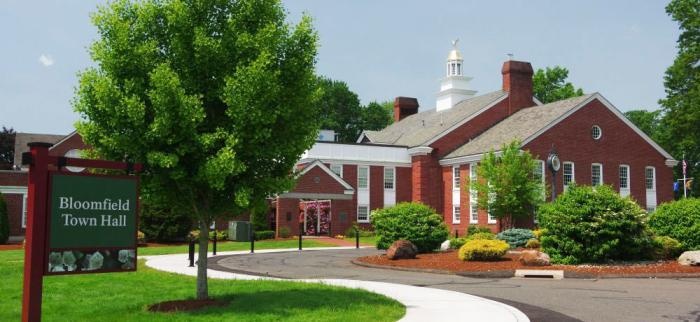
- Address: Bloomfield Town Hall, 800 Bloomfield Avenue, Bloomfield CT 06002
- Phone: 860‑769‑3500
- Hours: M, W, TH – 8:30 am – 5:00 pm; Tuesday – 8:30 am – 6:00 pm; Friday – 8:30 am – 12:30 pm
- Website: www.bloomfieldct.gov/ (Town Policies & Plans index: see Reference #1)
-
Town Manager’s Office
- Phone: 860‑769‑3504
- Guidance: Initial inquiries about policy direction or departmental referrals can be routed here.
-
Building Permits & Inspections
- Online: bloomfieldct.viewpointcloud.com/ (ViewpointCloud)
- Guidance: Use the portal to create an account, apply for permits, schedule inspections, and track status for building, electrical, mechanical, and fire/life safety approvals.
-
Tax Collector
- Guidance: Contact the Tax Collector for local occupancy tax information, billing, and collection procedures. The provided materials do not list a direct phone number.
Source References (as provided)
- Town of Bloomfield – Town Policies & Plans: www.bloomfieldct.gov/509/Town-Policies-Plans
- Connecticut Airbnb Laws and Regulations – What Hosts Need to Know (Proper Insurance): www.proper.insure/regulations/connecticut-airbnb-laws/
- Bloomfield Building Permits (ViewpointCloud): bloomfieldct.viewpointcloud.com/
- Simsbury, CT – Agenda Document (bloomfield_notification_2.docx): www.simsbury-ct.gov/sites/g/files/vyhlif9751/f/agendas/bloomfield_notifcation_2.docx
Important: Verify current local requirements with Bloomfield’s Building Department, Town Manager’s Office, and Town Clerk before listing, operating, or remodeling a short‑term rental. Regulations may change and can be subject to administrative interpretation.
Next step
Found a property in Bloomfield?
Paste any address and get estimated revenue, cash-on-cash return, and comparable STR performance in under 5 minutes. 3 free analyses per day.
Free brief
Get the free Bloomfield STR Investment Brief
Revenue data, top neighborhoods, seasonal trends, and the key regulations for Bloomfield, Connecticut in one email.
Bloomfield
Market Saturation Score
Photos of Bloomfield


Overview of Bloomfield
Bloomfield is a suburban town in Hartford County in north-central Connecticut, home to approximately 20,000 residents. Situated just northwest of Hartford, the state capital, Bloomfield carries the character of a quiet, well-established New England suburb with a mix of residential neighborhoods, wooded areas, and a long industrial history tied to the region's manufacturing past. It serves as a practical gateway to both the greater Hartford metropolitan area and the rolling hills and river valleys of the upper Connecticut River Valley, while also providing easy access to Bradley International Airport, which lies just a short drive to the north.
One of the most notable historical landmarks near Bloomfield is the Old Newgate Prison and Copper Mine, sometimes called the "Yankee Alcatraz." Located in neighboring East Granby and operating as a Connecticut state historic site, it preserves the remains of the colony's first copper mine, which was later repurposed as a colonial and Revolutionary War-era prison. The site is roughly a fifteen-minute drive from central Bloomfield and offers guided tours, hiking trails, and a glimpse into eighteenth-century life. The Old Newgate Prison is recognized as a National Historic Landmark and stands as one of the more distinctive heritage stops in the region.
Just outside the town's developed areas, Penwood State Park offers a different kind of draw. Tucked along the Metacomet Ridge, the park features miles of hiking trails that climb to scenic overlooks with wide views of the Connecticut River Valley and the Farmington Valley below. The trails are popular with walkers, joggers, and leaf-peepers in autumn, when the surrounding canopy turns to deep reds and oranges. Penwood is a favorite among locals and is roughly ten minutes from most of Bloomfield's residential neighborhoods.
A short drive south brings visitors into downtown Hartford, the cultural and historical heart of the region. The Wadsworth Atheneum, the oldest public art museum in the United States, anchors a cluster of institutions that includes the Mark Twain House and Museum, where the author lived and wrote several of his most famous works, and the Harriet Beecher Stowe Center next door. From Bloomfield, the downtown arts and museum district can typically be reached in about fifteen minutes, depending on traffic.
Bloomfield's appeal as a short-term rental base lies in its balance of suburban calm and regional connectivity. Visitors enjoy a quieter residential setting with easy drives to Hartford's museums, the hiking and vistas of the Metacomet Range, and the historic sites scattered through the Farmington Valley, all within roughly a half-hour radius. With reliable proximity to Bradley International Airport and major north-south highways, the town works well as a comfortable home base for travelers exploring central Connecticut and the broader New England region.
Want to know if a property in Bloomfield is a good investment?
Enter an address to get instant revenue potential and comps.